twin


Sync configuration between machines, from Markdown files that explain themselves.
A sync-file is a normal Markdown document. The prose explains it to you — and to whatever assistant you point at the file later. The fenced YAML blocks are what twin acts on:
---
Active: 1
Source: /Users/admin
Target: admin@macbook:/Users/admin
---

## Fish Shell

Shell config, including completions and abbreviations. `local.fish` stays
machine-specific — the laptop keeps its own.

```yaml
Program: Fish Shell
Path: .config/fish
Description: Fish Shell configuration
Own: conf.d/local.fish
```
twin then shows you what differs and syncs what you pick. Under the
hood it is rsync; the point is the file above, which still tells you in a
year why a path is synced, not just that it is.
That is the whole idea, and for most entries it stays exactly that small. The rest of this README is long because twin does handle the awkward cases — files the other machine owns, both sides changed since last time, paths that differ per host — not because you need any of them on day one. Skip what you don't need.
Why Markdown
- You can read it later. The reason a path is synced lives next to the path, in prose, not in a comment you stopped writing after the third entry.
- Machines can read it too. The YAML blocks are extracted by grubber, so the same file can feed other tools, not just twin.
- It stays editable by hand. No generated state, no database. Add a block in your editor and twin picks it up.
- And yes, ask your AI to write them. Markdown with YAML blocks is exactly what language models are good at. Show one an existing sync-file, describe the next entry, and what comes back is valid for grubber and still readable by you — which is the whole bargain of this format.
Screenshots
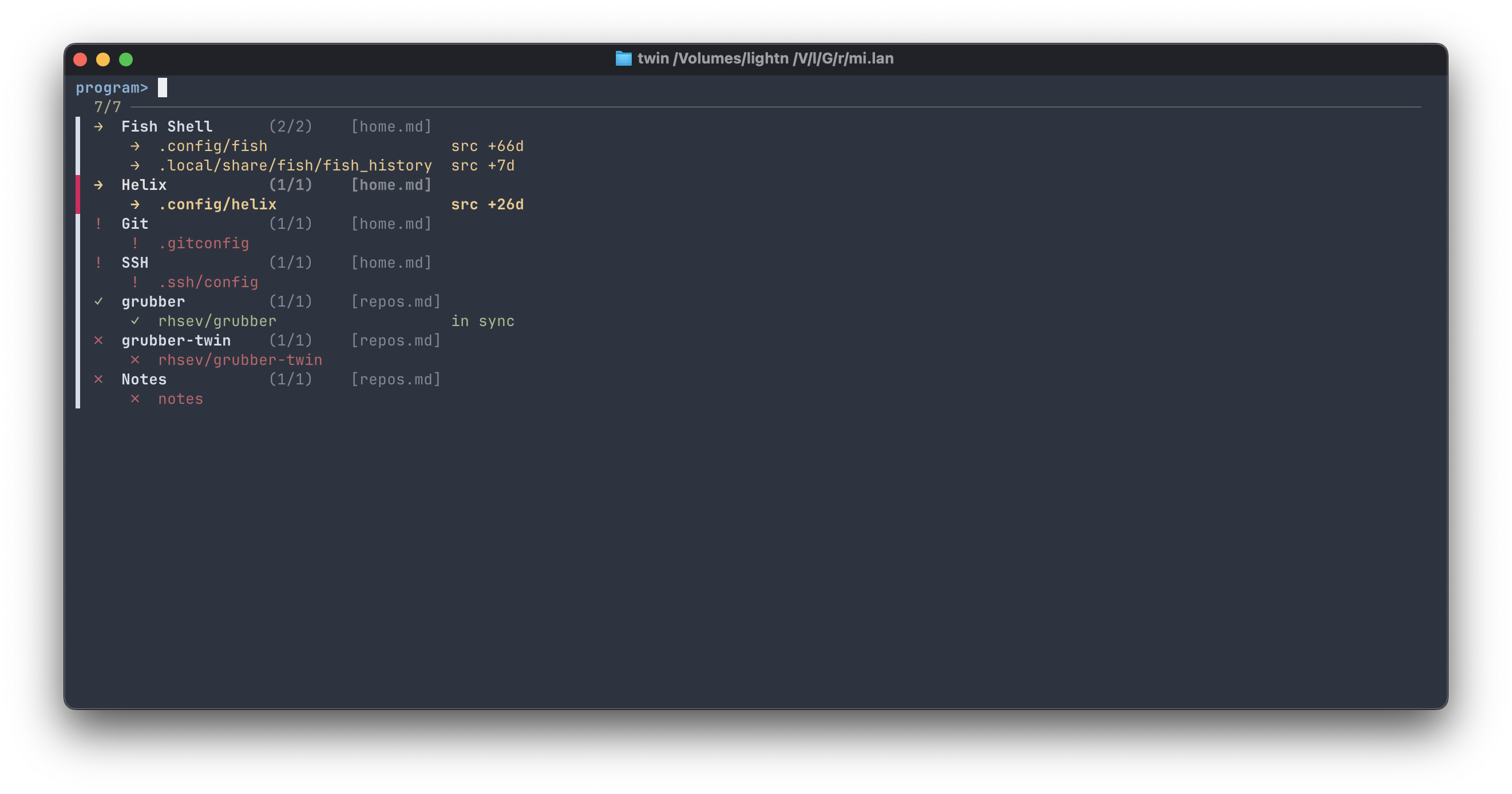
Stage 1 — program picker. One row per program, color-coded status, indented paths underneath:
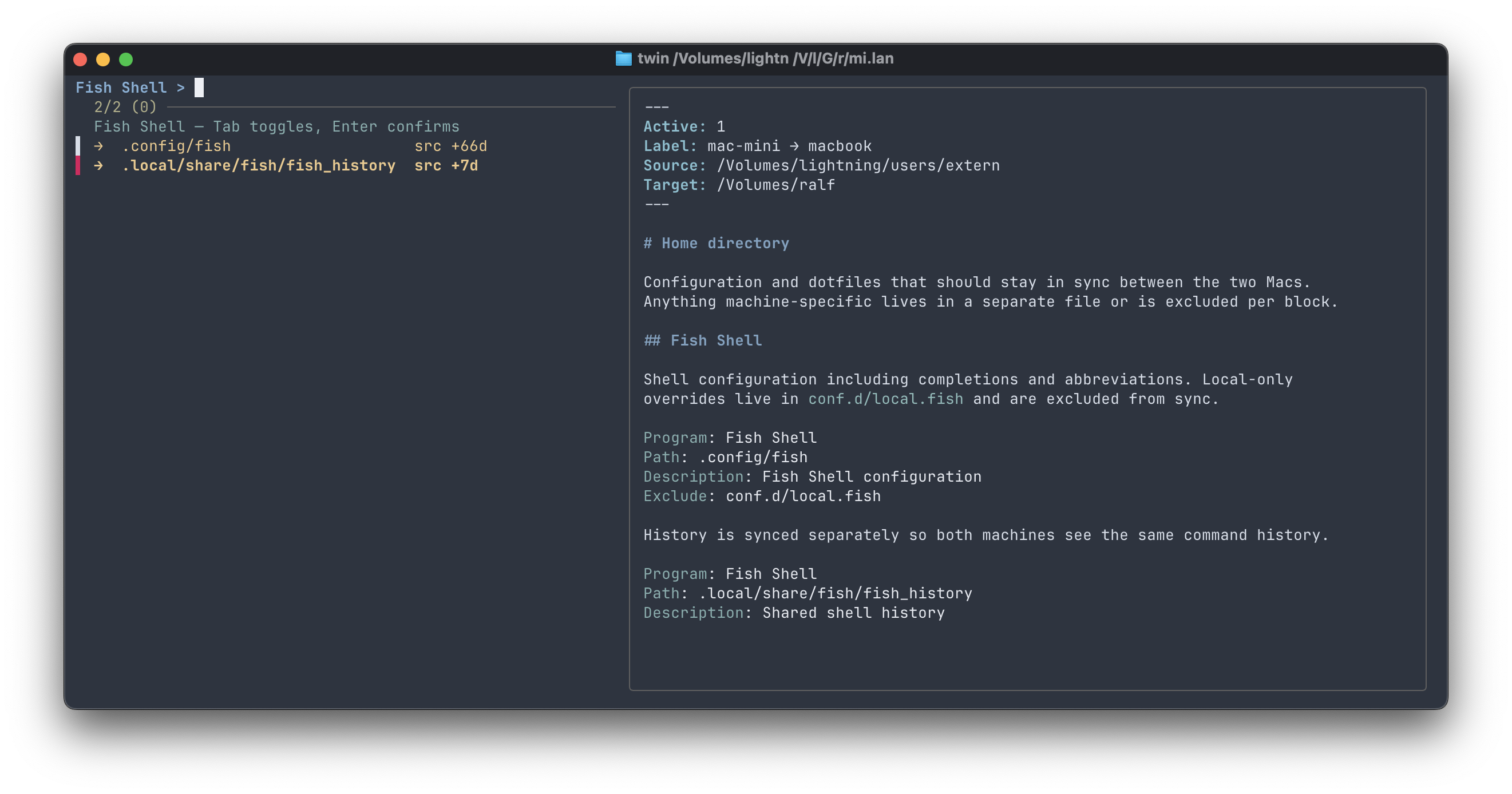
Stage 2 — multi-select over the paths of one program. The right pane shows a compact preview of the relevant sync-file section, rendered by apex:
Install
gem install mark-twin
brew install fzf
Plus grubber, a small Go binary —
download it and put it in your PATH. rsync ships with macOS.
Optional: one of apex, glow or bat for the preview pane (tried in that
order, cat if none are present). twin doctor reports what it found.
From source
git clone https://github.com/rhsev/mark-twin.git
cd mark-twin
gem build mark-twin.gemspec
gem install ./mark-twin-*.gem
Getting started
1. Decide where the other side lives. Target: takes either form, and
neither is the special case:
Target: admin@macbook:/Users/admin              # over ssh
Target: /Volumes/macbook/Users/admin            # a mounted volume (SMB, NFS, …)
Over ssh you need key-based login — twin runs ssh -o BatchMode=yes and never
prompts for a password, so set up ssh-copy-id macbook first. A mounted volume
needs no keys but has to be mounted; twin checks before every sync. The
comparison below covers the two differences that
actually matter.
2. Point twin at a folder for sync-files, in ~/.config/twin/config.yaml:
sync_dir: ~/Sync

global_excludes:
  - .DS_Store
  - .git/
3. Write a sync-file, or start from one of the examples:
mkdir -p ~/Sync
cp examples/home.md ~/Sync/
$EDITOR ~/Sync/home.md      # adjust Source: and Target:
twin add ~/.config/fish does the same interactively, if you prefer prompts to
an editor — it finds the matching sync-file, derives the relative path,
suggests excludes for what it sees in the directory, and appends a block with a
prose stub.
4. Look before you leap:
twin status              # what differs
twin sync --dry-run      # what a sync would do, without doing it
twin                     # interactive: pick a program, pick paths, Enter
That is the whole loop. Everything below is detail you can come back for.
Everyday commands
twin                         # picker — all programs across all sync-files
twin home.md                 # picker — one sync-file in sync_dir (by name)
twin ./some/dir/             # picker — all sync-files in a directory
twin list                    # plain listing
twin status                  # listing with source/target mtimes
twin sync -p grubber         # sync one program by name pattern
twin sync --file=repos       # sync all programs from a sync-file
twin sync --dry-run          # preview without writing
twin log                     # recent journal entries (-n N, --json)
twin doctor                  # check tools, renderers, and targets
twin --help                  # show usage
A file argument without / is matched by substring against sync-file names in
sync_dir; anything containing / is treated as a path, file or directory.
Every job is journaled to ~/.local/state/twin/log.jsonl — one JSON line with
timestamp, program, path and outcome. twin sync exits non-zero if any job
failed.
Sync-files
One Markdown file per relationship. Frontmatter sets it up, YAML blocks define
the individual paths. Frontmatter fields are merged into every block, so
Source:/Target: are usually written once at the top — but a block may
override them, which is how one file can serve several destinations.
Blocks sharing a Program are grouped: they are selected together, synced
together, and run in the order they appear in the file.
Field reference
Field names are capitalised English. An unknown key is ignored silently and a
missing Active counts as 0, so a typo shows up as an entry that never syncs
rather than as an error.
| Field | Where | Meaning |
|---|---|---|
Program |
block | Group name; blocks sharing it sync together |
Path |
block | Path relative to Source (file or directory) |
Source |
either | Absolute base path on this machine |
Target |
either | Absolute base path, or user@host:/path for ssh |
Target-Path |
block | Path under Target, when it differs from Path |
Active |
either | 1 syncs, 0 skips. Default 0 |
Description |
block | Shown in listings and the picker |
Label |
either | Free-text grouping, filterable via --label |
Exclude |
block | Comma-separated paths that are not part of the sync |
Own |
block | Comma-separated paths the target owns |
Delete |
block | true mirrors deletions, with backups |
Cmd |
block | Shell command, run only when bytes actually moved |
Render |
block | true substitutes {{tokens}} instead of copying |
Exclude or Own?
Both keep rsync away from a path and both take a comma-separated list
(Exclude: *.log, __pycache__/). What differs is the meaning, and twin status
reports them apart:
Exclude:— not part of this sync at all. Build artefacts, logs, caches,.git/, a test script with no business on the other machine.Own:— inside the sync scope, but the target owns it. Machine-specific configuration the source must never clobber:conf.d/local.fish,lazy-lock.json, a per-host credentials file.
The distinction is documentation, not mechanism. Six months on, Own: still
says "deliberate, the other machine maintains this", where the same entry sitting
in Exclude: between *.dwarf and .DS_Store reads like noise you once
filtered out.
Cmd: doing something after a sync
Cmd runs a shell command once rsync has actually transferred bytes — a no-op
sync runs nothing. Typically a curl to a local automation endpoint like
mi.lan, or an ssh host '…' for remote
targets (Cmd always runs locally).
It belongs to a block rather than to the program, which is what you want when
different paths need different follow-ups — reload nginx after its config,
re-link binaries after bin/. For a restart, put the command in the
last block: jobs run in file order, so a restart placed earlier brings the
service back before the remaining paths are written. The same command repeated
across blocks restarts repeatedly, for the same reason. One command, last block.
Delete: mirroring removals
Delete: true adds --delete, so files removed from the source disappear on
the target too. Deleted and overwritten files are moved to
<target>/.twin-backup/<timestamp>/ rather than destroyed — a safety net worth
pruning occasionally. It applies to Delete jobs only.
Mounted volume or ssh
Both are first-class. twin status, the picker, Exclude/Own, Delete and
Cmd behave identically; remote paths are stat'ed in a single ssh round-trip
per host, and an unreachable host shows as ? instead of failing the scan.
Two differences are real:
| mounted volume | ssh | |
|---|---|---|
| Setup | volume must be mounted | ssh key (ssh-copy-id) |
| Before syncing | mount check | reachability check |
Render: true |
supported | not supported |
Render needs to read and write file contents on the target, which twin only
does locally. Keep rendered files on mounted targets, or render locally and sync
the result.
Syncing is push-only in both cases: Source: is always this machine.
---
Active: 1
Label: mini → server
Source: /Volumes/lightning/Git/Website
Target: ralf@server:/srv/www
---
When the target has changed too
A sync has a direction: the source wins. But targets get edited — a quick fix made on the server at midnight, a config tweaked where it runs. Twin looks for that before it moves the first byte, and asks once for the whole program:
target has changed since the last sync — 1 file(s) differ:
  ! app/code.rb (target 2h newer)
syncing would replace them with the source version.

overwrite these on the target and sync? [y]es / [d]iff / [n]o (abort)
d prints a unified diff per file, then asks again. n aborts the entire
program — nothing is written, so you never end up with half a deploy applied.
Two properties make this bearable day to day:
- Content, not timestamps. A file that is merely newer on the target with identical bytes is not a conflict and does not ask. Sync a tree in both directions and you collect dozens of those; a prompt that fires on them gets answered without being read.
- Directory mtimes are ignored. Editing a file in place leaves its
directory's mtime untouched, and
rsync -aequalises those anyway. Twin asks rsync what it would actually transfer instead of guessing from a directory.
twin status is still mtime-based and cannot see an in-place edit. It is the
cheap overview; twin sync is what decides.
Automation
For a scheduled run (launchd, cron):
twin sync --quiet --skip-unavailable --skip-conflicts
--quiet— only conflicts, errors and jobs that changed something. A no-op run is silent.--skip-unavailable— a laptop that isn't docked is skipped, not an error.--skip-conflicts— leave target-side changes alone and sync the rest. Use--forceinstead to overwrite them.
Without a terminal and without one of those two flags, a real conflict aborts the run with exit code 1 rather than picking an answer for you. Output and a non-zero exit therefore mean something genuinely needs attention — which is what launchd's logging wants. The journal records every job regardless.
Templating
Skip this until you hit the problem it solves.
Some configs differ per machine — a LaunchAgent plist pointing at
/Volumes/lightning/… on one Mac and /Users/ralf/… on another. Those used to
fall out of twin and get hand-maintained.
Define a host table in ~/.config/twin/config.yaml:
host: mini          # which machine twin runs on
target: book        # the machine being synced to

hosts:
  mini: { home: /Volumes/lightning/users/extern, git: /Volumes/lightning/Git }
  book: { home: /Users/ralf, git: /Users/ralf/git, mount: /Volumes/ralf }
That exposes three sets of {{tokens}}, each with one fixed meaning:
| Token | Resolves to | Use in |
|---|---|---|
{{src.home}}, {{src.git}}, … |
the running host's own paths | Source: (read side) |
{{dst.mount}} |
where the target is mounted here (/Volumes/ralf) |
Target: (write side) |
{{dst.home}}, {{dst.git}}, … |
the target's native paths | rendered file content |
The distinction matters: a file written to the mount (/Volumes/ralf/…) but
read by the target machine must contain that machine's native paths
(/Users/ralf/…). {{dst.mount}} and {{dst.home}} keep the two apart.
Quote templated values.
{{` at the start of a YAML value collides with YAML flow-mapping syntax, so write `Source: "{{src.home}}", notSource: {{src.home}}— exactly as in Ansible.
Render: true turns a block from copy into render: twin reads the source as a
template, substitutes {{…}} in its content, and writes the result only if
it differs from the current target, so a Cmd hook fires only on a real change.
Target-Path: overrides the target-side relative path:
## LiveSync LaunchAgent

```yaml
Program: livesync-agent
Source: "{{src.home}}/Automation/launchd"
Path: com.ralf.livesync.plist
Target: "{{dst.mount}}"
Target-Path: Library/LaunchAgents/com.ralf.livesync.plist
Render: true
Cmd: curl -s http://mi.lan/livesync-reload
```
twin doctor checks that every {{token}} resolves, and twin status compares
rendered output by content rather than mtime. Without a hosts table,
templating is inert and literal-path sync-files behave exactly as before.
Configuration
~/.config/twin/config.yaml:
sync_dir: /path/to/sync-files

global_excludes:
  - .DS_Store
  - .git/

# Optional preview rendering (apex):
# apex_theme: default
# apex_width: 80
# apex_code_highlight: monokai
# apex_code_highlight_theme: dark
Environment overrides: TWIN_SYNC_DIR, TWIN_CONFIG, TWIN_HOST (which host
twin runs as — lets one config serve both machines).
Design
Sync instructions and their context in one place. No TUI framework: fzf does
the interactive part, apex the rendering, rsync the work.
See ARCHITECTURE.md for the data model and internals.
Tests
rake test
Part of a family of plain-text tools — the profile page has the map.