Class: Google::Apps::Chat::V1::ChatService::Rest::Client

Inherits:
Object
  • Object
show all
Includes:
Paths
Defined in:
lib/google/apps/chat/v1/chat_service/rest/client.rb

Overview

REST client for the ChatService service.

Enables developers to build Chat apps and integrations on Google Chat Platform.

Defined Under Namespace

Classes: Configuration

Class Method Summary collapse

Instance Method Summary collapse

Methods included from Paths

#attachment_path, #availability_path, #custom_emoji_path, #membership_path, #message_path, #quoted_message_metadata_path, #reaction_path, #section_item_path, #section_path, #space_event_path, #space_notification_setting_path, #space_path, #space_read_state_path, #thread_path, #thread_read_state_path, #user_path

Constructor Details

#initialize {|config| ... } ⇒ Client

Create a new ChatService REST client object.

Examples:


# Create a client using the default configuration
client = ::Google::Apps::Chat::V1::ChatService::Rest::Client.new

# Create a client using a custom configuration
client = ::Google::Apps::Chat::V1::ChatService::Rest::Client.new do |config|
  config.timeout = 10.0
end

Yields:

  • (config)

    Configure the ChatService client.

Yield Parameters:


367
368
369
370
371
372
373
374
375
376
377
378
379
380
381
382
383
384
385
386
387
388
389
390
391
392
393
394
395
396
397
398
399
400
401
402
403
404
405
406
407
# File 'lib/google/apps/chat/v1/chat_service/rest/client.rb', line 367

def initialize
  # Create the configuration object
  @config = Configuration.new Client.configure

  # Yield the configuration if needed
  yield @config if block_given?

  # Create credentials
  credentials = @config.credentials
  # Use self-signed JWT if the endpoint is unchanged from default,
  # but only if the default endpoint does not have a region prefix.
  enable_self_signed_jwt = @config.endpoint.nil? ||
                           (@config.endpoint == Configuration::DEFAULT_ENDPOINT &&
                           !@config.endpoint.split(".").first.include?("-"))
  credentials ||= Credentials.default scope: @config.scope,
                                      enable_self_signed_jwt: enable_self_signed_jwt
  if credentials.is_a?(::String) || credentials.is_a?(::Hash)
    credentials = Credentials.new credentials, scope: @config.scope
  end

  @quota_project_id = @config.quota_project
  @quota_project_id ||= credentials.quota_project_id if credentials.respond_to? :quota_project_id

  @chat_service_stub = ::Google::Apps::Chat::V1::ChatService::Rest::ServiceStub.new(
    endpoint: @config.endpoint,
    endpoint_template: DEFAULT_ENDPOINT_TEMPLATE,
    universe_domain: @config.universe_domain,
    credentials: credentials,
    logger: @config.logger
  )

  @chat_service_stub.logger(stub: true)&.info do |entry|
    entry.set_system_name
    entry.set_service
    entry.message = "Created client for #{entry.service}"
    entry.set_credentials_fields credentials
    entry.set "customEndpoint", @config.endpoint if @config.endpoint
    entry.set "defaultTimeout", @config.timeout if @config.timeout
    entry.set "quotaProject", @quota_project_id if @quota_project_id
  end
end

Class Method Details

.configure {|config| ... } ⇒ Client::Configuration

Configure the ChatService Client class.

See Configuration for a description of the configuration fields.

Examples:


# Modify the configuration for all ChatService clients
::Google::Apps::Chat::V1::ChatService::Rest::Client.configure do |config|
  config.timeout = 10.0
end

Yields:

  • (config)

    Configure the Client client.

Yield Parameters:

Returns:


65
66
67
68
69
70
71
72
73
74
75
76
77
78
79
80
81
82
83
84
85
86
87
88
89
90
91
92
93
94
95
96
97
98
99
100
101
102
103
104
105
106
107
108
109
110
111
112
113
114
115
116
117
118
119
120
121
122
123
124
125
126
127
128
129
130
131
132
133
134
135
136
137
138
139
140
141
142
143
144
145
146
147
148
149
150
151
152
153
154
155
156
157
158
159
160
161
162
163
164
165
166
167
168
169
170
171
172
173
174
175
176
177
178
179
180
181
182
183
184
185
186
187
188
189
190
191
192
193
194
195
196
197
198
199
200
201
202
203
204
205
206
207
208
209
210
211
212
213
214
215
216
217
218
219
220
221
222
223
224
225
226
227
228
229
230
231
232
233
234
235
236
237
238
239
240
241
242
243
244
245
246
247
248
249
250
251
252
253
254
255
256
257
258
259
260
261
262
263
264
265
266
267
268
269
270
271
272
273
274
275
276
277
278
279
280
281
282
283
284
285
286
287
288
289
290
291
292
293
294
295
296
297
298
299
300
301
302
303
304
305
306
307
308
309
310
311
312
313
314
315
316
317
318
319
320
# File 'lib/google/apps/chat/v1/chat_service/rest/client.rb', line 65

def self.configure
  @configure ||= begin
    namespace = ["Google", "Apps", "Chat", "V1"]
    parent_config = while namespace.any?
                      parent_name = namespace.join "::"
                      parent_const = const_get parent_name
                      break parent_const.configure if parent_const.respond_to? :configure
                      namespace.pop
                    end
    default_config = Client::Configuration.new parent_config

    default_config.rpcs.create_message.timeout = 30.0
    default_config.rpcs.create_message.retry_policy = {
      initial_delay: 1.0, max_delay: 10.0, multiplier: 1.3, retry_codes: [14]
    }

    default_config.rpcs.list_messages.timeout = 30.0
    default_config.rpcs.list_messages.retry_policy = {
      initial_delay: 1.0, max_delay: 10.0, multiplier: 1.3, retry_codes: [14]
    }

    default_config.rpcs.list_memberships.timeout = 30.0
    default_config.rpcs.list_memberships.retry_policy = {
      initial_delay: 1.0, max_delay: 10.0, multiplier: 1.3, retry_codes: [14]
    }

    default_config.rpcs.get_membership.timeout = 30.0
    default_config.rpcs.get_membership.retry_policy = {
      initial_delay: 1.0, max_delay: 10.0, multiplier: 1.3, retry_codes: [14]
    }

    default_config.rpcs.get_message.timeout = 30.0
    default_config.rpcs.get_message.retry_policy = {
      initial_delay: 1.0, max_delay: 10.0, multiplier: 1.3, retry_codes: [14]
    }

    default_config.rpcs.update_message.timeout = 30.0
    default_config.rpcs.update_message.retry_policy = {
      initial_delay: 1.0, max_delay: 10.0, multiplier: 1.3, retry_codes: [14]
    }

    default_config.rpcs.delete_message.timeout = 30.0
    default_config.rpcs.delete_message.retry_policy = {
      initial_delay: 1.0, max_delay: 10.0, multiplier: 1.3, retry_codes: [14]
    }

    default_config.rpcs.get_attachment.timeout = 30.0
    default_config.rpcs.get_attachment.retry_policy = {
      initial_delay: 1.0, max_delay: 10.0, multiplier: 1.3, retry_codes: [14]
    }

    default_config.rpcs.upload_attachment.timeout = 30.0
    default_config.rpcs.upload_attachment.retry_policy = {
      initial_delay: 1.0, max_delay: 10.0, multiplier: 1.3, retry_codes: [14]
    }

    default_config.rpcs.list_spaces.timeout = 30.0
    default_config.rpcs.list_spaces.retry_policy = {
      initial_delay: 1.0, max_delay: 10.0, multiplier: 1.3, retry_codes: [14]
    }

    default_config.rpcs.search_spaces.timeout = 30.0
    default_config.rpcs.search_spaces.retry_policy = {
      initial_delay: 1.0, max_delay: 10.0, multiplier: 1.3, retry_codes: [14]
    }

    default_config.rpcs.get_space.timeout = 30.0
    default_config.rpcs.get_space.retry_policy = {
      initial_delay: 1.0, max_delay: 10.0, multiplier: 1.3, retry_codes: [14]
    }

    default_config.rpcs.create_space.timeout = 30.0
    default_config.rpcs.create_space.retry_policy = {
      initial_delay: 1.0, max_delay: 10.0, multiplier: 1.3, retry_codes: [14]
    }

    default_config.rpcs.set_up_space.timeout = 30.0
    default_config.rpcs.set_up_space.retry_policy = {
      initial_delay: 1.0, max_delay: 10.0, multiplier: 1.3, retry_codes: [14]
    }

    default_config.rpcs.update_space.timeout = 30.0
    default_config.rpcs.update_space.retry_policy = {
      initial_delay: 1.0, max_delay: 10.0, multiplier: 1.3, retry_codes: [14]
    }

    default_config.rpcs.delete_space.timeout = 30.0
    default_config.rpcs.delete_space.retry_policy = {
      initial_delay: 1.0, max_delay: 10.0, multiplier: 1.3, retry_codes: [14]
    }

    default_config.rpcs.complete_import_space.timeout = 30.0
    default_config.rpcs.complete_import_space.retry_policy = {
      initial_delay: 1.0, max_delay: 10.0, multiplier: 1.3, retry_codes: [14]
    }

    default_config.rpcs.find_direct_message.timeout = 30.0
    default_config.rpcs.find_direct_message.retry_policy = {
      initial_delay: 1.0, max_delay: 10.0, multiplier: 1.3, retry_codes: [14]
    }

    default_config.rpcs.find_group_chats.timeout = 30.0
    default_config.rpcs.find_group_chats.retry_policy = {
      initial_delay: 1.0, max_delay: 10.0, multiplier: 1.3, retry_codes: [14]
    }

    default_config.rpcs.create_membership.timeout = 30.0
    default_config.rpcs.create_membership.retry_policy = {
      initial_delay: 1.0, max_delay: 10.0, multiplier: 1.3, retry_codes: [14]
    }

    default_config.rpcs.update_membership.timeout = 30.0
    default_config.rpcs.update_membership.retry_policy = {
      initial_delay: 1.0, max_delay: 10.0, multiplier: 1.3, retry_codes: [14]
    }

    default_config.rpcs.delete_membership.timeout = 30.0
    default_config.rpcs.delete_membership.retry_policy = {
      initial_delay: 1.0, max_delay: 10.0, multiplier: 1.3, retry_codes: [14]
    }

    default_config.rpcs.create_reaction.timeout = 30.0
    default_config.rpcs.create_reaction.retry_policy = {
      initial_delay: 1.0, max_delay: 10.0, multiplier: 1.3, retry_codes: [14]
    }

    default_config.rpcs.list_reactions.timeout = 30.0
    default_config.rpcs.list_reactions.retry_policy = {
      initial_delay: 1.0, max_delay: 10.0, multiplier: 1.3, retry_codes: [14]
    }

    default_config.rpcs.delete_reaction.timeout = 30.0
    default_config.rpcs.delete_reaction.retry_policy = {
      initial_delay: 1.0, max_delay: 10.0, multiplier: 1.3, retry_codes: [14]
    }

    default_config.rpcs.create_custom_emoji.timeout = 30.0
    default_config.rpcs.create_custom_emoji.retry_policy = {
      initial_delay: 1.0, max_delay: 10.0, multiplier: 1.3, retry_codes: [14]
    }

    default_config.rpcs.get_custom_emoji.timeout = 30.0
    default_config.rpcs.get_custom_emoji.retry_policy = {
      initial_delay: 1.0, max_delay: 10.0, multiplier: 1.3, retry_codes: [14]
    }

    default_config.rpcs.list_custom_emojis.timeout = 30.0
    default_config.rpcs.list_custom_emojis.retry_policy = {
      initial_delay: 1.0, max_delay: 10.0, multiplier: 1.3, retry_codes: [14]
    }

    default_config.rpcs.delete_custom_emoji.timeout = 30.0
    default_config.rpcs.delete_custom_emoji.retry_policy = {
      initial_delay: 1.0, max_delay: 10.0, multiplier: 1.3, retry_codes: [14]
    }

    default_config.rpcs.get_space_read_state.timeout = 30.0
    default_config.rpcs.get_space_read_state.retry_policy = {
      initial_delay: 1.0, max_delay: 10.0, multiplier: 1.3, retry_codes: [14]
    }

    default_config.rpcs.update_space_read_state.timeout = 30.0
    default_config.rpcs.update_space_read_state.retry_policy = {
      initial_delay: 1.0, max_delay: 10.0, multiplier: 1.3, retry_codes: [14]
    }

    default_config.rpcs.get_thread_read_state.timeout = 30.0
    default_config.rpcs.get_thread_read_state.retry_policy = {
      initial_delay: 1.0, max_delay: 10.0, multiplier: 1.3, retry_codes: [14]
    }

    default_config.rpcs.get_availability.timeout = 30.0
    default_config.rpcs.get_availability.retry_policy = {
      initial_delay: 1.0, max_delay: 10.0, multiplier: 1.3, retry_codes: [14]
    }

    default_config.rpcs.mark_as_active.timeout = 30.0
    default_config.rpcs.mark_as_active.retry_policy = {
      initial_delay: 1.0, max_delay: 10.0, multiplier: 1.3, retry_codes: [14]
    }

    default_config.rpcs.mark_as_away.timeout = 30.0
    default_config.rpcs.mark_as_away.retry_policy = {
      initial_delay: 1.0, max_delay: 10.0, multiplier: 1.3, retry_codes: [14]
    }

    default_config.rpcs.mark_as_do_not_disturb.timeout = 30.0
    default_config.rpcs.mark_as_do_not_disturb.retry_policy = {
      initial_delay: 1.0, max_delay: 10.0, multiplier: 1.3, retry_codes: [14]
    }

    default_config.rpcs.update_availability.timeout = 30.0
    default_config.rpcs.update_availability.retry_policy = {
      initial_delay: 1.0, max_delay: 10.0, multiplier: 1.3, retry_codes: [14]
    }

    default_config.rpcs.get_space_event.timeout = 30.0
    default_config.rpcs.get_space_event.retry_policy = {
      initial_delay: 1.0, max_delay: 10.0, multiplier: 1.3, retry_codes: [14]
    }

    default_config.rpcs.list_space_events.timeout = 30.0
    default_config.rpcs.list_space_events.retry_policy = {
      initial_delay: 1.0, max_delay: 10.0, multiplier: 1.3, retry_codes: [14]
    }

    default_config.rpcs.get_space_notification_setting.timeout = 30.0
    default_config.rpcs.get_space_notification_setting.retry_policy = {
      initial_delay: 1.0, max_delay: 10.0, multiplier: 1.3, retry_codes: [14]
    }

    default_config.rpcs.update_space_notification_setting.timeout = 30.0
    default_config.rpcs.update_space_notification_setting.retry_policy = {
      initial_delay: 1.0, max_delay: 10.0, multiplier: 1.3, retry_codes: [14]
    }

    default_config.rpcs.create_section.timeout = 30.0
    default_config.rpcs.create_section.retry_policy = {
      initial_delay: 1.0, max_delay: 10.0, multiplier: 1.3, retry_codes: [14]
    }

    default_config.rpcs.delete_section.timeout = 30.0
    default_config.rpcs.delete_section.retry_policy = {
      initial_delay: 1.0, max_delay: 10.0, multiplier: 1.3, retry_codes: [14]
    }

    default_config.rpcs.update_section.timeout = 30.0
    default_config.rpcs.update_section.retry_policy = {
      initial_delay: 1.0, max_delay: 10.0, multiplier: 1.3, retry_codes: [14]
    }

    default_config.rpcs.list_sections.timeout = 30.0
    default_config.rpcs.list_sections.retry_policy = {
      initial_delay: 1.0, max_delay: 10.0, multiplier: 1.3, retry_codes: [14]
    }

    default_config.rpcs.position_section.timeout = 30.0
    default_config.rpcs.position_section.retry_policy = {
      initial_delay: 1.0, max_delay: 10.0, multiplier: 1.3, retry_codes: [14]
    }

    default_config.rpcs.list_section_items.timeout = 30.0
    default_config.rpcs.list_section_items.retry_policy = {
      initial_delay: 1.0, max_delay: 10.0, multiplier: 1.3, retry_codes: [14]
    }

    default_config.rpcs.move_section_item.timeout = 30.0
    default_config.rpcs.move_section_item.retry_policy = {
      initial_delay: 1.0, max_delay: 10.0, multiplier: 1.3, retry_codes: [14]
    }

    default_config
  end
  yield @configure if block_given?
  @configure
end

Instance Method Details

#complete_import_space(request, options = nil) ⇒ ::Google::Apps::Chat::V1::CompleteImportSpaceResponse #complete_import_space(name: nil) ⇒ ::Google::Apps::Chat::V1::CompleteImportSpaceResponse

Completes the import process for the specified space and makes it visible to users.

Requires user authentication and domain-wide delegation with the authorization scope:

  • https://www.googleapis.com/auth/chat.import

For more information, see Authorize Google Chat apps to import data.

Examples:

Basic example

require "google/apps/chat/v1"

# Create a client object. The client can be reused for multiple calls.
client = Google::Apps::Chat::V1::ChatService::Rest::Client.new

# Create a request. To set request fields, pass in keyword arguments.
request = Google::Apps::Chat::V1::CompleteImportSpaceRequest.new

# Call the complete_import_space method.
result = client.complete_import_space request

# The returned object is of type Google::Apps::Chat::V1::CompleteImportSpaceResponse.
p result

Overloads:

  • #complete_import_space(request, options = nil) ⇒ ::Google::Apps::Chat::V1::CompleteImportSpaceResponse

    Pass arguments to complete_import_space via a request object, either of type Google::Apps::Chat::V1::CompleteImportSpaceRequest or an equivalent Hash.

    Parameters:

    • request (::Google::Apps::Chat::V1::CompleteImportSpaceRequest, ::Hash)

      A request object representing the call parameters. Required. To specify no parameters, or to keep all the default parameter values, pass an empty Hash.

    • options (::Gapic::CallOptions, ::Hash) (defaults to: nil)

      Overrides the default settings for this call, e.g, timeout, retries etc. Optional.

  • #complete_import_space(name: nil) ⇒ ::Google::Apps::Chat::V1::CompleteImportSpaceResponse

    Pass arguments to complete_import_space via keyword arguments. Note that at least one keyword argument is required. To specify no parameters, or to keep all the default parameter values, pass an empty Hash as a request object (see above).

    Parameters:

    • name (::String) (defaults to: nil)

      Required. Resource name of the import mode space.

      Format: spaces/{space}

Yields:

  • (result, operation)

    Access the result along with the TransportOperation object

Yield Parameters:

Returns:

Raises:

  • (::Google::Cloud::Error)

    if the REST call is aborted.


2821
2822
2823
2824
2825
2826
2827
2828
2829
2830
2831
2832
2833
2834
2835
2836
2837
2838
2839
2840
2841
2842
2843
2844
2845
2846
2847
2848
2849
2850
2851
2852
2853
2854
# File 'lib/google/apps/chat/v1/chat_service/rest/client.rb', line 2821

def complete_import_space request, options = nil
  raise ::ArgumentError, "request must be provided" if request.nil?

  request = ::Gapic::Protobuf.coerce request, to: ::Google::Apps::Chat::V1::CompleteImportSpaceRequest

  # Converts hash and nil to an options object
  options = ::Gapic::CallOptions.new(**options.to_h) if options.respond_to? :to_h

  # Customize the options with defaults
   = @config.rpcs.complete_import_space..to_h

  # Set x-goog-api-client, x-goog-user-project and x-goog-api-version headers
  [:"x-goog-api-client"] ||= ::Gapic::Headers.x_goog_api_client \
    lib_name: @config.lib_name, lib_version: @config.lib_version,
    gapic_version: ::Google::Apps::Chat::V1::VERSION,
    transports_version_send: [:rest]

  [:"x-goog-api-version"] = API_VERSION unless API_VERSION.empty?
  [:"x-goog-user-project"] = @quota_project_id if @quota_project_id

  options.apply_defaults timeout:      @config.rpcs.complete_import_space.timeout,
                         metadata:     ,
                         retry_policy: @config.rpcs.complete_import_space.retry_policy

  options.apply_defaults timeout:      @config.timeout,
                         metadata:     @config.,
                         retry_policy: @config.retry_policy

  @chat_service_stub.complete_import_space request, options do |result, operation|
    yield result, operation if block_given?
  end
rescue ::Gapic::Rest::Error => e
  raise ::Google::Cloud::Error.from_error(e)
end

#configure {|config| ... } ⇒ Client::Configuration

Configure the ChatService Client instance.

The configuration is set to the derived mode, meaning that values can be changed, but structural changes (adding new fields, etc.) are not allowed. Structural changes should be made on configure.

See Configuration for a description of the configuration fields.

Yields:

  • (config)

    Configure the Client client.

Yield Parameters:

Returns:


337
338
339
340
# File 'lib/google/apps/chat/v1/chat_service/rest/client.rb', line 337

def configure
  yield @config if block_given?
  @config
end

#create_custom_emoji(request, options = nil) ⇒ ::Google::Apps::Chat::V1::CustomEmoji #create_custom_emoji(custom_emoji: nil) ⇒ ::Google::Apps::Chat::V1::CustomEmoji

Creates a custom emoji.

Custom emojis are only available for Google Workspace accounts, and the administrator must turn custom emojis on for the organization. For more information, see Learn about custom emojis in Google Chat and Manage custom emoji permissions.

Requires user authentication with the authorization scope:

  • https://www.googleapis.com/auth/chat.customemojis

Examples:

Basic example

require "google/apps/chat/v1"

# Create a client object. The client can be reused for multiple calls.
client = Google::Apps::Chat::V1::ChatService::Rest::Client.new

# Create a request. To set request fields, pass in keyword arguments.
request = Google::Apps::Chat::V1::CreateCustomEmojiRequest.new

# Call the create_custom_emoji method.
result = client.create_custom_emoji request

# The returned object is of type Google::Apps::Chat::V1::CustomEmoji.
p result

Overloads:

  • #create_custom_emoji(request, options = nil) ⇒ ::Google::Apps::Chat::V1::CustomEmoji

    Pass arguments to create_custom_emoji via a request object, either of type Google::Apps::Chat::V1::CreateCustomEmojiRequest or an equivalent Hash.

    Parameters:

    • request (::Google::Apps::Chat::V1::CreateCustomEmojiRequest, ::Hash)

      A request object representing the call parameters. Required. To specify no parameters, or to keep all the default parameter values, pass an empty Hash.

    • options (::Gapic::CallOptions, ::Hash) (defaults to: nil)

      Overrides the default settings for this call, e.g, timeout, retries etc. Optional.

  • #create_custom_emoji(custom_emoji: nil) ⇒ ::Google::Apps::Chat::V1::CustomEmoji

    Pass arguments to create_custom_emoji via keyword arguments. Note that at least one keyword argument is required. To specify no parameters, or to keep all the default parameter values, pass an empty Hash as a request object (see above).

    Parameters:

Yields:

  • (result, operation)

    Access the result along with the TransportOperation object

Yield Parameters:

Returns:

Raises:

  • (::Google::Cloud::Error)

    if the REST call is aborted.


3945
3946
3947
3948
3949
3950
3951
3952
3953
3954
3955
3956
3957
3958
3959
3960
3961
3962
3963
3964
3965
3966
3967
3968
3969
3970
3971
3972
3973
3974
3975
3976
3977
3978
# File 'lib/google/apps/chat/v1/chat_service/rest/client.rb', line 3945

def create_custom_emoji request, options = nil
  raise ::ArgumentError, "request must be provided" if request.nil?

  request = ::Gapic::Protobuf.coerce request, to: ::Google::Apps::Chat::V1::CreateCustomEmojiRequest

  # Converts hash and nil to an options object
  options = ::Gapic::CallOptions.new(**options.to_h) if options.respond_to? :to_h

  # Customize the options with defaults
   = @config.rpcs.create_custom_emoji..to_h

  # Set x-goog-api-client, x-goog-user-project and x-goog-api-version headers
  [:"x-goog-api-client"] ||= ::Gapic::Headers.x_goog_api_client \
    lib_name: @config.lib_name, lib_version: @config.lib_version,
    gapic_version: ::Google::Apps::Chat::V1::VERSION,
    transports_version_send: [:rest]

  [:"x-goog-api-version"] = API_VERSION unless API_VERSION.empty?
  [:"x-goog-user-project"] = @quota_project_id if @quota_project_id

  options.apply_defaults timeout:      @config.rpcs.create_custom_emoji.timeout,
                         metadata:     ,
                         retry_policy: @config.rpcs.create_custom_emoji.retry_policy

  options.apply_defaults timeout:      @config.timeout,
                         metadata:     @config.,
                         retry_policy: @config.retry_policy

  @chat_service_stub.create_custom_emoji request, options do |result, operation|
    yield result, operation if block_given?
  end
rescue ::Gapic::Rest::Error => e
  raise ::Google::Cloud::Error.from_error(e)
end

#create_membership(request, options = nil) ⇒ ::Google::Apps::Chat::V1::Membership #create_membership(parent: nil, membership: nil, use_admin_access: nil) ⇒ ::Google::Apps::Chat::V1::Membership

Creates a membership for the calling Chat app, a user, or a Google Group. Creating memberships for other Chat apps isn't supported. When creating a membership, if the specified member has their auto-accept policy turned off, then they're invited, and must accept the space invitation before joining. Otherwise, creating a membership adds the member directly to the specified space.

Supports the following types of authentication:

  • App authentication with administrator approval and the authorization scope:

    • https://www.googleapis.com/auth/chat.app.memberships
  • User authentication with one of the following authorization scopes:

    • https://www.googleapis.com/auth/chat.memberships
    • https://www.googleapis.com/auth/chat.memberships.app (to add the calling app to the space)
    • https://www.googleapis.com/auth/chat.import (import mode spaces only)
    • User authentication grants administrator privileges when an administrator account authenticates, use_admin_access is true, and the following authorization scope is used:
      • https://www.googleapis.com/auth/chat.admin.memberships

App authentication is not supported for the following use cases:

  • Inviting users external to the Workspace organization that owns the space.
  • Adding a Google Group to a space.
  • Adding a Chat app to a space.

For example usage, see:

Examples:

Basic example

require "google/apps/chat/v1"

# Create a client object. The client can be reused for multiple calls.
client = Google::Apps::Chat::V1::ChatService::Rest::Client.new

# Create a request. To set request fields, pass in keyword arguments.
request = Google::Apps::Chat::V1::CreateMembershipRequest.new

# Call the create_membership method.
result = client.create_membership request

# The returned object is of type Google::Apps::Chat::V1::Membership.
p result

Overloads:

  • #create_membership(request, options = nil) ⇒ ::Google::Apps::Chat::V1::Membership

    Pass arguments to create_membership via a request object, either of type Google::Apps::Chat::V1::CreateMembershipRequest or an equivalent Hash.

    Parameters:

    • request (::Google::Apps::Chat::V1::CreateMembershipRequest, ::Hash)

      A request object representing the call parameters. Required. To specify no parameters, or to keep all the default parameter values, pass an empty Hash.

    • options (::Gapic::CallOptions, ::Hash) (defaults to: nil)

      Overrides the default settings for this call, e.g, timeout, retries etc. Optional.

  • #create_membership(parent: nil, membership: nil, use_admin_access: nil) ⇒ ::Google::Apps::Chat::V1::Membership

    Pass arguments to create_membership via keyword arguments. Note that at least one keyword argument is required. To specify no parameters, or to keep all the default parameter values, pass an empty Hash as a request object (see above).

    Parameters:

    • parent (::String) (defaults to: nil)

      Required. The resource name of the space for which to create the membership.

      Format: spaces/{space}

    • membership (::Google::Apps::Chat::V1::Membership, ::Hash) (defaults to: nil)

      Required. The membership relation to create.

      The memberType field must contain a user with the user.name and user.type fields populated. The server will assign a resource name and overwrite anything specified.

      When a Chat app creates a membership relation for a human user, it must use certain authorization scopes and set specific values for certain fields:

      • When authenticating as a user, the chat.memberships authorization scope is required.

      • When authenticating as an app, the chat.app.memberships authorization scope is required.

      • Set user.type to HUMAN, and set user.name with format users/{user}, where {user} can be the email address for the user. For users in the same Workspace organization {user} can also be the id of the person from the People API, or the id for the user in the Directory API. For example, if the People API Person profile ID for user@example.com is 123456789, you can add the user to the space by setting the membership.member.name to users/user@example.com or users/123456789.

      Inviting users external to the Workspace organization that owns the space requires user authentication.

      When a Chat app creates a membership relation for itself, it must authenticate as a user and use the chat.memberships.app scope, set user.type to BOT, and set user.name to users/app.

    • use_admin_access (::Boolean) (defaults to: nil)

      Optional. When true, the method runs using the user's Google Workspace administrator privileges.

      The calling user must be a Google Workspace administrator with the manage chat and spaces conversations privilege.

      Requires the chat.admin.memberships OAuth 2.0 scope.

      Creating app memberships or creating memberships for users outside the administrator's Google Workspace organization isn't supported using admin access.

Yields:

  • (result, operation)

    Access the result along with the TransportOperation object

Yield Parameters:

Returns:

Raises:

  • (::Google::Cloud::Error)

    if the REST call is aborted.


3254
3255
3256
3257
3258
3259
3260
3261
3262
3263
3264
3265
3266
3267
3268
3269
3270
3271
3272
3273
3274
3275
3276
3277
3278
3279
3280
3281
3282
3283
3284
3285
3286
3287
# File 'lib/google/apps/chat/v1/chat_service/rest/client.rb', line 3254

def create_membership request, options = nil
  raise ::ArgumentError, "request must be provided" if request.nil?

  request = ::Gapic::Protobuf.coerce request, to: ::Google::Apps::Chat::V1::CreateMembershipRequest

  # Converts hash and nil to an options object
  options = ::Gapic::CallOptions.new(**options.to_h) if options.respond_to? :to_h

  # Customize the options with defaults
   = @config.rpcs.create_membership..to_h

  # Set x-goog-api-client, x-goog-user-project and x-goog-api-version headers
  [:"x-goog-api-client"] ||= ::Gapic::Headers.x_goog_api_client \
    lib_name: @config.lib_name, lib_version: @config.lib_version,
    gapic_version: ::Google::Apps::Chat::V1::VERSION,
    transports_version_send: [:rest]

  [:"x-goog-api-version"] = API_VERSION unless API_VERSION.empty?
  [:"x-goog-user-project"] = @quota_project_id if @quota_project_id

  options.apply_defaults timeout:      @config.rpcs.create_membership.timeout,
                         metadata:     ,
                         retry_policy: @config.rpcs.create_membership.retry_policy

  options.apply_defaults timeout:      @config.timeout,
                         metadata:     @config.,
                         retry_policy: @config.retry_policy

  @chat_service_stub.create_membership request, options do |result, operation|
    yield result, operation if block_given?
  end
rescue ::Gapic::Rest::Error => e
  raise ::Google::Cloud::Error.from_error(e)
end

#create_message(request, options = nil) ⇒ ::Google::Apps::Chat::V1::Message #create_message(parent: nil, message: nil, thread_key: nil, request_id: nil, message_reply_option: nil, message_id: nil, create_message_notification_options: nil) ⇒ ::Google::Apps::Chat::V1::Message

Creates a message in a Google Chat space. For an example, see Send a message.

Supports the following types of authentication:

  • App authentication with the authorization scope:
    • https://www.googleapis.com/auth/chat.bot
  • User authentication with one of the following authorization scopes:
    • https://www.googleapis.com/auth/chat.messages.create
    • https://www.googleapis.com/auth/chat.messages
    • https://www.googleapis.com/auth/chat.import (import mode spaces only)

Chat attributes the message sender differently depending on the type of authentication that you use in your request.

The following image shows how Chat attributes a message when you use app authentication. Chat displays the Chat app as the message sender. The content of the message can contain text (text), cards (cardsV2), and accessory widgets (accessoryWidgets).
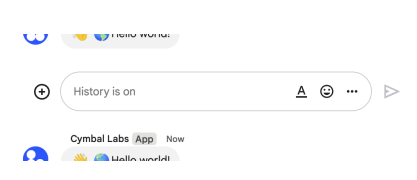
Message sent with app
authentication

The following image shows how Chat attributes a message when you use user authentication. Chat displays the user as the message sender and attributes the Chat app to the message by displaying its name. The content of message can only contain text (text).
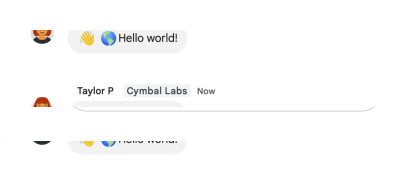
Message sent with user
authentication

The maximum message size, including the message contents, is 32,000 bytes.

For webhook requests, the response doesn't contain the full message. The response only populates the name and thread.name fields in addition to the information that was in the request.

Examples:

Basic example

require "google/apps/chat/v1"

# Create a client object. The client can be reused for multiple calls.
client = Google::Apps::Chat::V1::ChatService::Rest::Client.new

# Create a request. To set request fields, pass in keyword arguments.
request = Google::Apps::Chat::V1::CreateMessageRequest.new

# Call the create_message method.
result = client.create_message request

# The returned object is of type Google::Apps::Chat::V1::Message.
p result

Overloads:

  • #create_message(request, options = nil) ⇒ ::Google::Apps::Chat::V1::Message

    Pass arguments to create_message via a request object, either of type Google::Apps::Chat::V1::CreateMessageRequest or an equivalent Hash.

    Parameters:

    • request (::Google::Apps::Chat::V1::CreateMessageRequest, ::Hash)

      A request object representing the call parameters. Required. To specify no parameters, or to keep all the default parameter values, pass an empty Hash.

    • options (::Gapic::CallOptions, ::Hash) (defaults to: nil)

      Overrides the default settings for this call, e.g, timeout, retries etc. Optional.

  • #create_message(parent: nil, message: nil, thread_key: nil, request_id: nil, message_reply_option: nil, message_id: nil, create_message_notification_options: nil) ⇒ ::Google::Apps::Chat::V1::Message

    Pass arguments to create_message via keyword arguments. Note that at least one keyword argument is required. To specify no parameters, or to keep all the default parameter values, pass an empty Hash as a request object (see above).

    Parameters:

    • parent (::String) (defaults to: nil)

      Required. The resource name of the space in which to create a message.

      Format: spaces/{space}

    • message (::Google::Apps::Chat::V1::Message, ::Hash) (defaults to: nil)

      Required. Message body.

    • thread_key (::String) (defaults to: nil)

      Optional. Deprecated: Use thread.thread_key instead. ID for the thread. Supports up to 4000 characters. To start or add to a thread, create a message and specify a threadKey or the thread.name. For example usage, see Start or reply to a message thread.

    • request_id (::String) (defaults to: nil)

      Optional. A unique request ID for this message. Specifying an existing request ID returns the message created with that ID instead of creating a new message.

    • message_reply_option (::Google::Apps::Chat::V1::CreateMessageRequest::MessageReplyOption) (defaults to: nil)

      Optional. Specifies whether a message starts a thread or replies to one. Only supported in named spaces.

      When responding to user interactions, this field is ignored. For interactions within a thread, the reply is created in the same thread. Otherwise, the reply is created as a new thread.

    • message_id (::String) (defaults to: nil)

      Optional. A custom ID for a message. Lets Chat apps get, update, or delete a message without needing to store the system-assigned ID in the message's resource name (represented in the message name field).

      The value for this field must meet the following requirements:

      • Begins with client-. For example, client-custom-name is a valid custom ID, but custom-name is not.
      • Contains up to 63 characters and only lowercase letters, numbers, and hyphens.
      • Is unique within a space. A Chat app can't use the same custom ID for different messages.

      For details, see Name a message.

    • create_message_notification_options (::Google::Apps::Chat::V1::CreateMessageNotificationOptions, ::Hash) (defaults to: nil)

      Optional. Controls the notification behavior when the message is posted. To learn more, see Force notifications or send silent messages.

Yields:

  • (result, operation)

    Access the result along with the TransportOperation object

Yield Parameters:

Returns:

Raises:

  • (::Google::Cloud::Error)

    if the REST call is aborted.


551
552
553
554
555
556
557
558
559
560
561
562
563
564
565
566
567
568
569
570
571
572
573
574
575
576
577
578
579
580
581
582
583
584
# File 'lib/google/apps/chat/v1/chat_service/rest/client.rb', line 551

def create_message request, options = nil
  raise ::ArgumentError, "request must be provided" if request.nil?

  request = ::Gapic::Protobuf.coerce request, to: ::Google::Apps::Chat::V1::CreateMessageRequest

  # Converts hash and nil to an options object
  options = ::Gapic::CallOptions.new(**options.to_h) if options.respond_to? :to_h

  # Customize the options with defaults
   = @config.rpcs.create_message..to_h

  # Set x-goog-api-client, x-goog-user-project and x-goog-api-version headers
  [:"x-goog-api-client"] ||= ::Gapic::Headers.x_goog_api_client \
    lib_name: @config.lib_name, lib_version: @config.lib_version,
    gapic_version: ::Google::Apps::Chat::V1::VERSION,
    transports_version_send: [:rest]

  [:"x-goog-api-version"] = API_VERSION unless API_VERSION.empty?
  [:"x-goog-user-project"] = @quota_project_id if @quota_project_id

  options.apply_defaults timeout:      @config.rpcs.create_message.timeout,
                         metadata:     ,
                         retry_policy: @config.rpcs.create_message.retry_policy

  options.apply_defaults timeout:      @config.timeout,
                         metadata:     @config.,
                         retry_policy: @config.retry_policy

  @chat_service_stub.create_message request, options do |result, operation|
    yield result, operation if block_given?
  end
rescue ::Gapic::Rest::Error => e
  raise ::Google::Cloud::Error.from_error(e)
end

#create_reaction(request, options = nil) ⇒ ::Google::Apps::Chat::V1::Reaction #create_reaction(parent: nil, reaction: nil) ⇒ ::Google::Apps::Chat::V1::Reaction

Creates a reaction and adds it to a message. For an example, see Add a reaction to a message.

Requires user authentication with one of the following authorization scopes:

  • https://www.googleapis.com/auth/chat.messages.reactions.create
  • https://www.googleapis.com/auth/chat.messages.reactions
  • https://www.googleapis.com/auth/chat.messages
  • https://www.googleapis.com/auth/chat.import (import mode spaces only)

Examples:

Basic example

require "google/apps/chat/v1"

# Create a client object. The client can be reused for multiple calls.
client = Google::Apps::Chat::V1::ChatService::Rest::Client.new

# Create a request. To set request fields, pass in keyword arguments.
request = Google::Apps::Chat::V1::CreateReactionRequest.new

# Call the create_reaction method.
result = client.create_reaction request

# The returned object is of type Google::Apps::Chat::V1::Reaction.
p result

Overloads:

  • #create_reaction(request, options = nil) ⇒ ::Google::Apps::Chat::V1::Reaction

    Pass arguments to create_reaction via a request object, either of type Google::Apps::Chat::V1::CreateReactionRequest or an equivalent Hash.

    Parameters:

    • request (::Google::Apps::Chat::V1::CreateReactionRequest, ::Hash)

      A request object representing the call parameters. Required. To specify no parameters, or to keep all the default parameter values, pass an empty Hash.

    • options (::Gapic::CallOptions, ::Hash) (defaults to: nil)

      Overrides the default settings for this call, e.g, timeout, retries etc. Optional.

  • #create_reaction(parent: nil, reaction: nil) ⇒ ::Google::Apps::Chat::V1::Reaction

    Pass arguments to create_reaction via keyword arguments. Note that at least one keyword argument is required. To specify no parameters, or to keep all the default parameter values, pass an empty Hash as a request object (see above).

    Parameters:

    • parent (::String) (defaults to: nil)

      Required. The message where the reaction is created.

      Format: spaces/{space}/messages/{message}

    • reaction (::Google::Apps::Chat::V1::Reaction, ::Hash) (defaults to: nil)

      Required. The reaction to create.

Yields:

  • (result, operation)

    Access the result along with the TransportOperation object

Yield Parameters:

Returns:

Raises:

  • (::Google::Cloud::Error)

    if the REST call is aborted.


3608
3609
3610
3611
3612
3613
3614
3615
3616
3617
3618
3619
3620
3621
3622
3623
3624
3625
3626
3627
3628
3629
3630
3631
3632
3633
3634
3635
3636
3637
3638
3639
3640
3641
# File 'lib/google/apps/chat/v1/chat_service/rest/client.rb', line 3608

def create_reaction request, options = nil
  raise ::ArgumentError, "request must be provided" if request.nil?

  request = ::Gapic::Protobuf.coerce request, to: ::Google::Apps::Chat::V1::CreateReactionRequest

  # Converts hash and nil to an options object
  options = ::Gapic::CallOptions.new(**options.to_h) if options.respond_to? :to_h

  # Customize the options with defaults
   = @config.rpcs.create_reaction..to_h

  # Set x-goog-api-client, x-goog-user-project and x-goog-api-version headers
  [:"x-goog-api-client"] ||= ::Gapic::Headers.x_goog_api_client \
    lib_name: @config.lib_name, lib_version: @config.lib_version,
    gapic_version: ::Google::Apps::Chat::V1::VERSION,
    transports_version_send: [:rest]

  [:"x-goog-api-version"] = API_VERSION unless API_VERSION.empty?
  [:"x-goog-user-project"] = @quota_project_id if @quota_project_id

  options.apply_defaults timeout:      @config.rpcs.create_reaction.timeout,
                         metadata:     ,
                         retry_policy: @config.rpcs.create_reaction.retry_policy

  options.apply_defaults timeout:      @config.timeout,
                         metadata:     @config.,
                         retry_policy: @config.retry_policy

  @chat_service_stub.create_reaction request, options do |result, operation|
    yield result, operation if block_given?
  end
rescue ::Gapic::Rest::Error => e
  raise ::Google::Cloud::Error.from_error(e)
end

#create_section(request, options = nil) ⇒ ::Google::Apps::Chat::V1::Section #create_section(parent: nil, section: nil) ⇒ ::Google::Apps::Chat::V1::Section

Creates a section in Google Chat. Sections help users group conversations and customize the list of spaces displayed in Chat navigation panel. Only sections of type CUSTOM_SECTION can be created. For details, see Create and organize sections in Google Chat.

Requires user authentication with the authorization scope:

  • https://www.googleapis.com/auth/chat.users.sections

Examples:

Basic example

require "google/apps/chat/v1"

# Create a client object. The client can be reused for multiple calls.
client = Google::Apps::Chat::V1::ChatService::Rest::Client.new

# Create a request. To set request fields, pass in keyword arguments.
request = Google::Apps::Chat::V1::CreateSectionRequest.new

# Call the create_section method.
result = client.create_section request

# The returned object is of type Google::Apps::Chat::V1::Section.
p result

Overloads:

  • #create_section(request, options = nil) ⇒ ::Google::Apps::Chat::V1::Section

    Pass arguments to create_section via a request object, either of type Google::Apps::Chat::V1::CreateSectionRequest or an equivalent Hash.

    Parameters:

    • request (::Google::Apps::Chat::V1::CreateSectionRequest, ::Hash)

      A request object representing the call parameters. Required. To specify no parameters, or to keep all the default parameter values, pass an empty Hash.

    • options (::Gapic::CallOptions, ::Hash) (defaults to: nil)

      Overrides the default settings for this call, e.g, timeout, retries etc. Optional.

  • #create_section(parent: nil, section: nil) ⇒ ::Google::Apps::Chat::V1::Section

    Pass arguments to create_section via keyword arguments. Note that at least one keyword argument is required. To specify no parameters, or to keep all the default parameter values, pass an empty Hash as a request object (see above).

    Parameters:

    • parent (::String) (defaults to: nil)

      Required. The parent resource name where the section is created.

      Format: users/{user}

    • section (::Google::Apps::Chat::V1::Section, ::Hash) (defaults to: nil)

      Required. The section to create.

Yields:

  • (result, operation)

    Access the result along with the TransportOperation object

Yield Parameters:

Returns:

Raises:

  • (::Google::Cloud::Error)

    if the REST call is aborted.


5693
5694
5695
5696
5697
5698
5699
5700
5701
5702
5703
5704
5705
5706
5707
5708
5709
5710
5711
5712
5713
5714
5715
5716
5717
5718
5719
5720
5721
5722
5723
5724
5725
5726
# File 'lib/google/apps/chat/v1/chat_service/rest/client.rb', line 5693

def create_section request, options = nil
  raise ::ArgumentError, "request must be provided" if request.nil?

  request = ::Gapic::Protobuf.coerce request, to: ::Google::Apps::Chat::V1::CreateSectionRequest

  # Converts hash and nil to an options object
  options = ::Gapic::CallOptions.new(**options.to_h) if options.respond_to? :to_h

  # Customize the options with defaults
   = @config.rpcs.create_section..to_h

  # Set x-goog-api-client, x-goog-user-project and x-goog-api-version headers
  [:"x-goog-api-client"] ||= ::Gapic::Headers.x_goog_api_client \
    lib_name: @config.lib_name, lib_version: @config.lib_version,
    gapic_version: ::Google::Apps::Chat::V1::VERSION,
    transports_version_send: [:rest]

  [:"x-goog-api-version"] = API_VERSION unless API_VERSION.empty?
  [:"x-goog-user-project"] = @quota_project_id if @quota_project_id

  options.apply_defaults timeout:      @config.rpcs.create_section.timeout,
                         metadata:     ,
                         retry_policy: @config.rpcs.create_section.retry_policy

  options.apply_defaults timeout:      @config.timeout,
                         metadata:     @config.,
                         retry_policy: @config.retry_policy

  @chat_service_stub.create_section request, options do |result, operation|
    yield result, operation if block_given?
  end
rescue ::Gapic::Rest::Error => e
  raise ::Google::Cloud::Error.from_error(e)
end

#create_space(request, options = nil) ⇒ ::Google::Apps::Chat::V1::Space #create_space(space: nil, request_id: nil) ⇒ ::Google::Apps::Chat::V1::Space

Creates a space. Can be used to create a named space, or a group chat in Import mode. For an example, see Create a space.

Supports the following types of authentication:

  • App authentication with administrator approval and one of the following authorization scopes:

    • https://www.googleapis.com/auth/chat.app.spaces.create
    • https://www.googleapis.com/auth/chat.app.spaces
  • User authentication with one of the following authorization scopes:

    • https://www.googleapis.com/auth/chat.spaces.create
    • https://www.googleapis.com/auth/chat.spaces
    • https://www.googleapis.com/auth/chat.import (import mode spaces only)

When authenticating as an app, the space.customer field must be set in the request.

When authenticating as an app, the Chat app is added as a member of the space. However, unlike human authentication, the Chat app is not added as a space manager. By default, the Chat app can be removed from the space by all space members. To allow only space managers to remove the app from a space, set space.permission_settings.manage_apps to managers_allowed.

Space membership upon creation depends on whether the space is created in Import mode:

  • Import mode: No members are created.
  • All other modes: The calling user is added as a member. This is:
    • The app itself when using app authentication.
    • The human user when using user authentication.

If you receive the error message ALREADY_EXISTS when creating a space, try a different displayName. An existing space within the Google Workspace organization might already use this display name.

Examples:

Basic example

require "google/apps/chat/v1"

# Create a client object. The client can be reused for multiple calls.
client = Google::Apps::Chat::V1::ChatService::Rest::Client.new

# Create a request. To set request fields, pass in keyword arguments.
request = Google::Apps::Chat::V1::CreateSpaceRequest.new

# Call the create_space method.
result = client.create_space request

# The returned object is of type Google::Apps::Chat::V1::Space.
p result

Overloads:

  • #create_space(request, options = nil) ⇒ ::Google::Apps::Chat::V1::Space

    Pass arguments to create_space via a request object, either of type Google::Apps::Chat::V1::CreateSpaceRequest or an equivalent Hash.

    Parameters:

    • request (::Google::Apps::Chat::V1::CreateSpaceRequest, ::Hash)

      A request object representing the call parameters. Required. To specify no parameters, or to keep all the default parameter values, pass an empty Hash.

    • options (::Gapic::CallOptions, ::Hash) (defaults to: nil)

      Overrides the default settings for this call, e.g, timeout, retries etc. Optional.

  • #create_space(space: nil, request_id: nil) ⇒ ::Google::Apps::Chat::V1::Space

    Pass arguments to create_space via keyword arguments. Note that at least one keyword argument is required. To specify no parameters, or to keep all the default parameter values, pass an empty Hash as a request object (see above).

    Parameters:

    • space (::Google::Apps::Chat::V1::Space, ::Hash) (defaults to: nil)

      Required. The displayName and spaceType fields must be populated. Only SpaceType.SPACE and SpaceType.GROUP_CHAT are supported. SpaceType.GROUP_CHAT can only be used if importMode is set to true.

      If you receive the error message ALREADY_EXISTS, try a different displayName. An existing space within the Google Workspace organization might already use this display name.

      The space name is assigned on the server so anything specified in this field will be ignored.

    • request_id (::String) (defaults to: nil)

      Optional. A unique identifier for this request. A random UUID is recommended. Specifying an existing request ID returns the space created with that ID instead of creating a new space. Specifying an existing request ID from the same Chat app with a different authenticated user returns an error.

Yields:

  • (result, operation)

    Access the result along with the TransportOperation object

Yield Parameters:

Returns:

Raises:

  • (::Google::Cloud::Error)

    if the REST call is aborted.


2212
2213
2214
2215
2216
2217
2218
2219
2220
2221
2222
2223
2224
2225
2226
2227
2228
2229
2230
2231
2232
2233
2234
2235
2236
2237
2238
2239
2240
2241
2242
2243
2244
2245
# File 'lib/google/apps/chat/v1/chat_service/rest/client.rb', line 2212

def create_space request, options = nil
  raise ::ArgumentError, "request must be provided" if request.nil?

  request = ::Gapic::Protobuf.coerce request, to: ::Google::Apps::Chat::V1::CreateSpaceRequest

  # Converts hash and nil to an options object
  options = ::Gapic::CallOptions.new(**options.to_h) if options.respond_to? :to_h

  # Customize the options with defaults
   = @config.rpcs.create_space..to_h

  # Set x-goog-api-client, x-goog-user-project and x-goog-api-version headers
  [:"x-goog-api-client"] ||= ::Gapic::Headers.x_goog_api_client \
    lib_name: @config.lib_name, lib_version: @config.lib_version,
    gapic_version: ::Google::Apps::Chat::V1::VERSION,
    transports_version_send: [:rest]

  [:"x-goog-api-version"] = API_VERSION unless API_VERSION.empty?
  [:"x-goog-user-project"] = @quota_project_id if @quota_project_id

  options.apply_defaults timeout:      @config.rpcs.create_space.timeout,
                         metadata:     ,
                         retry_policy: @config.rpcs.create_space.retry_policy

  options.apply_defaults timeout:      @config.timeout,
                         metadata:     @config.,
                         retry_policy: @config.retry_policy

  @chat_service_stub.create_space request, options do |result, operation|
    yield result, operation if block_given?
  end
rescue ::Gapic::Rest::Error => e
  raise ::Google::Cloud::Error.from_error(e)
end

#delete_custom_emoji(request, options = nil) ⇒ ::Google::Protobuf::Empty #delete_custom_emoji(name: nil) ⇒ ::Google::Protobuf::Empty

Deletes a custom emoji. By default, users can only delete custom emoji they created. Emoji managers assigned by the administrator can delete any custom emoji in the organization. See Learn about custom emojis in Google Chat.

Custom emojis are only available for Google Workspace accounts, and the administrator must turn custom emojis on for the organization. For more information, see Learn about custom emojis in Google Chat and Manage custom emoji permissions.

Requires user authentication with the authorization scope:

  • https://www.googleapis.com/auth/chat.customemojis

Examples:

Basic example

require "google/apps/chat/v1"

# Create a client object. The client can be reused for multiple calls.
client = Google::Apps::Chat::V1::ChatService::Rest::Client.new

# Create a request. To set request fields, pass in keyword arguments.
request = Google::Apps::Chat::V1::DeleteCustomEmojiRequest.new

# Call the delete_custom_emoji method.
result = client.delete_custom_emoji request

# The returned object is of type Google::Protobuf::Empty.
p result

Overloads:

  • #delete_custom_emoji(request, options = nil) ⇒ ::Google::Protobuf::Empty

    Pass arguments to delete_custom_emoji via a request object, either of type DeleteCustomEmojiRequest or an equivalent Hash.

    Parameters:

    • request (::Google::Apps::Chat::V1::DeleteCustomEmojiRequest, ::Hash)

      A request object representing the call parameters. Required. To specify no parameters, or to keep all the default parameter values, pass an empty Hash.

    • options (::Gapic::CallOptions, ::Hash) (defaults to: nil)

      Overrides the default settings for this call, e.g, timeout, retries etc. Optional.

  • #delete_custom_emoji(name: nil) ⇒ ::Google::Protobuf::Empty

    Pass arguments to delete_custom_emoji via keyword arguments. Note that at least one keyword argument is required. To specify no parameters, or to keep all the default parameter values, pass an empty Hash as a request object (see above).

    Parameters:

    • name (::String) (defaults to: nil)

      Required. Resource name of the custom emoji to delete.

      Format: customEmojis/{customEmoji}

      You can use the emoji name as an alias for {customEmoji}. For example, customEmojis/:example-emoji: where :example-emoji: is the emoji name for a custom emoji.

Yields:

  • (result, operation)

    Access the result along with the TransportOperation object

Yield Parameters:

Returns:

Raises:

  • (::Google::Cloud::Error)

    if the REST call is aborted.


4271
4272
4273
4274
4275
4276
4277
4278
4279
4280
4281
4282
4283
4284
4285
4286
4287
4288
4289
4290
4291
4292
4293
4294
4295
4296
4297
4298
4299
4300
4301
4302
4303
4304
# File 'lib/google/apps/chat/v1/chat_service/rest/client.rb', line 4271

def delete_custom_emoji request, options = nil
  raise ::ArgumentError, "request must be provided" if request.nil?

  request = ::Gapic::Protobuf.coerce request, to: ::Google::Apps::Chat::V1::DeleteCustomEmojiRequest

  # Converts hash and nil to an options object
  options = ::Gapic::CallOptions.new(**options.to_h) if options.respond_to? :to_h

  # Customize the options with defaults
   = @config.rpcs.delete_custom_emoji..to_h

  # Set x-goog-api-client, x-goog-user-project and x-goog-api-version headers
  [:"x-goog-api-client"] ||= ::Gapic::Headers.x_goog_api_client \
    lib_name: @config.lib_name, lib_version: @config.lib_version,
    gapic_version: ::Google::Apps::Chat::V1::VERSION,
    transports_version_send: [:rest]

  [:"x-goog-api-version"] = API_VERSION unless API_VERSION.empty?
  [:"x-goog-user-project"] = @quota_project_id if @quota_project_id

  options.apply_defaults timeout:      @config.rpcs.delete_custom_emoji.timeout,
                         metadata:     ,
                         retry_policy: @config.rpcs.delete_custom_emoji.retry_policy

  options.apply_defaults timeout:      @config.timeout,
                         metadata:     @config.,
                         retry_policy: @config.retry_policy

  @chat_service_stub.delete_custom_emoji request, options do |result, operation|
    yield result, operation if block_given?
  end
rescue ::Gapic::Rest::Error => e
  raise ::Google::Cloud::Error.from_error(e)
end

#delete_membership(request, options = nil) ⇒ ::Google::Apps::Chat::V1::Membership #delete_membership(name: nil, use_admin_access: nil) ⇒ ::Google::Apps::Chat::V1::Membership

Deletes a membership. For an example, see Remove a user or a Google Chat app from a space.

Supports the following types of authentication:

  • App authentication with administrator approval and the authorization scope:

    • https://www.googleapis.com/auth/chat.app.memberships
  • User authentication with one of the following authorization scopes:

    • https://www.googleapis.com/auth/chat.memberships
    • https://www.googleapis.com/auth/chat.memberships.app (to remove the calling app from the space)
    • https://www.googleapis.com/auth/chat.import (import mode spaces only)
    • User authentication grants administrator privileges when an administrator account authenticates, use_admin_access is true, and the following authorization scope is used:
      • https://www.googleapis.com/auth/chat.admin.memberships

App authentication is not supported for the following use cases:

  • Removing a Google Group from a space.
  • Removing a Chat app from a space.

To delete memberships for space managers, the requester must be a space manager. If you're using app authentication the Chat app must be the space creator.

Examples:

Basic example

require "google/apps/chat/v1"

# Create a client object. The client can be reused for multiple calls.
client = Google::Apps::Chat::V1::ChatService::Rest::Client.new

# Create a request. To set request fields, pass in keyword arguments.
request = Google::Apps::Chat::V1::DeleteMembershipRequest.new

# Call the delete_membership method.
result = client.delete_membership request

# The returned object is of type Google::Apps::Chat::V1::Membership.
p result

Overloads:

  • #delete_membership(request, options = nil) ⇒ ::Google::Apps::Chat::V1::Membership

    Pass arguments to delete_membership via a request object, either of type DeleteMembershipRequest or an equivalent Hash.

    Parameters:

    • request (::Google::Apps::Chat::V1::DeleteMembershipRequest, ::Hash)

      A request object representing the call parameters. Required. To specify no parameters, or to keep all the default parameter values, pass an empty Hash.

    • options (::Gapic::CallOptions, ::Hash) (defaults to: nil)

      Overrides the default settings for this call, e.g, timeout, retries etc. Optional.

  • #delete_membership(name: nil, use_admin_access: nil) ⇒ ::Google::Apps::Chat::V1::Membership

    Pass arguments to delete_membership via keyword arguments. Note that at least one keyword argument is required. To specify no parameters, or to keep all the default parameter values, pass an empty Hash as a request object (see above).

    Parameters:

    • name (::String) (defaults to: nil)

      Required. Resource name of the membership to delete. Chat apps can delete human users' or their own memberships. Chat apps can't delete other apps' memberships.

      When deleting a human membership, requires the chat.memberships scope with user authentication or the chat.memberships.app scope with app authentication and the spaces/{space}/members/{member} format. You can use the email as an alias for {member}. For example, spaces/{space}/members/example@gmail.com where example@gmail.com is the email of the Google Chat user.

      When deleting an app membership, requires the chat.memberships.app scope and spaces/{space}/members/app format.

      Format: spaces/{space}/members/{member} or spaces/{space}/members/app.

    • use_admin_access (::Boolean) (defaults to: nil)

      Optional. When true, the method runs using the user's Google Workspace administrator privileges.

      The calling user must be a Google Workspace administrator with the manage chat and spaces conversations privilege.

      Requires the chat.admin.memberships OAuth 2.0 scope.

      Deleting app memberships in a space isn't supported using admin access.

Yields:

  • (result, operation)

    Access the result along with the TransportOperation object

Yield Parameters:

Returns:

Raises:

  • (::Google::Cloud::Error)

    if the REST call is aborted.


3514
3515
3516
3517
3518
3519
3520
3521
3522
3523
3524
3525
3526
3527
3528
3529
3530
3531
3532
3533
3534
3535
3536
3537
3538
3539
3540
3541
3542
3543
3544
3545
3546
3547
# File 'lib/google/apps/chat/v1/chat_service/rest/client.rb', line 3514

def delete_membership request, options = nil
  raise ::ArgumentError, "request must be provided" if request.nil?

  request = ::Gapic::Protobuf.coerce request, to: ::Google::Apps::Chat::V1::DeleteMembershipRequest

  # Converts hash and nil to an options object
  options = ::Gapic::CallOptions.new(**options.to_h) if options.respond_to? :to_h

  # Customize the options with defaults
   = @config.rpcs.delete_membership..to_h

  # Set x-goog-api-client, x-goog-user-project and x-goog-api-version headers
  [:"x-goog-api-client"] ||= ::Gapic::Headers.x_goog_api_client \
    lib_name: @config.lib_name, lib_version: @config.lib_version,
    gapic_version: ::Google::Apps::Chat::V1::VERSION,
    transports_version_send: [:rest]

  [:"x-goog-api-version"] = API_VERSION unless API_VERSION.empty?
  [:"x-goog-user-project"] = @quota_project_id if @quota_project_id

  options.apply_defaults timeout:      @config.rpcs.delete_membership.timeout,
                         metadata:     ,
                         retry_policy: @config.rpcs.delete_membership.retry_policy

  options.apply_defaults timeout:      @config.timeout,
                         metadata:     @config.,
                         retry_policy: @config.retry_policy

  @chat_service_stub.delete_membership request, options do |result, operation|
    yield result, operation if block_given?
  end
rescue ::Gapic::Rest::Error => e
  raise ::Google::Cloud::Error.from_error(e)
end

#delete_message(request, options = nil) ⇒ ::Google::Protobuf::Empty #delete_message(name: nil, force: nil) ⇒ ::Google::Protobuf::Empty

Deletes a message. For an example, see Delete a message.

Supports the following types of authentication:

  • App authentication with the authorization scope:

    • https://www.googleapis.com/auth/chat.bot
  • User authentication with one of the following authorization scopes:

    • https://www.googleapis.com/auth/chat.messages
    • https://www.googleapis.com/auth/chat.import (import mode spaces only)

When using app authentication, requests can only delete messages created by the calling Chat app.

Examples:

Basic example

require "google/apps/chat/v1"

# Create a client object. The client can be reused for multiple calls.
client = Google::Apps::Chat::V1::ChatService::Rest::Client.new

# Create a request. To set request fields, pass in keyword arguments.
request = Google::Apps::Chat::V1::DeleteMessageRequest.new

# Call the delete_message method.
result = client.delete_message request

# The returned object is of type Google::Protobuf::Empty.
p result

Overloads:

  • #delete_message(request, options = nil) ⇒ ::Google::Protobuf::Empty

    Pass arguments to delete_message via a request object, either of type DeleteMessageRequest or an equivalent Hash.

    Parameters:

    • request (::Google::Apps::Chat::V1::DeleteMessageRequest, ::Hash)

      A request object representing the call parameters. Required. To specify no parameters, or to keep all the default parameter values, pass an empty Hash.

    • options (::Gapic::CallOptions, ::Hash) (defaults to: nil)

      Overrides the default settings for this call, e.g, timeout, retries etc. Optional.

  • #delete_message(name: nil, force: nil) ⇒ ::Google::Protobuf::Empty

    Pass arguments to delete_message via keyword arguments. Note that at least one keyword argument is required. To specify no parameters, or to keep all the default parameter values, pass an empty Hash as a request object (see above).

    Parameters:

    • name (::String) (defaults to: nil)

      Required. Resource name of the message.

      Format: spaces/{space}/messages/{message}

      If you've set a custom ID for your message, you can use the value from the clientAssignedMessageId field for {message}. For details, see Name a message.

    • force (::Boolean) (defaults to: nil)

      Optional. When true, deleting a message also deletes its threaded replies. When false, if a message has threaded replies, deletion fails.

      Only applies when authenticating as a user. Has no effect when authenticating as a Chat app.

Yields:

  • (result, operation)

    Access the result along with the TransportOperation object

Yield Parameters:

Returns:

Raises:

  • (::Google::Cloud::Error)

    if the REST call is aborted.


1412
1413
1414
1415
1416
1417
1418
1419
1420
1421
1422
1423
1424
1425
1426
1427
1428
1429
1430
1431
1432
1433
1434
1435
1436
1437
1438
1439
1440
1441
1442
1443
1444
1445
# File 'lib/google/apps/chat/v1/chat_service/rest/client.rb', line 1412

def delete_message request, options = nil
  raise ::ArgumentError, "request must be provided" if request.nil?

  request = ::Gapic::Protobuf.coerce request, to: ::Google::Apps::Chat::V1::DeleteMessageRequest

  # Converts hash and nil to an options object
  options = ::Gapic::CallOptions.new(**options.to_h) if options.respond_to? :to_h

  # Customize the options with defaults
   = @config.rpcs.delete_message..to_h

  # Set x-goog-api-client, x-goog-user-project and x-goog-api-version headers
  [:"x-goog-api-client"] ||= ::Gapic::Headers.x_goog_api_client \
    lib_name: @config.lib_name, lib_version: @config.lib_version,
    gapic_version: ::Google::Apps::Chat::V1::VERSION,
    transports_version_send: [:rest]

  [:"x-goog-api-version"] = API_VERSION unless API_VERSION.empty?
  [:"x-goog-user-project"] = @quota_project_id if @quota_project_id

  options.apply_defaults timeout:      @config.rpcs.delete_message.timeout,
                         metadata:     ,
                         retry_policy: @config.rpcs.delete_message.retry_policy

  options.apply_defaults timeout:      @config.timeout,
                         metadata:     @config.,
                         retry_policy: @config.retry_policy

  @chat_service_stub.delete_message request, options do |result, operation|
    yield result, operation if block_given?
  end
rescue ::Gapic::Rest::Error => e
  raise ::Google::Cloud::Error.from_error(e)
end

#delete_reaction(request, options = nil) ⇒ ::Google::Protobuf::Empty #delete_reaction(name: nil) ⇒ ::Google::Protobuf::Empty

Deletes a reaction to a message. For an example, see Delete a reaction.

Requires user authentication with one of the following authorization scopes:

  • https://www.googleapis.com/auth/chat.messages.reactions
  • https://www.googleapis.com/auth/chat.messages
  • https://www.googleapis.com/auth/chat.import (import mode spaces only)

Examples:

Basic example

require "google/apps/chat/v1"

# Create a client object. The client can be reused for multiple calls.
client = Google::Apps::Chat::V1::ChatService::Rest::Client.new

# Create a request. To set request fields, pass in keyword arguments.
request = Google::Apps::Chat::V1::DeleteReactionRequest.new

# Call the delete_reaction method.
result = client.delete_reaction request

# The returned object is of type Google::Protobuf::Empty.
p result

Overloads:

  • #delete_reaction(request, options = nil) ⇒ ::Google::Protobuf::Empty

    Pass arguments to delete_reaction via a request object, either of type DeleteReactionRequest or an equivalent Hash.

    Parameters:

    • request (::Google::Apps::Chat::V1::DeleteReactionRequest, ::Hash)

      A request object representing the call parameters. Required. To specify no parameters, or to keep all the default parameter values, pass an empty Hash.

    • options (::Gapic::CallOptions, ::Hash) (defaults to: nil)

      Overrides the default settings for this call, e.g, timeout, retries etc. Optional.

  • #delete_reaction(name: nil) ⇒ ::Google::Protobuf::Empty

    Pass arguments to delete_reaction via keyword arguments. Note that at least one keyword argument is required. To specify no parameters, or to keep all the default parameter values, pass an empty Hash as a request object (see above).

    Parameters:

    • name (::String) (defaults to: nil)

      Required. Name of the reaction to delete.

      Format: spaces/{space}/messages/{message}/reactions/{reaction}

Yields:

  • (result, operation)

    Access the result along with the TransportOperation object

Yield Parameters:

Returns:

Raises:

  • (::Google::Cloud::Error)

    if the REST call is aborted.


3853
3854
3855
3856
3857
3858
3859
3860
3861
3862
3863
3864
3865
3866
3867
3868
3869
3870
3871
3872
3873
3874
3875
3876
3877
3878
3879
3880
3881
3882
3883
3884
3885
3886
# File 'lib/google/apps/chat/v1/chat_service/rest/client.rb', line 3853

def delete_reaction request, options = nil
  raise ::ArgumentError, "request must be provided" if request.nil?

  request = ::Gapic::Protobuf.coerce request, to: ::Google::Apps::Chat::V1::DeleteReactionRequest

  # Converts hash and nil to an options object
  options = ::Gapic::CallOptions.new(**options.to_h) if options.respond_to? :to_h

  # Customize the options with defaults
   = @config.rpcs.delete_reaction..to_h

  # Set x-goog-api-client, x-goog-user-project and x-goog-api-version headers
  [:"x-goog-api-client"] ||= ::Gapic::Headers.x_goog_api_client \
    lib_name: @config.lib_name, lib_version: @config.lib_version,
    gapic_version: ::Google::Apps::Chat::V1::VERSION,
    transports_version_send: [:rest]

  [:"x-goog-api-version"] = API_VERSION unless API_VERSION.empty?
  [:"x-goog-user-project"] = @quota_project_id if @quota_project_id

  options.apply_defaults timeout:      @config.rpcs.delete_reaction.timeout,
                         metadata:     ,
                         retry_policy: @config.rpcs.delete_reaction.retry_policy

  options.apply_defaults timeout:      @config.timeout,
                         metadata:     @config.,
                         retry_policy: @config.retry_policy

  @chat_service_stub.delete_reaction request, options do |result, operation|
    yield result, operation if block_given?
  end
rescue ::Gapic::Rest::Error => e
  raise ::Google::Cloud::Error.from_error(e)
end

#delete_section(request, options = nil) ⇒ ::Google::Protobuf::Empty #delete_section(name: nil) ⇒ ::Google::Protobuf::Empty

Deletes a section of type CUSTOM_SECTION.

If the section contains items, such as spaces, the items are moved to Google Chat's default sections and are not deleted.

For details, see Create and organize sections in Google Chat.

Requires user authentication with the authorization scope:

  • https://www.googleapis.com/auth/chat.users.sections

Examples:

Basic example

require "google/apps/chat/v1"

# Create a client object. The client can be reused for multiple calls.
client = Google::Apps::Chat::V1::ChatService::Rest::Client.new

# Create a request. To set request fields, pass in keyword arguments.
request = Google::Apps::Chat::V1::DeleteSectionRequest.new

# Call the delete_section method.
result = client.delete_section request

# The returned object is of type Google::Protobuf::Empty.
p result

Overloads:

  • #delete_section(request, options = nil) ⇒ ::Google::Protobuf::Empty

    Pass arguments to delete_section via a request object, either of type DeleteSectionRequest or an equivalent Hash.

    Parameters:

    • request (::Google::Apps::Chat::V1::DeleteSectionRequest, ::Hash)

      A request object representing the call parameters. Required. To specify no parameters, or to keep all the default parameter values, pass an empty Hash.

    • options (::Gapic::CallOptions, ::Hash) (defaults to: nil)

      Overrides the default settings for this call, e.g, timeout, retries etc. Optional.

  • #delete_section(name: nil) ⇒ ::Google::Protobuf::Empty

    Pass arguments to delete_section via keyword arguments. Note that at least one keyword argument is required. To specify no parameters, or to keep all the default parameter values, pass an empty Hash as a request object (see above).

    Parameters:

    • name (::String) (defaults to: nil)

      Required. The name of the section to delete.

      Format: users/{user}/sections/{section}

Yields:

  • (result, operation)

    Access the result along with the TransportOperation object

Yield Parameters:

Returns:

Raises:

  • (::Google::Cloud::Error)

    if the REST call is aborted.


5786
5787
5788
5789
5790
5791
5792
5793
5794
5795
5796
5797
5798
5799
5800
5801
5802
5803
5804
5805
5806
5807
5808
5809
5810
5811
5812
5813
5814
5815
5816
5817
5818
5819
# File 'lib/google/apps/chat/v1/chat_service/rest/client.rb', line 5786

def delete_section request, options = nil
  raise ::ArgumentError, "request must be provided" if request.nil?

  request = ::Gapic::Protobuf.coerce request, to: ::Google::Apps::Chat::V1::DeleteSectionRequest

  # Converts hash and nil to an options object
  options = ::Gapic::CallOptions.new(**options.to_h) if options.respond_to? :to_h

  # Customize the options with defaults
   = @config.rpcs.delete_section..to_h

  # Set x-goog-api-client, x-goog-user-project and x-goog-api-version headers
  [:"x-goog-api-client"] ||= ::Gapic::Headers.x_goog_api_client \
    lib_name: @config.lib_name, lib_version: @config.lib_version,
    gapic_version: ::Google::Apps::Chat::V1::VERSION,
    transports_version_send: [:rest]

  [:"x-goog-api-version"] = API_VERSION unless API_VERSION.empty?
  [:"x-goog-user-project"] = @quota_project_id if @quota_project_id

  options.apply_defaults timeout:      @config.rpcs.delete_section.timeout,
                         metadata:     ,
                         retry_policy: @config.rpcs.delete_section.retry_policy

  options.apply_defaults timeout:      @config.timeout,
                         metadata:     @config.,
                         retry_policy: @config.retry_policy

  @chat_service_stub.delete_section request, options do |result, operation|
    yield result, operation if block_given?
  end
rescue ::Gapic::Rest::Error => e
  raise ::Google::Cloud::Error.from_error(e)
end

#delete_space(request, options = nil) ⇒ ::Google::Protobuf::Empty #delete_space(name: nil, use_admin_access: nil) ⇒ ::Google::Protobuf::Empty

Deletes a named space. Always performs a cascading delete, which means that the space's child resources—like messages posted in the space and memberships in the space—are also deleted. For an example, see Delete a space.

Supports the following types of authentication:

  • App authentication with administrator approval and the authorization scope:

    • https://www.googleapis.com/auth/chat.app.delete (only in spaces the app created)
  • User authentication with one of the following authorization scopes:

    • https://www.googleapis.com/auth/chat.delete
    • https://www.googleapis.com/auth/chat.import (import mode spaces only)
    • User authentication grants administrator privileges when an administrator account authenticates, use_admin_access is true, and the following authorization scope is used:
      • https://www.googleapis.com/auth/chat.admin.delete

Examples:

Basic example

require "google/apps/chat/v1"

# Create a client object. The client can be reused for multiple calls.
client = Google::Apps::Chat::V1::ChatService::Rest::Client.new

# Create a request. To set request fields, pass in keyword arguments.
request = Google::Apps::Chat::V1::DeleteSpaceRequest.new

# Call the delete_space method.
result = client.delete_space request

# The returned object is of type Google::Protobuf::Empty.
p result

Overloads:

  • #delete_space(request, options = nil) ⇒ ::Google::Protobuf::Empty

    Pass arguments to delete_space via a request object, either of type DeleteSpaceRequest or an equivalent Hash.

    Parameters:

    • request (::Google::Apps::Chat::V1::DeleteSpaceRequest, ::Hash)

      A request object representing the call parameters. Required. To specify no parameters, or to keep all the default parameter values, pass an empty Hash.

    • options (::Gapic::CallOptions, ::Hash) (defaults to: nil)

      Overrides the default settings for this call, e.g, timeout, retries etc. Optional.

  • #delete_space(name: nil, use_admin_access: nil) ⇒ ::Google::Protobuf::Empty

    Pass arguments to delete_space via keyword arguments. Note that at least one keyword argument is required. To specify no parameters, or to keep all the default parameter values, pass an empty Hash as a request object (see above).

    Parameters:

    • name (::String) (defaults to: nil)

      Required. Resource name of the space to delete.

      Format: spaces/{space}

    • use_admin_access (::Boolean) (defaults to: nil)

      Optional. When true, the method runs using the user's Google Workspace administrator privileges.

      The calling user must be a Google Workspace administrator with the manage chat and spaces conversations privilege.

      Requires the chat.admin.delete OAuth 2.0 scope.

Yields:

  • (result, operation)

    Access the result along with the TransportOperation object

Yield Parameters:

Returns:

Raises:

  • (::Google::Cloud::Error)

    if the REST call is aborted.


2728
2729
2730
2731
2732
2733
2734
2735
2736
2737
2738
2739
2740
2741
2742
2743
2744
2745
2746
2747
2748
2749
2750
2751
2752
2753
2754
2755
2756
2757
2758
2759
2760
2761
# File 'lib/google/apps/chat/v1/chat_service/rest/client.rb', line 2728

def delete_space request, options = nil
  raise ::ArgumentError, "request must be provided" if request.nil?

  request = ::Gapic::Protobuf.coerce request, to: ::Google::Apps::Chat::V1::DeleteSpaceRequest

  # Converts hash and nil to an options object
  options = ::Gapic::CallOptions.new(**options.to_h) if options.respond_to? :to_h

  # Customize the options with defaults
   = @config.rpcs.delete_space..to_h

  # Set x-goog-api-client, x-goog-user-project and x-goog-api-version headers
  [:"x-goog-api-client"] ||= ::Gapic::Headers.x_goog_api_client \
    lib_name: @config.lib_name, lib_version: @config.lib_version,
    gapic_version: ::Google::Apps::Chat::V1::VERSION,
    transports_version_send: [:rest]

  [:"x-goog-api-version"] = API_VERSION unless API_VERSION.empty?
  [:"x-goog-user-project"] = @quota_project_id if @quota_project_id

  options.apply_defaults timeout:      @config.rpcs.delete_space.timeout,
                         metadata:     ,
                         retry_policy: @config.rpcs.delete_space.retry_policy

  options.apply_defaults timeout:      @config.timeout,
                         metadata:     @config.,
                         retry_policy: @config.retry_policy

  @chat_service_stub.delete_space request, options do |result, operation|
    yield result, operation if block_given?
  end
rescue ::Gapic::Rest::Error => e
  raise ::Google::Cloud::Error.from_error(e)
end

#find_direct_message(request, options = nil) ⇒ ::Google::Apps::Chat::V1::Space #find_direct_message(name: nil) ⇒ ::Google::Apps::Chat::V1::Space

Returns the existing direct message with the specified user. If no direct message space is found, returns a 404 NOT_FOUND error. For an example, see Find a direct message.

With app authentication, returns the direct message space between the specified user and the calling Chat app.

With user authentication, returns the direct message space between the specified user and the authenticated user.

Supports the following types of authentication:

  • App authentication with the authorization scope:

    • https://www.googleapis.com/auth/chat.bot
  • User authentication with one of the following authorization scopes:

    • https://www.googleapis.com/auth/chat.spaces.readonly
    • https://www.googleapis.com/auth/chat.spaces

Examples:

Basic example

require "google/apps/chat/v1"

# Create a client object. The client can be reused for multiple calls.
client = Google::Apps::Chat::V1::ChatService::Rest::Client.new

# Create a request. To set request fields, pass in keyword arguments.
request = Google::Apps::Chat::V1::FindDirectMessageRequest.new

# Call the find_direct_message method.
result = client.find_direct_message request

# The returned object is of type Google::Apps::Chat::V1::Space.
p result

Overloads:

  • #find_direct_message(request, options = nil) ⇒ ::Google::Apps::Chat::V1::Space

    Pass arguments to find_direct_message via a request object, either of type FindDirectMessageRequest or an equivalent Hash.

    Parameters:

    • request (::Google::Apps::Chat::V1::FindDirectMessageRequest, ::Hash)

      A request object representing the call parameters. Required. To specify no parameters, or to keep all the default parameter values, pass an empty Hash.

    • options (::Gapic::CallOptions, ::Hash) (defaults to: nil)

      Overrides the default settings for this call, e.g, timeout, retries etc. Optional.

  • #find_direct_message(name: nil) ⇒ ::Google::Apps::Chat::V1::Space

    Pass arguments to find_direct_message via keyword arguments. Note that at least one keyword argument is required. To specify no parameters, or to keep all the default parameter values, pass an empty Hash as a request object (see above).

    Parameters:

    • name (::String) (defaults to: nil)

      Required. Resource name of the user to find direct message with.

      Format: users/{user}, where {user} is either the id for the person from the People API, or the id for the user in the Directory API. For example, if the People API profile ID is 123456789, you can find a direct message with that person by using users/123456789 as the name. When authenticated as a user, you can use the email as an alias for {user}. For example, users/example@gmail.com where example@gmail.com is the email of the Google Chat user.

Yields:

  • (result, operation)

    Access the result along with the TransportOperation object

Yield Parameters:

Returns:

Raises:

  • (::Google::Cloud::Error)

    if the REST call is aborted.


2938
2939
2940
2941
2942
2943
2944
2945
2946
2947
2948
2949
2950
2951
2952
2953
2954
2955
2956
2957
2958
2959
2960
2961
2962
2963
2964
2965
2966
2967
2968
2969
2970
2971
# File 'lib/google/apps/chat/v1/chat_service/rest/client.rb', line 2938

def find_direct_message request, options = nil
  raise ::ArgumentError, "request must be provided" if request.nil?

  request = ::Gapic::Protobuf.coerce request, to: ::Google::Apps::Chat::V1::FindDirectMessageRequest

  # Converts hash and nil to an options object
  options = ::Gapic::CallOptions.new(**options.to_h) if options.respond_to? :to_h

  # Customize the options with defaults
   = @config.rpcs.find_direct_message..to_h

  # Set x-goog-api-client, x-goog-user-project and x-goog-api-version headers
  [:"x-goog-api-client"] ||= ::Gapic::Headers.x_goog_api_client \
    lib_name: @config.lib_name, lib_version: @config.lib_version,
    gapic_version: ::Google::Apps::Chat::V1::VERSION,
    transports_version_send: [:rest]

  [:"x-goog-api-version"] = API_VERSION unless API_VERSION.empty?
  [:"x-goog-user-project"] = @quota_project_id if @quota_project_id

  options.apply_defaults timeout:      @config.rpcs.find_direct_message.timeout,
                         metadata:     ,
                         retry_policy: @config.rpcs.find_direct_message.retry_policy

  options.apply_defaults timeout:      @config.timeout,
                         metadata:     @config.,
                         retry_policy: @config.retry_policy

  @chat_service_stub.find_direct_message request, options do |result, operation|
    yield result, operation if block_given?
  end
rescue ::Gapic::Rest::Error => e
  raise ::Google::Cloud::Error.from_error(e)
end

#find_group_chats(request, options = nil) ⇒ ::Gapic::Rest::PagedEnumerable<::Google::Apps::Chat::V1::Space> #find_group_chats(users: nil, page_size: nil, page_token: nil, space_view: nil) ⇒ ::Gapic::Rest::PagedEnumerable<::Google::Apps::Chat::V1::Space>

Returns all spaces with spaceType == GROUP_CHAT, whose human memberships contain exactly the calling user, and the users specified in FindGroupChatsRequest.users. Only members that have joined the conversation are supported. For an example, see Find group chats.

If the calling user blocks, or is blocked by, some users, and no spaces with the entire specified set of users are found, this method returns spaces that don't include the blocked or blocking users.

The specified set of users must contain only human (non-app) memberships. A request that contains non-human users doesn't return any spaces.

Requires user authentication with one of the following authorization scopes:

  • https://www.googleapis.com/auth/chat.memberships.readonly
  • https://www.googleapis.com/auth/chat.memberships

Examples:

Basic example

require "google/apps/chat/v1"

# Create a client object. The client can be reused for multiple calls.
client = Google::Apps::Chat::V1::ChatService::Rest::Client.new

# Create a request. To set request fields, pass in keyword arguments.
request = Google::Apps::Chat::V1::FindGroupChatsRequest.new

# Call the find_group_chats method.
result = client.find_group_chats request

# The returned object is of type Gapic::PagedEnumerable. You can iterate
# over elements, and API calls will be issued to fetch pages as needed.
result.each do |item|
  # Each element is of type ::Google::Apps::Chat::V1::Space.
  p item
end

Overloads:

  • #find_group_chats(request, options = nil) ⇒ ::Gapic::Rest::PagedEnumerable<::Google::Apps::Chat::V1::Space>

    Pass arguments to find_group_chats via a request object, either of type FindGroupChatsRequest or an equivalent Hash.

    Parameters:

    • request (::Google::Apps::Chat::V1::FindGroupChatsRequest, ::Hash)

      A request object representing the call parameters. Required. To specify no parameters, or to keep all the default parameter values, pass an empty Hash.

    • options (::Gapic::CallOptions, ::Hash) (defaults to: nil)

      Overrides the default settings for this call, e.g, timeout, retries etc. Optional.

  • #find_group_chats(users: nil, page_size: nil, page_token: nil, space_view: nil) ⇒ ::Gapic::Rest::PagedEnumerable<::Google::Apps::Chat::V1::Space>

    Pass arguments to find_group_chats via keyword arguments. Note that at least one keyword argument is required. To specify no parameters, or to keep all the default parameter values, pass an empty Hash as a request object (see above).

    Parameters:

    • users (::Array<::String>) (defaults to: nil)

      Optional. Resource names of all human users in group chat with the calling user. Chat apps can't be included in the request.

      The maximum number of users that can be specified in a single request is 49.

      Format: users/{user}, where {user} is either the id for the person from the People API, or the id for the user in the Directory API. For example, to find all group chats with the calling user and two other users, with People API profile IDs 123456789 and 987654321, you can use users/123456789 and users/987654321. You can also use the email as an alias for {user}. For example, users/example@gmail.com where example@gmail.com is the email of the Google Chat user.

    • page_size (::Integer) (defaults to: nil)

      Optional. The maximum number of spaces to return. The service might return fewer than this value.

      If unspecified, at most 10 spaces are returned.

      The maximum value is 30. If you use a value more than 30, it's automatically changed to 30.

      Negative values return an INVALID_ARGUMENT error.

    • page_token (::String) (defaults to: nil)

      Optional. A page token, received from a previous call to find group chats. Provide this parameter to retrieve the subsequent page.

      When paginating, all other parameters provided should match the call that provided the token. Passing different values may lead to unexpected results.

    • space_view (::Google::Apps::Chat::V1::SpaceView) (defaults to: nil)

      Requested space view type. If unset, defaults to SPACE_VIEW_RESOURCE_NAME_ONLY. Requests that specify SPACE_VIEW_EXPANDED must include scopes that allow reading space data, for example, https://www.googleapis.com/auth/chat.spaces or https://www.googleapis.com/auth/chat.spaces.readonly.

Yields:

  • (result, operation)

    Access the result along with the TransportOperation object

Yield Parameters:

Returns:

Raises:

  • (::Google::Cloud::Error)

    if the REST call is aborted.


3078
3079
3080
3081
3082
3083
3084
3085
3086
3087
3088
3089
3090
3091
3092
3093
3094
3095
3096
3097
3098
3099
3100
3101
3102
3103
3104
3105
3106
3107
3108
3109
3110
3111
3112
3113
# File 'lib/google/apps/chat/v1/chat_service/rest/client.rb', line 3078

def find_group_chats request, options = nil
  raise ::ArgumentError, "request must be provided" if request.nil?

  request = ::Gapic::Protobuf.coerce request, to: ::Google::Apps::Chat::V1::FindGroupChatsRequest

  # Converts hash and nil to an options object
  options = ::Gapic::CallOptions.new(**options.to_h) if options.respond_to? :to_h

  # Customize the options with defaults
   = @config.rpcs.find_group_chats..to_h

  # Set x-goog-api-client, x-goog-user-project and x-goog-api-version headers
  [:"x-goog-api-client"] ||= ::Gapic::Headers.x_goog_api_client \
    lib_name: @config.lib_name, lib_version: @config.lib_version,
    gapic_version: ::Google::Apps::Chat::V1::VERSION,
    transports_version_send: [:rest]

  [:"x-goog-api-version"] = API_VERSION unless API_VERSION.empty?
  [:"x-goog-user-project"] = @quota_project_id if @quota_project_id

  options.apply_defaults timeout:      @config.rpcs.find_group_chats.timeout,
                         metadata:     ,
                         retry_policy: @config.rpcs.find_group_chats.retry_policy

  options.apply_defaults timeout:      @config.timeout,
                         metadata:     @config.,
                         retry_policy: @config.retry_policy

  @chat_service_stub.find_group_chats request, options do |result, operation|
    result = ::Gapic::Rest::PagedEnumerable.new @chat_service_stub, :find_group_chats, "spaces", request, result, options
    yield result, operation if block_given?
    throw :response, result
  end
rescue ::Gapic::Rest::Error => e
  raise ::Google::Cloud::Error.from_error(e)
end

#get_attachment(request, options = nil) ⇒ ::Google::Apps::Chat::V1::Attachment #get_attachment(name: nil) ⇒ ::Google::Apps::Chat::V1::Attachment

Gets the metadata of a message attachment. The attachment data is fetched using the media API. For an example, see Get metadata about a message attachment.

Requires app authentication with the authorization scope:

  • https://www.googleapis.com/auth/chat.bot

Examples:

Basic example

require "google/apps/chat/v1"

# Create a client object. The client can be reused for multiple calls.
client = Google::Apps::Chat::V1::ChatService::Rest::Client.new

# Create a request. To set request fields, pass in keyword arguments.
request = Google::Apps::Chat::V1::GetAttachmentRequest.new

# Call the get_attachment method.
result = client.get_attachment request

# The returned object is of type Google::Apps::Chat::V1::Attachment.
p result

Overloads:

  • #get_attachment(request, options = nil) ⇒ ::Google::Apps::Chat::V1::Attachment

    Pass arguments to get_attachment via a request object, either of type GetAttachmentRequest or an equivalent Hash.

    Parameters:

    • request (::Google::Apps::Chat::V1::GetAttachmentRequest, ::Hash)

      A request object representing the call parameters. Required. To specify no parameters, or to keep all the default parameter values, pass an empty Hash.

    • options (::Gapic::CallOptions, ::Hash) (defaults to: nil)

      Overrides the default settings for this call, e.g, timeout, retries etc. Optional.

  • #get_attachment(name: nil) ⇒ ::Google::Apps::Chat::V1::Attachment

    Pass arguments to get_attachment via keyword arguments. Note that at least one keyword argument is required. To specify no parameters, or to keep all the default parameter values, pass an empty Hash as a request object (see above).

    Parameters:

    • name (::String) (defaults to: nil)

      Required. Resource name of the attachment, in the form spaces/{space}/messages/{message}/attachments/{attachment}.

Yields:

  • (result, operation)

    Access the result along with the TransportOperation object

Yield Parameters:

Returns:

Raises:

  • (::Google::Cloud::Error)

    if the REST call is aborted.


1503
1504
1505
1506
1507
1508
1509
1510
1511
1512
1513
1514
1515
1516
1517
1518
1519
1520
1521
1522
1523
1524
1525
1526
1527
1528
1529
1530
1531
1532
1533
1534
1535
1536
# File 'lib/google/apps/chat/v1/chat_service/rest/client.rb', line 1503

def get_attachment request, options = nil
  raise ::ArgumentError, "request must be provided" if request.nil?

  request = ::Gapic::Protobuf.coerce request, to: ::Google::Apps::Chat::V1::GetAttachmentRequest

  # Converts hash and nil to an options object
  options = ::Gapic::CallOptions.new(**options.to_h) if options.respond_to? :to_h

  # Customize the options with defaults
   = @config.rpcs.get_attachment..to_h

  # Set x-goog-api-client, x-goog-user-project and x-goog-api-version headers
  [:"x-goog-api-client"] ||= ::Gapic::Headers.x_goog_api_client \
    lib_name: @config.lib_name, lib_version: @config.lib_version,
    gapic_version: ::Google::Apps::Chat::V1::VERSION,
    transports_version_send: [:rest]

  [:"x-goog-api-version"] = API_VERSION unless API_VERSION.empty?
  [:"x-goog-user-project"] = @quota_project_id if @quota_project_id

  options.apply_defaults timeout:      @config.rpcs.get_attachment.timeout,
                         metadata:     ,
                         retry_policy: @config.rpcs.get_attachment.retry_policy

  options.apply_defaults timeout:      @config.timeout,
                         metadata:     @config.,
                         retry_policy: @config.retry_policy

  @chat_service_stub.get_attachment request, options do |result, operation|
    yield result, operation if block_given?
  end
rescue ::Gapic::Rest::Error => e
  raise ::Google::Cloud::Error.from_error(e)
end

#get_availability(request, options = nil) ⇒ ::Google::Apps::Chat::V1::Availability #get_availability(name: nil) ⇒ ::Google::Apps::Chat::V1::Availability

Returns availability information for a human user in Google Chat. For example, this can be used to check if a user is online or away, or to retrieve their custom status message.

This method only retrieves the authenticated user's availability.

Requires user authentication with one of the following authorization scopes:

  • https://www.googleapis.com/auth/chat.users.availability.readonly
  • https://www.googleapis.com/auth/chat.users.availability

Examples:

Basic example

require "google/apps/chat/v1"

# Create a client object. The client can be reused for multiple calls.
client = Google::Apps::Chat::V1::ChatService::Rest::Client.new

# Create a request. To set request fields, pass in keyword arguments.
request = Google::Apps::Chat::V1::GetAvailabilityRequest.new

# Call the get_availability method.
result = client.get_availability request

# The returned object is of type Google::Apps::Chat::V1::Availability.
p result

Overloads:

  • #get_availability(request, options = nil) ⇒ ::Google::Apps::Chat::V1::Availability

    Pass arguments to get_availability via a request object, either of type GetAvailabilityRequest or an equivalent Hash.

    Parameters:

    • request (::Google::Apps::Chat::V1::GetAvailabilityRequest, ::Hash)

      A request object representing the call parameters. Required. To specify no parameters, or to keep all the default parameter values, pass an empty Hash.

    • options (::Gapic::CallOptions, ::Hash) (defaults to: nil)

      Overrides the default settings for this call, e.g, timeout, retries etc. Optional.

  • #get_availability(name: nil) ⇒ ::Google::Apps::Chat::V1::Availability

    Pass arguments to get_availability via keyword arguments. Note that at least one keyword argument is required. To specify no parameters, or to keep all the default parameter values, pass an empty Hash as a request object (see above).

    Parameters:

    • name (::String) (defaults to: nil)

      Required. The resource name of the availability to retrieve.

      Format: users/{user}/availability

      {user} is the id for the Person in the People API or Admin SDK directory API. For example, users/123456789.

      The user's email address or me can also be used as an alias to refer to the caller. For example, users/user@example.com or users/me.

Yields:

  • (result, operation)

    Access the result along with the TransportOperation object

Yield Parameters:

Returns:

Raises:

  • (::Google::Cloud::Error)

    if the REST call is aborted.


4691
4692
4693
4694
4695
4696
4697
4698
4699
4700
4701
4702
4703
4704
4705
4706
4707
4708
4709
4710
4711
4712
4713
4714
4715
4716
4717
4718
4719
4720
4721
4722
4723
4724
# File 'lib/google/apps/chat/v1/chat_service/rest/client.rb', line 4691

def get_availability request, options = nil
  raise ::ArgumentError, "request must be provided" if request.nil?

  request = ::Gapic::Protobuf.coerce request, to: ::Google::Apps::Chat::V1::GetAvailabilityRequest

  # Converts hash and nil to an options object
  options = ::Gapic::CallOptions.new(**options.to_h) if options.respond_to? :to_h

  # Customize the options with defaults
   = @config.rpcs.get_availability..to_h

  # Set x-goog-api-client, x-goog-user-project and x-goog-api-version headers
  [:"x-goog-api-client"] ||= ::Gapic::Headers.x_goog_api_client \
    lib_name: @config.lib_name, lib_version: @config.lib_version,
    gapic_version: ::Google::Apps::Chat::V1::VERSION,
    transports_version_send: [:rest]

  [:"x-goog-api-version"] = API_VERSION unless API_VERSION.empty?
  [:"x-goog-user-project"] = @quota_project_id if @quota_project_id

  options.apply_defaults timeout:      @config.rpcs.get_availability.timeout,
                         metadata:     ,
                         retry_policy: @config.rpcs.get_availability.retry_policy

  options.apply_defaults timeout:      @config.timeout,
                         metadata:     @config.,
                         retry_policy: @config.retry_policy

  @chat_service_stub.get_availability request, options do |result, operation|
    yield result, operation if block_given?
  end
rescue ::Gapic::Rest::Error => e
  raise ::Google::Cloud::Error.from_error(e)
end

#get_custom_emoji(request, options = nil) ⇒ ::Google::Apps::Chat::V1::CustomEmoji #get_custom_emoji(name: nil) ⇒ ::Google::Apps::Chat::V1::CustomEmoji

Returns details about a custom emoji.

Custom emojis are only available for Google Workspace accounts, and the administrator must turn custom emojis on for the organization. For more information, see Learn about custom emojis in Google Chat and Manage custom emoji permissions.

Requires user authentication with one of the following authorization scopes:

  • https://www.googleapis.com/auth/chat.customemojis.readonly
  • https://www.googleapis.com/auth/chat.customemojis

Examples:

Basic example

require "google/apps/chat/v1"

# Create a client object. The client can be reused for multiple calls.
client = Google::Apps::Chat::V1::ChatService::Rest::Client.new

# Create a request. To set request fields, pass in keyword arguments.
request = Google::Apps::Chat::V1::GetCustomEmojiRequest.new

# Call the get_custom_emoji method.
result = client.get_custom_emoji request

# The returned object is of type Google::Apps::Chat::V1::CustomEmoji.
p result

Overloads:

  • #get_custom_emoji(request, options = nil) ⇒ ::Google::Apps::Chat::V1::CustomEmoji

    Pass arguments to get_custom_emoji via a request object, either of type GetCustomEmojiRequest or an equivalent Hash.

    Parameters:

    • request (::Google::Apps::Chat::V1::GetCustomEmojiRequest, ::Hash)

      A request object representing the call parameters. Required. To specify no parameters, or to keep all the default parameter values, pass an empty Hash.

    • options (::Gapic::CallOptions, ::Hash) (defaults to: nil)

      Overrides the default settings for this call, e.g, timeout, retries etc. Optional.

  • #get_custom_emoji(name: nil) ⇒ ::Google::Apps::Chat::V1::CustomEmoji

    Pass arguments to get_custom_emoji via keyword arguments. Note that at least one keyword argument is required. To specify no parameters, or to keep all the default parameter values, pass an empty Hash as a request object (see above).

    Parameters:

    • name (::String) (defaults to: nil)

      Required. Resource name of the custom emoji.

      Format: customEmojis/{customEmoji}

      You can use the emoji name as an alias for {customEmoji}. For example, customEmojis/:example-emoji: where :example-emoji: is the emoji name for a custom emoji.

Yields:

  • (result, operation)

    Access the result along with the TransportOperation object

Yield Parameters:

Returns:

Raises:

  • (::Google::Cloud::Error)

    if the REST call is aborted.


4044
4045
4046
4047
4048
4049
4050
4051
4052
4053
4054
4055
4056
4057
4058
4059
4060
4061
4062
4063
4064
4065
4066
4067
4068
4069
4070
4071
4072
4073
4074
4075
4076
4077
# File 'lib/google/apps/chat/v1/chat_service/rest/client.rb', line 4044

def get_custom_emoji request, options = nil
  raise ::ArgumentError, "request must be provided" if request.nil?

  request = ::Gapic::Protobuf.coerce request, to: ::Google::Apps::Chat::V1::GetCustomEmojiRequest

  # Converts hash and nil to an options object
  options = ::Gapic::CallOptions.new(**options.to_h) if options.respond_to? :to_h

  # Customize the options with defaults
   = @config.rpcs.get_custom_emoji..to_h

  # Set x-goog-api-client, x-goog-user-project and x-goog-api-version headers
  [:"x-goog-api-client"] ||= ::Gapic::Headers.x_goog_api_client \
    lib_name: @config.lib_name, lib_version: @config.lib_version,
    gapic_version: ::Google::Apps::Chat::V1::VERSION,
    transports_version_send: [:rest]

  [:"x-goog-api-version"] = API_VERSION unless API_VERSION.empty?
  [:"x-goog-user-project"] = @quota_project_id if @quota_project_id

  options.apply_defaults timeout:      @config.rpcs.get_custom_emoji.timeout,
                         metadata:     ,
                         retry_policy: @config.rpcs.get_custom_emoji.retry_policy

  options.apply_defaults timeout:      @config.timeout,
                         metadata:     @config.,
                         retry_policy: @config.retry_policy

  @chat_service_stub.get_custom_emoji request, options do |result, operation|
    yield result, operation if block_given?
  end
rescue ::Gapic::Rest::Error => e
  raise ::Google::Cloud::Error.from_error(e)
end

#get_membership(request, options = nil) ⇒ ::Google::Apps::Chat::V1::Membership #get_membership(name: nil, use_admin_access: nil) ⇒ ::Google::Apps::Chat::V1::Membership

Returns details about a membership. For an example, see Get details about a user's or Google Chat app's membership.

Supports the following types of authentication:

  • App authentication with one of the following authorization scopes:

    • https://www.googleapis.com/auth/chat.bot
    • https://www.googleapis.com/auth/chat.app.memberships (requires administrator approval)
  • User authentication with one of the following authorization scopes:

    • https://www.googleapis.com/auth/chat.memberships.readonly
    • https://www.googleapis.com/auth/chat.memberships
    • User authentication grants administrator privileges when an administrator account authenticates, use_admin_access is true, and one of the following authorization scopes is used:
      • https://www.googleapis.com/auth/chat.admin.memberships.readonly
      • https://www.googleapis.com/auth/chat.admin.memberships

Examples:

Basic example

require "google/apps/chat/v1"

# Create a client object. The client can be reused for multiple calls.
client = Google::Apps::Chat::V1::ChatService::Rest::Client.new

# Create a request. To set request fields, pass in keyword arguments.
request = Google::Apps::Chat::V1::GetMembershipRequest.new

# Call the get_membership method.
result = client.get_membership request

# The returned object is of type Google::Apps::Chat::V1::Membership.
p result

Overloads:

  • #get_membership(request, options = nil) ⇒ ::Google::Apps::Chat::V1::Membership

    Pass arguments to get_membership via a request object, either of type GetMembershipRequest or an equivalent Hash.

    Parameters:

    • request (::Google::Apps::Chat::V1::GetMembershipRequest, ::Hash)

      A request object representing the call parameters. Required. To specify no parameters, or to keep all the default parameter values, pass an empty Hash.

    • options (::Gapic::CallOptions, ::Hash) (defaults to: nil)

      Overrides the default settings for this call, e.g, timeout, retries etc. Optional.

  • #get_membership(name: nil, use_admin_access: nil) ⇒ ::Google::Apps::Chat::V1::Membership

    Pass arguments to get_membership via keyword arguments. Note that at least one keyword argument is required. To specify no parameters, or to keep all the default parameter values, pass an empty Hash as a request object (see above).

    Parameters:

    • name (::String) (defaults to: nil)

      Required. Resource name of the membership to retrieve.

      To get the app's own membership by using user authentication, you can optionally use spaces/{space}/members/app.

      Format: spaces/{space}/members/{member} or spaces/{space}/members/app

      You can use the user's email as an alias for {member}. For example, spaces/{space}/members/example@gmail.com where example@gmail.com is the email of the Google Chat user.

    • use_admin_access (::Boolean) (defaults to: nil)

      Optional. When true, the method runs using the user's Google Workspace administrator privileges.

      The calling user must be a Google Workspace administrator with the manage chat and spaces conversations privilege.

      Requires the chat.admin.memberships or chat.admin.memberships.readonly OAuth 2.0 scopes.

      Getting app memberships in a space isn't supported when using admin access.

Yields:

  • (result, operation)

    Access the result along with the TransportOperation object

Yield Parameters:

Returns:

Raises:

  • (::Google::Cloud::Error)

    if the REST call is aborted.


1061
1062
1063
1064
1065
1066
1067
1068
1069
1070
1071
1072
1073
1074
1075
1076
1077
1078
1079
1080
1081
1082
1083
1084
1085
1086
1087
1088
1089
1090
1091
1092
1093
1094
# File 'lib/google/apps/chat/v1/chat_service/rest/client.rb', line 1061

def get_membership request, options = nil
  raise ::ArgumentError, "request must be provided" if request.nil?

  request = ::Gapic::Protobuf.coerce request, to: ::Google::Apps::Chat::V1::GetMembershipRequest

  # Converts hash and nil to an options object
  options = ::Gapic::CallOptions.new(**options.to_h) if options.respond_to? :to_h

  # Customize the options with defaults
   = @config.rpcs.get_membership..to_h

  # Set x-goog-api-client, x-goog-user-project and x-goog-api-version headers
  [:"x-goog-api-client"] ||= ::Gapic::Headers.x_goog_api_client \
    lib_name: @config.lib_name, lib_version: @config.lib_version,
    gapic_version: ::Google::Apps::Chat::V1::VERSION,
    transports_version_send: [:rest]

  [:"x-goog-api-version"] = API_VERSION unless API_VERSION.empty?
  [:"x-goog-user-project"] = @quota_project_id if @quota_project_id

  options.apply_defaults timeout:      @config.rpcs.get_membership.timeout,
                         metadata:     ,
                         retry_policy: @config.rpcs.get_membership.retry_policy

  options.apply_defaults timeout:      @config.timeout,
                         metadata:     @config.,
                         retry_policy: @config.retry_policy

  @chat_service_stub.get_membership request, options do |result, operation|
    yield result, operation if block_given?
  end
rescue ::Gapic::Rest::Error => e
  raise ::Google::Cloud::Error.from_error(e)
end

#get_message(request, options = nil) ⇒ ::Google::Apps::Chat::V1::Message #get_message(name: nil) ⇒ ::Google::Apps::Chat::V1::Message

Returns details about a message. For an example, see Get details about a message.

Supports the following types of authentication:

  • App authentication with one of the following authorization scopes:

    • https://www.googleapis.com/auth/chat.bot: When using this authorization scope, this method returns details about a message the Chat app has access to, like direct messages and slash commands that invoke the Chat app.
    • https://www.googleapis.com/auth/chat.app.messages.readonly with administrator approval. When using this authentication scope, this method returns details about a public message in a space.
  • User authentication with one of the following authorization scopes:

    • https://www.googleapis.com/auth/chat.messages.readonly
    • https://www.googleapis.com/auth/chat.messages

Note: Might return a message from a blocked member or space.

Examples:

Basic example

require "google/apps/chat/v1"

# Create a client object. The client can be reused for multiple calls.
client = Google::Apps::Chat::V1::ChatService::Rest::Client.new

# Create a request. To set request fields, pass in keyword arguments.
request = Google::Apps::Chat::V1::GetMessageRequest.new

# Call the get_message method.
result = client.get_message request

# The returned object is of type Google::Apps::Chat::V1::Message.
p result

Overloads:

  • #get_message(request, options = nil) ⇒ ::Google::Apps::Chat::V1::Message

    Pass arguments to get_message via a request object, either of type GetMessageRequest or an equivalent Hash.

    Parameters:

    • request (::Google::Apps::Chat::V1::GetMessageRequest, ::Hash)

      A request object representing the call parameters. Required. To specify no parameters, or to keep all the default parameter values, pass an empty Hash.

    • options (::Gapic::CallOptions, ::Hash) (defaults to: nil)

      Overrides the default settings for this call, e.g, timeout, retries etc. Optional.

  • #get_message(name: nil) ⇒ ::Google::Apps::Chat::V1::Message

    Pass arguments to get_message via keyword arguments. Note that at least one keyword argument is required. To specify no parameters, or to keep all the default parameter values, pass an empty Hash as a request object (see above).

    Parameters:

    • name (::String) (defaults to: nil)

      Required. Resource name of the message.

      Format: spaces/{space}/messages/{message}

      If you've set a custom ID for your message, you can use the value from the clientAssignedMessageId field for {message}. For details, see Name a message.

Yields:

  • (result, operation)

    Access the result along with the TransportOperation object

Yield Parameters:

Returns:

Raises:

  • (::Google::Cloud::Error)

    if the REST call is aborted.


1173
1174
1175
1176
1177
1178
1179
1180
1181
1182
1183
1184
1185
1186
1187
1188
1189
1190
1191
1192
1193
1194
1195
1196
1197
1198
1199
1200
1201
1202
1203
1204
1205
1206
# File 'lib/google/apps/chat/v1/chat_service/rest/client.rb', line 1173

def get_message request, options = nil
  raise ::ArgumentError, "request must be provided" if request.nil?

  request = ::Gapic::Protobuf.coerce request, to: ::Google::Apps::Chat::V1::GetMessageRequest

  # Converts hash and nil to an options object
  options = ::Gapic::CallOptions.new(**options.to_h) if options.respond_to? :to_h

  # Customize the options with defaults
   = @config.rpcs.get_message..to_h

  # Set x-goog-api-client, x-goog-user-project and x-goog-api-version headers
  [:"x-goog-api-client"] ||= ::Gapic::Headers.x_goog_api_client \
    lib_name: @config.lib_name, lib_version: @config.lib_version,
    gapic_version: ::Google::Apps::Chat::V1::VERSION,
    transports_version_send: [:rest]

  [:"x-goog-api-version"] = API_VERSION unless API_VERSION.empty?
  [:"x-goog-user-project"] = @quota_project_id if @quota_project_id

  options.apply_defaults timeout:      @config.rpcs.get_message.timeout,
                         metadata:     ,
                         retry_policy: @config.rpcs.get_message.retry_policy

  options.apply_defaults timeout:      @config.timeout,
                         metadata:     @config.,
                         retry_policy: @config.retry_policy

  @chat_service_stub.get_message request, options do |result, operation|
    yield result, operation if block_given?
  end
rescue ::Gapic::Rest::Error => e
  raise ::Google::Cloud::Error.from_error(e)
end

#get_space(request, options = nil) ⇒ ::Google::Apps::Chat::V1::Space #get_space(name: nil, use_admin_access: nil) ⇒ ::Google::Apps::Chat::V1::Space

Returns details about a space. For an example, see Get details about a space.

Supports the following types of authentication:

  • App authentication with one of the following authorization scopes:

    • https://www.googleapis.com/auth/chat.bot
    • https://www.googleapis.com/auth/chat.app.spaces with administrator approval
  • User authentication with one of the following authorization scopes:

    • https://www.googleapis.com/auth/chat.spaces.readonly
    • https://www.googleapis.com/auth/chat.spaces
    • User authentication grants administrator privileges when an administrator account authenticates, use_admin_access is true, and one of the following authorization scopes is used:
      • https://www.googleapis.com/auth/chat.admin.spaces.readonly
      • https://www.googleapis.com/auth/chat.admin.spaces

App authentication has the following limitations:

  • space.access_settings is only populated when using the chat.app.spaces scope.
  • space.predefind_permission_settings and space.permission_settings are only populated when using the chat.app.spaces scope, and only for spaces the app created.

Examples:

Basic example

require "google/apps/chat/v1"

# Create a client object. The client can be reused for multiple calls.
client = Google::Apps::Chat::V1::ChatService::Rest::Client.new

# Create a request. To set request fields, pass in keyword arguments.
request = Google::Apps::Chat::V1::GetSpaceRequest.new

# Call the get_space method.
result = client.get_space request

# The returned object is of type Google::Apps::Chat::V1::Space.
p result

Overloads:

  • #get_space(request, options = nil) ⇒ ::Google::Apps::Chat::V1::Space

    Pass arguments to get_space via a request object, either of type GetSpaceRequest or an equivalent Hash.

    Parameters:

    • request (::Google::Apps::Chat::V1::GetSpaceRequest, ::Hash)

      A request object representing the call parameters. Required. To specify no parameters, or to keep all the default parameter values, pass an empty Hash.

    • options (::Gapic::CallOptions, ::Hash) (defaults to: nil)

      Overrides the default settings for this call, e.g, timeout, retries etc. Optional.

  • #get_space(name: nil, use_admin_access: nil) ⇒ ::Google::Apps::Chat::V1::Space

    Pass arguments to get_space via keyword arguments. Note that at least one keyword argument is required. To specify no parameters, or to keep all the default parameter values, pass an empty Hash as a request object (see above).

    Parameters:

    • name (::String) (defaults to: nil)

      Required. Resource name of the space, in the form spaces/{space}.

      Format: spaces/{space}

    • use_admin_access (::Boolean) (defaults to: nil)

      Optional. When true, the method runs using the user's Google Workspace administrator privileges.

      The calling user must be a Google Workspace administrator with the manage chat and spaces conversations privilege.

      Requires the chat.admin.spaces or chat.admin.spaces.readonly OAuth 2.0 scopes.

Yields:

  • (result, operation)

    Access the result along with the TransportOperation object

Yield Parameters:

Returns:

Raises:

  • (::Google::Cloud::Error)

    if the REST call is aborted.


2076
2077
2078
2079
2080
2081
2082
2083
2084
2085
2086
2087
2088
2089
2090
2091
2092
2093
2094
2095
2096
2097
2098
2099
2100
2101
2102
2103
2104
2105
2106
2107
2108
2109
# File 'lib/google/apps/chat/v1/chat_service/rest/client.rb', line 2076

def get_space request, options = nil
  raise ::ArgumentError, "request must be provided" if request.nil?

  request = ::Gapic::Protobuf.coerce request, to: ::Google::Apps::Chat::V1::GetSpaceRequest

  # Converts hash and nil to an options object
  options = ::Gapic::CallOptions.new(**options.to_h) if options.respond_to? :to_h

  # Customize the options with defaults
   = @config.rpcs.get_space..to_h

  # Set x-goog-api-client, x-goog-user-project and x-goog-api-version headers
  [:"x-goog-api-client"] ||= ::Gapic::Headers.x_goog_api_client \
    lib_name: @config.lib_name, lib_version: @config.lib_version,
    gapic_version: ::Google::Apps::Chat::V1::VERSION,
    transports_version_send: [:rest]

  [:"x-goog-api-version"] = API_VERSION unless API_VERSION.empty?
  [:"x-goog-user-project"] = @quota_project_id if @quota_project_id

  options.apply_defaults timeout:      @config.rpcs.get_space.timeout,
                         metadata:     ,
                         retry_policy: @config.rpcs.get_space.retry_policy

  options.apply_defaults timeout:      @config.timeout,
                         metadata:     @config.,
                         retry_policy: @config.retry_policy

  @chat_service_stub.get_space request, options do |result, operation|
    yield result, operation if block_given?
  end
rescue ::Gapic::Rest::Error => e
  raise ::Google::Cloud::Error.from_error(e)
end

#get_space_event(request, options = nil) ⇒ ::Google::Apps::Chat::V1::SpaceEvent #get_space_event(name: nil) ⇒ ::Google::Apps::Chat::V1::SpaceEvent

Returns an event from a Google Chat space. The event payload contains the most recent version of the resource that changed. For example, if you request an event about a new message but the message was later updated, the server returns the updated Message resource in the event payload.

Note: The permissionSettings field is not returned in the Space object of the Space event data for this request.

Supports the following types of authentication with an authorization scope appropriate for reading the requested data:

  • App authentication with administrator approval with one of the following authorization scopes:

    • https://www.googleapis.com/auth/chat.app.spaces
    • https://www.googleapis.com/auth/chat.app.spaces.readonly
    • https://www.googleapis.com/auth/chat.app.messages.readonly
    • https://www.googleapis.com/auth/chat.app.memberships
    • https://www.googleapis.com/auth/chat.app.memberships.readonly
  • User authentication with one of the following authorization scopes:

    • https://www.googleapis.com/auth/chat.spaces.readonly
    • https://www.googleapis.com/auth/chat.spaces
    • https://www.googleapis.com/auth/chat.messages.readonly
    • https://www.googleapis.com/auth/chat.messages
    • https://www.googleapis.com/auth/chat.messages.reactions.readonly
    • https://www.googleapis.com/auth/chat.messages.reactions
    • https://www.googleapis.com/auth/chat.memberships.readonly
    • https://www.googleapis.com/auth/chat.memberships

To get an event, the authenticated caller must be a member of the space.

For an example, see Get details about an event from a Google Chat space.

Examples:

Basic example

require "google/apps/chat/v1"

# Create a client object. The client can be reused for multiple calls.
client = Google::Apps::Chat::V1::ChatService::Rest::Client.new

# Create a request. To set request fields, pass in keyword arguments.
request = Google::Apps::Chat::V1::GetSpaceEventRequest.new

# Call the get_space_event method.
result = client.get_space_event request

# The returned object is of type Google::Apps::Chat::V1::SpaceEvent.
p result

Overloads:

  • #get_space_event(request, options = nil) ⇒ ::Google::Apps::Chat::V1::SpaceEvent

    Pass arguments to get_space_event via a request object, either of type GetSpaceEventRequest or an equivalent Hash.

    Parameters:

    • request (::Google::Apps::Chat::V1::GetSpaceEventRequest, ::Hash)

      A request object representing the call parameters. Required. To specify no parameters, or to keep all the default parameter values, pass an empty Hash.

    • options (::Gapic::CallOptions, ::Hash) (defaults to: nil)

      Overrides the default settings for this call, e.g, timeout, retries etc. Optional.

  • #get_space_event(name: nil) ⇒ ::Google::Apps::Chat::V1::SpaceEvent

    Pass arguments to get_space_event via keyword arguments. Note that at least one keyword argument is required. To specify no parameters, or to keep all the default parameter values, pass an empty Hash as a request object (see above).

    Parameters:

    • name (::String) (defaults to: nil)

      Required. The resource name of the space event.

      Format: spaces/{space}/spaceEvents/{spaceEvent}

Yields:

  • (result, operation)

    Access the result along with the TransportOperation object

Yield Parameters:

Returns:

Raises:

  • (::Google::Cloud::Error)

    if the REST call is aborted.


5218
5219
5220
5221
5222
5223
5224
5225
5226
5227
5228
5229
5230
5231
5232
5233
5234
5235
5236
5237
5238
5239
5240
5241
5242
5243
5244
5245
5246
5247
5248
5249
5250
5251
# File 'lib/google/apps/chat/v1/chat_service/rest/client.rb', line 5218

def get_space_event request, options = nil
  raise ::ArgumentError, "request must be provided" if request.nil?

  request = ::Gapic::Protobuf.coerce request, to: ::Google::Apps::Chat::V1::GetSpaceEventRequest

  # Converts hash and nil to an options object
  options = ::Gapic::CallOptions.new(**options.to_h) if options.respond_to? :to_h

  # Customize the options with defaults
   = @config.rpcs.get_space_event..to_h

  # Set x-goog-api-client, x-goog-user-project and x-goog-api-version headers
  [:"x-goog-api-client"] ||= ::Gapic::Headers.x_goog_api_client \
    lib_name: @config.lib_name, lib_version: @config.lib_version,
    gapic_version: ::Google::Apps::Chat::V1::VERSION,
    transports_version_send: [:rest]

  [:"x-goog-api-version"] = API_VERSION unless API_VERSION.empty?
  [:"x-goog-user-project"] = @quota_project_id if @quota_project_id

  options.apply_defaults timeout:      @config.rpcs.get_space_event.timeout,
                         metadata:     ,
                         retry_policy: @config.rpcs.get_space_event.retry_policy

  options.apply_defaults timeout:      @config.timeout,
                         metadata:     @config.,
                         retry_policy: @config.retry_policy

  @chat_service_stub.get_space_event request, options do |result, operation|
    yield result, operation if block_given?
  end
rescue ::Gapic::Rest::Error => e
  raise ::Google::Cloud::Error.from_error(e)
end

#get_space_notification_setting(request, options = nil) ⇒ ::Google::Apps::Chat::V1::SpaceNotificationSetting #get_space_notification_setting(name: nil) ⇒ ::Google::Apps::Chat::V1::SpaceNotificationSetting

Gets the space notification setting. For an example, see Get the caller's space notification setting.

Requires user authentication with the authorization scope:

  • https://www.googleapis.com/auth/chat.users.spacesettings

Examples:

Basic example

require "google/apps/chat/v1"

# Create a client object. The client can be reused for multiple calls.
client = Google::Apps::Chat::V1::ChatService::Rest::Client.new

# Create a request. To set request fields, pass in keyword arguments.
request = Google::Apps::Chat::V1::GetSpaceNotificationSettingRequest.new

# Call the get_space_notification_setting method.
result = client.get_space_notification_setting request

# The returned object is of type Google::Apps::Chat::V1::SpaceNotificationSetting.
p result

Overloads:

  • #get_space_notification_setting(request, options = nil) ⇒ ::Google::Apps::Chat::V1::SpaceNotificationSetting

    Pass arguments to get_space_notification_setting via a request object, either of type GetSpaceNotificationSettingRequest or an equivalent Hash.

    Parameters:

    • request (::Google::Apps::Chat::V1::GetSpaceNotificationSettingRequest, ::Hash)

      A request object representing the call parameters. Required. To specify no parameters, or to keep all the default parameter values, pass an empty Hash.

    • options (::Gapic::CallOptions, ::Hash) (defaults to: nil)

      Overrides the default settings for this call, e.g, timeout, retries etc. Optional.

  • #get_space_notification_setting(name: nil) ⇒ ::Google::Apps::Chat::V1::SpaceNotificationSetting

    Pass arguments to get_space_notification_setting via keyword arguments. Note that at least one keyword argument is required. To specify no parameters, or to keep all the default parameter values, pass an empty Hash as a request object (see above).

    Parameters:

    • name (::String) (defaults to: nil)

      Required. Format: users/{user}/spaces/{space}/spaceNotificationSetting

      • users/me/spaces/{space}/spaceNotificationSetting, OR
      • users/user@example.com/spaces/{space}/spaceNotificationSetting, OR
      • users/123456789/spaces/{space}/spaceNotificationSetting. Note: Only the caller's user id or email is allowed in the path.

Yields:

  • (result, operation)

    Access the result along with the TransportOperation object

Yield Parameters:

Returns:

Raises:

  • (::Google::Cloud::Error)

    if the REST call is aborted.


5504
5505
5506
5507
5508
5509
5510
5511
5512
5513
5514
5515
5516
5517
5518
5519
5520
5521
5522
5523
5524
5525
5526
5527
5528
5529
5530
5531
5532
5533
5534
5535
5536
5537
# File 'lib/google/apps/chat/v1/chat_service/rest/client.rb', line 5504

def get_space_notification_setting request, options = nil
  raise ::ArgumentError, "request must be provided" if request.nil?

  request = ::Gapic::Protobuf.coerce request, to: ::Google::Apps::Chat::V1::GetSpaceNotificationSettingRequest

  # Converts hash and nil to an options object
  options = ::Gapic::CallOptions.new(**options.to_h) if options.respond_to? :to_h

  # Customize the options with defaults
   = @config.rpcs.get_space_notification_setting..to_h

  # Set x-goog-api-client, x-goog-user-project and x-goog-api-version headers
  [:"x-goog-api-client"] ||= ::Gapic::Headers.x_goog_api_client \
    lib_name: @config.lib_name, lib_version: @config.lib_version,
    gapic_version: ::Google::Apps::Chat::V1::VERSION,
    transports_version_send: [:rest]

  [:"x-goog-api-version"] = API_VERSION unless API_VERSION.empty?
  [:"x-goog-user-project"] = @quota_project_id if @quota_project_id

  options.apply_defaults timeout:      @config.rpcs.get_space_notification_setting.timeout,
                         metadata:     ,
                         retry_policy: @config.rpcs.get_space_notification_setting.retry_policy

  options.apply_defaults timeout:      @config.timeout,
                         metadata:     @config.,
                         retry_policy: @config.retry_policy

  @chat_service_stub.get_space_notification_setting request, options do |result, operation|
    yield result, operation if block_given?
  end
rescue ::Gapic::Rest::Error => e
  raise ::Google::Cloud::Error.from_error(e)
end

#get_space_read_state(request, options = nil) ⇒ ::Google::Apps::Chat::V1::SpaceReadState #get_space_read_state(name: nil) ⇒ ::Google::Apps::Chat::V1::SpaceReadState

Returns details about a user's read state within a space, used to identify read and unread messages. For an example, see Get details about a user's space read state.

Requires user authentication with one of the following authorization scopes:

  • https://www.googleapis.com/auth/chat.users.readstate.readonly
  • https://www.googleapis.com/auth/chat.users.readstate

Examples:

Basic example

require "google/apps/chat/v1"

# Create a client object. The client can be reused for multiple calls.
client = Google::Apps::Chat::V1::ChatService::Rest::Client.new

# Create a request. To set request fields, pass in keyword arguments.
request = Google::Apps::Chat::V1::GetSpaceReadStateRequest.new

# Call the get_space_read_state method.
result = client.get_space_read_state request

# The returned object is of type Google::Apps::Chat::V1::SpaceReadState.
p result

Overloads:

  • #get_space_read_state(request, options = nil) ⇒ ::Google::Apps::Chat::V1::SpaceReadState

    Pass arguments to get_space_read_state via a request object, either of type GetSpaceReadStateRequest or an equivalent Hash.

    Parameters:

    • request (::Google::Apps::Chat::V1::GetSpaceReadStateRequest, ::Hash)

      A request object representing the call parameters. Required. To specify no parameters, or to keep all the default parameter values, pass an empty Hash.

    • options (::Gapic::CallOptions, ::Hash) (defaults to: nil)

      Overrides the default settings for this call, e.g, timeout, retries etc. Optional.

  • #get_space_read_state(name: nil) ⇒ ::Google::Apps::Chat::V1::SpaceReadState

    Pass arguments to get_space_read_state via keyword arguments. Note that at least one keyword argument is required. To specify no parameters, or to keep all the default parameter values, pass an empty Hash as a request object (see above).

    Parameters:

    • name (::String) (defaults to: nil)

      Required. Resource name of the space read state to retrieve.

      Only supports getting read state for the calling user.

      To refer to the calling user, set one of the following:

      • The me alias. For example, users/me/spaces/{space}/spaceReadState.

      • Their Workspace email address. For example, users/user@example.com/spaces/{space}/spaceReadState.

      • Their user id. For example, users/123456789/spaces/{space}/spaceReadState.

      Format: users/{user}/spaces/{space}/spaceReadState

Yields:

  • (result, operation)

    Access the result along with the TransportOperation object

Yield Parameters:

Returns:

Raises:

  • (::Google::Cloud::Error)

    if the REST call is aborted.


4374
4375
4376
4377
4378
4379
4380
4381
4382
4383
4384
4385
4386
4387
4388
4389
4390
4391
4392
4393
4394
4395
4396
4397
4398
4399
4400
4401
4402
4403
4404
4405
4406
4407
# File 'lib/google/apps/chat/v1/chat_service/rest/client.rb', line 4374

def get_space_read_state request, options = nil
  raise ::ArgumentError, "request must be provided" if request.nil?

  request = ::Gapic::Protobuf.coerce request, to: ::Google::Apps::Chat::V1::GetSpaceReadStateRequest

  # Converts hash and nil to an options object
  options = ::Gapic::CallOptions.new(**options.to_h) if options.respond_to? :to_h

  # Customize the options with defaults
   = @config.rpcs.get_space_read_state..to_h

  # Set x-goog-api-client, x-goog-user-project and x-goog-api-version headers
  [:"x-goog-api-client"] ||= ::Gapic::Headers.x_goog_api_client \
    lib_name: @config.lib_name, lib_version: @config.lib_version,
    gapic_version: ::Google::Apps::Chat::V1::VERSION,
    transports_version_send: [:rest]

  [:"x-goog-api-version"] = API_VERSION unless API_VERSION.empty?
  [:"x-goog-user-project"] = @quota_project_id if @quota_project_id

  options.apply_defaults timeout:      @config.rpcs.get_space_read_state.timeout,
                         metadata:     ,
                         retry_policy: @config.rpcs.get_space_read_state.retry_policy

  options.apply_defaults timeout:      @config.timeout,
                         metadata:     @config.,
                         retry_policy: @config.retry_policy

  @chat_service_stub.get_space_read_state request, options do |result, operation|
    yield result, operation if block_given?
  end
rescue ::Gapic::Rest::Error => e
  raise ::Google::Cloud::Error.from_error(e)
end

#get_thread_read_state(request, options = nil) ⇒ ::Google::Apps::Chat::V1::ThreadReadState #get_thread_read_state(name: nil) ⇒ ::Google::Apps::Chat::V1::ThreadReadState

Returns details about a user's read state within a thread, used to identify read and unread messages. For an example, see Get details about a user's thread read state.

Requires user authentication with one of the following authorization scopes:

  • https://www.googleapis.com/auth/chat.users.readstate.readonly
  • https://www.googleapis.com/auth/chat.users.readstate

Examples:

Basic example

require "google/apps/chat/v1"

# Create a client object. The client can be reused for multiple calls.
client = Google::Apps::Chat::V1::ChatService::Rest::Client.new

# Create a request. To set request fields, pass in keyword arguments.
request = Google::Apps::Chat::V1::GetThreadReadStateRequest.new

# Call the get_thread_read_state method.
result = client.get_thread_read_state request

# The returned object is of type Google::Apps::Chat::V1::ThreadReadState.
p result

Overloads:

  • #get_thread_read_state(request, options = nil) ⇒ ::Google::Apps::Chat::V1::ThreadReadState

    Pass arguments to get_thread_read_state via a request object, either of type GetThreadReadStateRequest or an equivalent Hash.

    Parameters:

    • request (::Google::Apps::Chat::V1::GetThreadReadStateRequest, ::Hash)

      A request object representing the call parameters. Required. To specify no parameters, or to keep all the default parameter values, pass an empty Hash.

    • options (::Gapic::CallOptions, ::Hash) (defaults to: nil)

      Overrides the default settings for this call, e.g, timeout, retries etc. Optional.

  • #get_thread_read_state(name: nil) ⇒ ::Google::Apps::Chat::V1::ThreadReadState

    Pass arguments to get_thread_read_state via keyword arguments. Note that at least one keyword argument is required. To specify no parameters, or to keep all the default parameter values, pass an empty Hash as a request object (see above).

    Parameters:

    • name (::String) (defaults to: nil)

      Required. Resource name of the thread read state to retrieve.

      Only supports getting read state for the calling user.

      To refer to the calling user, set one of the following:

      • The me alias. For example, users/me/spaces/{space}/threads/{thread}/threadReadState.

      • Their Workspace email address. For example, users/user@example.com/spaces/{space}/threads/{thread}/threadReadState.

      • Their user id. For example, users/123456789/spaces/{space}/threads/{thread}/threadReadState.

      Format: users/{user}/spaces/{space}/threads/{thread}/threadReadState

Yields:

  • (result, operation)

    Access the result along with the TransportOperation object

Yield Parameters:

Returns:

Raises:

  • (::Google::Cloud::Error)

    if the REST call is aborted.


4593
4594
4595
4596
4597
4598
4599
4600
4601
4602
4603
4604
4605
4606
4607
4608
4609
4610
4611
4612
4613
4614
4615
4616
4617
4618
4619
4620
4621
4622
4623
4624
4625
4626
# File 'lib/google/apps/chat/v1/chat_service/rest/client.rb', line 4593

def get_thread_read_state request, options = nil
  raise ::ArgumentError, "request must be provided" if request.nil?

  request = ::Gapic::Protobuf.coerce request, to: ::Google::Apps::Chat::V1::GetThreadReadStateRequest

  # Converts hash and nil to an options object
  options = ::Gapic::CallOptions.new(**options.to_h) if options.respond_to? :to_h

  # Customize the options with defaults
   = @config.rpcs.get_thread_read_state..to_h

  # Set x-goog-api-client, x-goog-user-project and x-goog-api-version headers
  [:"x-goog-api-client"] ||= ::Gapic::Headers.x_goog_api_client \
    lib_name: @config.lib_name, lib_version: @config.lib_version,
    gapic_version: ::Google::Apps::Chat::V1::VERSION,
    transports_version_send: [:rest]

  [:"x-goog-api-version"] = API_VERSION unless API_VERSION.empty?
  [:"x-goog-user-project"] = @quota_project_id if @quota_project_id

  options.apply_defaults timeout:      @config.rpcs.get_thread_read_state.timeout,
                         metadata:     ,
                         retry_policy: @config.rpcs.get_thread_read_state.retry_policy

  options.apply_defaults timeout:      @config.timeout,
                         metadata:     @config.,
                         retry_policy: @config.retry_policy

  @chat_service_stub.get_thread_read_state request, options do |result, operation|
    yield result, operation if block_given?
  end
rescue ::Gapic::Rest::Error => e
  raise ::Google::Cloud::Error.from_error(e)
end

#list_custom_emojis(request, options = nil) ⇒ ::Gapic::Rest::PagedEnumerable<::Google::Apps::Chat::V1::CustomEmoji> #list_custom_emojis(page_size: nil, page_token: nil, filter: nil) ⇒ ::Gapic::Rest::PagedEnumerable<::Google::Apps::Chat::V1::CustomEmoji>

Lists custom emojis visible to the authenticated user.

Custom emojis are only available for Google Workspace accounts, and the administrator must turn custom emojis on for the organization. For more information, see Learn about custom emojis in Google Chat and Manage custom emoji permissions.

Requires user authentication with one of the following authorization scopes:

  • https://www.googleapis.com/auth/chat.customemojis.readonly
  • https://www.googleapis.com/auth/chat.customemojis

Examples:

Basic example

require "google/apps/chat/v1"

# Create a client object. The client can be reused for multiple calls.
client = Google::Apps::Chat::V1::ChatService::Rest::Client.new

# Create a request. To set request fields, pass in keyword arguments.
request = Google::Apps::Chat::V1::ListCustomEmojisRequest.new

# Call the list_custom_emojis method.
result = client.list_custom_emojis request

# The returned object is of type Gapic::PagedEnumerable. You can iterate
# over elements, and API calls will be issued to fetch pages as needed.
result.each do |item|
  # Each element is of type ::Google::Apps::Chat::V1::CustomEmoji.
  p item
end

Overloads:

  • #list_custom_emojis(request, options = nil) ⇒ ::Gapic::Rest::PagedEnumerable<::Google::Apps::Chat::V1::CustomEmoji>

    Pass arguments to list_custom_emojis via a request object, either of type ListCustomEmojisRequest or an equivalent Hash.

    Parameters:

    • request (::Google::Apps::Chat::V1::ListCustomEmojisRequest, ::Hash)

      A request object representing the call parameters. Required. To specify no parameters, or to keep all the default parameter values, pass an empty Hash.

    • options (::Gapic::CallOptions, ::Hash) (defaults to: nil)

      Overrides the default settings for this call, e.g, timeout, retries etc. Optional.

  • #list_custom_emojis(page_size: nil, page_token: nil, filter: nil) ⇒ ::Gapic::Rest::PagedEnumerable<::Google::Apps::Chat::V1::CustomEmoji>

    Pass arguments to list_custom_emojis via keyword arguments. Note that at least one keyword argument is required. To specify no parameters, or to keep all the default parameter values, pass an empty Hash as a request object (see above).

    Parameters:

    • page_size (::Integer) (defaults to: nil)

      Optional. The maximum number of custom emojis returned. The service can return fewer custom emojis than this value. If unspecified, the default value is 25. The maximum value is 200; values above 200 are changed to 200.

    • page_token (::String) (defaults to: nil)

      Optional. (If resuming from a previous query.)

      A page token received from a previous list custom emoji call. Provide this to retrieve the subsequent page.

      When paginating, the filter value should match the call that provided the page token. Passing a different value might lead to unexpected results.

    • filter (::String) (defaults to: nil)

      Optional. A query filter.

      Supports filtering by creator.

      To filter by creator, you must specify a valid value. Currently only creator("users/me") and NOT creator("users/me") are accepted to filter custom emojis by whether they were created by the calling user or not.

      For example, the following query returns custom emojis created by the caller:

      creator("users/me")
      

      Invalid queries are rejected with an INVALID_ARGUMENT error.

Yields:

  • (result, operation)

    Access the result along with the TransportOperation object

Yield Parameters:

Returns:

Raises:

  • (::Google::Cloud::Error)

    if the REST call is aborted.


4167
4168
4169
4170
4171
4172
4173
4174
4175
4176
4177
4178
4179
4180
4181
4182
4183
4184
4185
4186
4187
4188
4189
4190
4191
4192
4193
4194
4195
4196
4197
4198
4199
4200
4201
4202
# File 'lib/google/apps/chat/v1/chat_service/rest/client.rb', line 4167

def list_custom_emojis request, options = nil
  raise ::ArgumentError, "request must be provided" if request.nil?

  request = ::Gapic::Protobuf.coerce request, to: ::Google::Apps::Chat::V1::ListCustomEmojisRequest

  # Converts hash and nil to an options object
  options = ::Gapic::CallOptions.new(**options.to_h) if options.respond_to? :to_h

  # Customize the options with defaults
   = @config.rpcs.list_custom_emojis..to_h

  # Set x-goog-api-client, x-goog-user-project and x-goog-api-version headers
  [:"x-goog-api-client"] ||= ::Gapic::Headers.x_goog_api_client \
    lib_name: @config.lib_name, lib_version: @config.lib_version,
    gapic_version: ::Google::Apps::Chat::V1::VERSION,
    transports_version_send: [:rest]

  [:"x-goog-api-version"] = API_VERSION unless API_VERSION.empty?
  [:"x-goog-user-project"] = @quota_project_id if @quota_project_id

  options.apply_defaults timeout:      @config.rpcs.list_custom_emojis.timeout,
                         metadata:     ,
                         retry_policy: @config.rpcs.list_custom_emojis.retry_policy

  options.apply_defaults timeout:      @config.timeout,
                         metadata:     @config.,
                         retry_policy: @config.retry_policy

  @chat_service_stub.list_custom_emojis request, options do |result, operation|
    result = ::Gapic::Rest::PagedEnumerable.new @chat_service_stub, :list_custom_emojis, "custom_emojis", request, result, options
    yield result, operation if block_given?
    throw :response, result
  end
rescue ::Gapic::Rest::Error => e
  raise ::Google::Cloud::Error.from_error(e)
end

#list_memberships(request, options = nil) ⇒ ::Gapic::Rest::PagedEnumerable<::Google::Apps::Chat::V1::Membership> #list_memberships(parent: nil, page_size: nil, page_token: nil, filter: nil, show_groups: nil, show_invited: nil, use_admin_access: nil) ⇒ ::Gapic::Rest::PagedEnumerable<::Google::Apps::Chat::V1::Membership>

Lists memberships in a space. For an example, see List users and Google Chat apps in a space. Listing memberships with app authentication lists memberships in spaces that the Chat app has access to, but excludes Chat app memberships, including its own. Listing memberships with User authentication lists memberships in spaces that the authenticated user has access to.

Supports the following types of authentication:

  • App authentication with one of the following authorization scopes:

    • https://www.googleapis.com/auth/chat.bot
    • https://www.googleapis.com/auth/chat.app.memberships (requires administrator approval)
  • User authentication with one of the following authorization scopes:

    • https://www.googleapis.com/auth/chat.memberships.readonly
    • https://www.googleapis.com/auth/chat.memberships
    • https://www.googleapis.com/auth/chat.import (import mode spaces only)
    • User authentication grants administrator privileges when an administrator account authenticates, use_admin_access is true, and one of the following authorization scopes is used:
      • https://www.googleapis.com/auth/chat.admin.memberships.readonly
      • https://www.googleapis.com/auth/chat.admin.memberships

Examples:

Basic example

require "google/apps/chat/v1"

# Create a client object. The client can be reused for multiple calls.
client = Google::Apps::Chat::V1::ChatService::Rest::Client.new

# Create a request. To set request fields, pass in keyword arguments.
request = Google::Apps::Chat::V1::ListMembershipsRequest.new

# Call the list_memberships method.
result = client.list_memberships request

# The returned object is of type Gapic::PagedEnumerable. You can iterate
# over elements, and API calls will be issued to fetch pages as needed.
result.each do |item|
  # Each element is of type ::Google::Apps::Chat::V1::Membership.
  p item
end

Overloads:

  • #list_memberships(request, options = nil) ⇒ ::Gapic::Rest::PagedEnumerable<::Google::Apps::Chat::V1::Membership>

    Pass arguments to list_memberships via a request object, either of type ListMembershipsRequest or an equivalent Hash.

    Parameters:

    • request (::Google::Apps::Chat::V1::ListMembershipsRequest, ::Hash)

      A request object representing the call parameters. Required. To specify no parameters, or to keep all the default parameter values, pass an empty Hash.

    • options (::Gapic::CallOptions, ::Hash) (defaults to: nil)

      Overrides the default settings for this call, e.g, timeout, retries etc. Optional.

  • #list_memberships(parent: nil, page_size: nil, page_token: nil, filter: nil, show_groups: nil, show_invited: nil, use_admin_access: nil) ⇒ ::Gapic::Rest::PagedEnumerable<::Google::Apps::Chat::V1::Membership>

    Pass arguments to list_memberships via keyword arguments. Note that at least one keyword argument is required. To specify no parameters, or to keep all the default parameter values, pass an empty Hash as a request object (see above).

    Parameters:

    • parent (::String) (defaults to: nil)

      Required. The resource name of the space for which to fetch a membership list.

      Format: spaces/{space}

    • page_size (::Integer) (defaults to: nil)

      Optional. The maximum number of memberships to return. The service might return fewer than this value.

      If unspecified, at most 100 memberships are returned.

      The maximum value is 1000. If you use a value more than 1000, it's automatically changed to 1000.

      Negative values return an INVALID_ARGUMENT error.

    • page_token (::String) (defaults to: nil)

      Optional. A page token, received from a previous call to list memberships. Provide this parameter to retrieve the subsequent page.

      When paginating, all other parameters provided should match the call that provided the page token. Passing different values to the other parameters might lead to unexpected results.

    • filter (::String) (defaults to: nil)

      Optional. A query filter.

      You can filter memberships by a member's role (role) and type (member.type).

      To filter by role, set role to ROLE_MEMBER or ROLE_MANAGER.

      To filter by type, set member.type to HUMAN or BOT. You can also filter for member.type using the != operator.

      To filter by both role and type, use the AND operator. To filter by either role or type, use the OR operator.

      Either member.type = "HUMAN" or member.type != "BOT" is required when use_admin_access is set to true. Other member type filters will be rejected.

      For example, the following queries are valid:

      role = "ROLE_MANAGER" OR role = "ROLE_MEMBER"
      member.type = "HUMAN" AND role = "ROLE_MANAGER"
      
      member.type != "BOT"
      

      The following queries are invalid:

      member.type = "HUMAN" AND member.type = "BOT"
      role = "ROLE_MANAGER" AND role = "ROLE_MEMBER"
      

      Invalid queries are rejected by the server with an INVALID_ARGUMENT error.

    • show_groups (::Boolean) (defaults to: nil)

      Optional. When true, also returns memberships associated with a Google Group, in addition to other types of memberships. If a filter is set, Google Group memberships that don't match the filter criteria aren't returned.

    • show_invited (::Boolean) (defaults to: nil)

      Optional. When true, also returns memberships associated with invited members, in addition to other types of memberships. If a filter is set, invited memberships that don't match the filter criteria aren't returned.

      Currently requires user authentication.

    • use_admin_access (::Boolean) (defaults to: nil)

      Optional. When true, the method runs using the user's Google Workspace administrator privileges.

      The calling user must be a Google Workspace administrator with the manage chat and spaces conversations privilege.

      Requires either the chat.admin.memberships.readonly or chat.admin.memberships OAuth 2.0 scope.

      Listing app memberships in a space isn't supported when using admin access.

Yields:

  • (result, operation)

    Access the result along with the TransportOperation object

Yield Parameters:

Returns:

Raises:

  • (::Google::Cloud::Error)

    if the REST call is aborted.


935
936
937
938
939
940
941
942
943
944
945
946
947
948
949
950
951
952
953
954
955
956
957
958
959
960
961
962
963
964
965
966
967
968
969
970
# File 'lib/google/apps/chat/v1/chat_service/rest/client.rb', line 935

def list_memberships request, options = nil
  raise ::ArgumentError, "request must be provided" if request.nil?

  request = ::Gapic::Protobuf.coerce request, to: ::Google::Apps::Chat::V1::ListMembershipsRequest

  # Converts hash and nil to an options object
  options = ::Gapic::CallOptions.new(**options.to_h) if options.respond_to? :to_h

  # Customize the options with defaults
   = @config.rpcs.list_memberships..to_h

  # Set x-goog-api-client, x-goog-user-project and x-goog-api-version headers
  [:"x-goog-api-client"] ||= ::Gapic::Headers.x_goog_api_client \
    lib_name: @config.lib_name, lib_version: @config.lib_version,
    gapic_version: ::Google::Apps::Chat::V1::VERSION,
    transports_version_send: [:rest]

  [:"x-goog-api-version"] = API_VERSION unless API_VERSION.empty?
  [:"x-goog-user-project"] = @quota_project_id if @quota_project_id

  options.apply_defaults timeout:      @config.rpcs.list_memberships.timeout,
                         metadata:     ,
                         retry_policy: @config.rpcs.list_memberships.retry_policy

  options.apply_defaults timeout:      @config.timeout,
                         metadata:     @config.,
                         retry_policy: @config.retry_policy

  @chat_service_stub.list_memberships request, options do |result, operation|
    result = ::Gapic::Rest::PagedEnumerable.new @chat_service_stub, :list_memberships, "memberships", request, result, options
    yield result, operation if block_given?
    throw :response, result
  end
rescue ::Gapic::Rest::Error => e
  raise ::Google::Cloud::Error.from_error(e)
end

#list_messages(request, options = nil) ⇒ ::Gapic::Rest::PagedEnumerable<::Google::Apps::Chat::V1::Message> #list_messages(parent: nil, page_size: nil, page_token: nil, filter: nil, order_by: nil, show_deleted: nil) ⇒ ::Gapic::Rest::PagedEnumerable<::Google::Apps::Chat::V1::Message>

Lists messages in a space that the caller is a member of, including messages from blocked members and spaces. System messages, like those announcing new space members, aren't included. If you list messages from a space with no messages, the response is an empty object. When using a REST/HTTP interface, the response contains an empty JSON object, {}. For an example, see List messages.

Supports the following types of authentication:

  • App authentication with administrator approval with the authorization scope:

    • https://www.googleapis.com/auth/chat.app.messages.readonly. When using this authentication scope, this method only returns public messages in a space. It doesn't include private messages.
  • User authentication with one of the following authorization scopes:

    • https://www.googleapis.com/auth/chat.messages.readonly
    • https://www.googleapis.com/auth/chat.messages
    • https://www.googleapis.com/auth/chat.import (import mode spaces only)

Examples:

Basic example

require "google/apps/chat/v1"

# Create a client object. The client can be reused for multiple calls.
client = Google::Apps::Chat::V1::ChatService::Rest::Client.new

# Create a request. To set request fields, pass in keyword arguments.
request = Google::Apps::Chat::V1::ListMessagesRequest.new

# Call the list_messages method.
result = client.list_messages request

# The returned object is of type Gapic::PagedEnumerable. You can iterate
# over elements, and API calls will be issued to fetch pages as needed.
result.each do |item|
  # Each element is of type ::Google::Apps::Chat::V1::Message.
  p item
end

Overloads:

  • #list_messages(request, options = nil) ⇒ ::Gapic::Rest::PagedEnumerable<::Google::Apps::Chat::V1::Message>

    Pass arguments to list_messages via a request object, either of type ListMessagesRequest or an equivalent Hash.

    Parameters:

    • request (::Google::Apps::Chat::V1::ListMessagesRequest, ::Hash)

      A request object representing the call parameters. Required. To specify no parameters, or to keep all the default parameter values, pass an empty Hash.

    • options (::Gapic::CallOptions, ::Hash) (defaults to: nil)

      Overrides the default settings for this call, e.g, timeout, retries etc. Optional.

  • #list_messages(parent: nil, page_size: nil, page_token: nil, filter: nil, order_by: nil, show_deleted: nil) ⇒ ::Gapic::Rest::PagedEnumerable<::Google::Apps::Chat::V1::Message>

    Pass arguments to list_messages via keyword arguments. Note that at least one keyword argument is required. To specify no parameters, or to keep all the default parameter values, pass an empty Hash as a request object (see above).

    Parameters:

    • parent (::String) (defaults to: nil)

      Required. The resource name of the space to list messages from.

      Format: spaces/{space}

    • page_size (::Integer) (defaults to: nil)

      Optional. The maximum number of messages returned. The service might return fewer messages than this value.

      If unspecified, at most 25 are returned.

      The maximum value is 1000. If you use a value more than 1000, it's automatically changed to 1000.

      Negative values return an INVALID_ARGUMENT error.

    • page_token (::String) (defaults to: nil)

      Optional. A page token received from a previous list messages call. Provide this parameter to retrieve the subsequent page.

      When paginating, all other parameters provided should match the call that provided the page token. Passing different values to the other parameters might lead to unexpected results.

    • filter (::String) (defaults to: nil)

      Optional. A query filter.

      You can filter messages by date (create_time) and thread (thread.name).

      To filter messages by the date they were created, specify the create_time with a timestamp in RFC-3339 format and double quotation marks. For example, "2023-04-21T11:30:00-04:00". You can use the greater than operator > to list messages that were created after a timestamp, or the less than operator < to list messages that were created before a timestamp. To filter messages within a time interval, use the AND operator between two timestamps.

      To filter by thread, specify the thread.name, formatted as spaces/{space}/threads/{thread}. You can only specify one thread.name per query.

      To filter by both thread and date, use the AND operator in your query.

      For example, the following queries are valid:

      create_time > "2012-04-21T11:30:00-04:00"
      
      create_time > "2012-04-21T11:30:00-04:00" AND
        thread.name = spaces/AAAAAAAAAAA/threads/123
      
      create_time > "2012-04-21T11:30:00+00:00" AND
      
      create_time < "2013-01-01T00:00:00+00:00" AND
        thread.name = spaces/AAAAAAAAAAA/threads/123
      
      thread.name = spaces/AAAAAAAAAAA/threads/123
      

      Invalid queries are rejected by the server with an INVALID_ARGUMENT error.

    • order_by (::String) (defaults to: nil)

      Optional. How the list of messages is ordered. Specify a value to order by an ordering operation. Valid ordering operation values are as follows:

      • ASC for ascending.

      • DESC for descending.

      The default ordering is create_time ASC.

    • show_deleted (::Boolean) (defaults to: nil)

      Optional. Whether to include deleted messages. Deleted messages include deleted time and metadata about their deletion, but message content is unavailable.

Yields:

  • (result, operation)

    Access the result along with the TransportOperation object

Yield Parameters:

Returns:

Raises:

  • (::Google::Cloud::Error)

    if the REST call is aborted.


730
731
732
733
734
735
736
737
738
739
740
741
742
743
744
745
746
747
748
749
750
751
752
753
754
755
756
757
758
759
760
761
762
763
764
765
# File 'lib/google/apps/chat/v1/chat_service/rest/client.rb', line 730

def list_messages request, options = nil
  raise ::ArgumentError, "request must be provided" if request.nil?

  request = ::Gapic::Protobuf.coerce request, to: ::Google::Apps::Chat::V1::ListMessagesRequest

  # Converts hash and nil to an options object
  options = ::Gapic::CallOptions.new(**options.to_h) if options.respond_to? :to_h

  # Customize the options with defaults
   = @config.rpcs.list_messages..to_h

  # Set x-goog-api-client, x-goog-user-project and x-goog-api-version headers
  [:"x-goog-api-client"] ||= ::Gapic::Headers.x_goog_api_client \
    lib_name: @config.lib_name, lib_version: @config.lib_version,
    gapic_version: ::Google::Apps::Chat::V1::VERSION,
    transports_version_send: [:rest]

  [:"x-goog-api-version"] = API_VERSION unless API_VERSION.empty?
  [:"x-goog-user-project"] = @quota_project_id if @quota_project_id

  options.apply_defaults timeout:      @config.rpcs.list_messages.timeout,
                         metadata:     ,
                         retry_policy: @config.rpcs.list_messages.retry_policy

  options.apply_defaults timeout:      @config.timeout,
                         metadata:     @config.,
                         retry_policy: @config.retry_policy

  @chat_service_stub.list_messages request, options do |result, operation|
    result = ::Gapic::Rest::PagedEnumerable.new @chat_service_stub, :list_messages, "messages", request, result, options
    yield result, operation if block_given?
    throw :response, result
  end
rescue ::Gapic::Rest::Error => e
  raise ::Google::Cloud::Error.from_error(e)
end

#list_reactions(request, options = nil) ⇒ ::Gapic::Rest::PagedEnumerable<::Google::Apps::Chat::V1::Reaction> #list_reactions(parent: nil, page_size: nil, page_token: nil, filter: nil) ⇒ ::Gapic::Rest::PagedEnumerable<::Google::Apps::Chat::V1::Reaction>

Lists reactions to a message. For an example, see List reactions for a message.

Requires user authentication with one of the following authorization scopes:

  • https://www.googleapis.com/auth/chat.messages.reactions.readonly
  • https://www.googleapis.com/auth/chat.messages.reactions
  • https://www.googleapis.com/auth/chat.messages.readonly
  • https://www.googleapis.com/auth/chat.messages

Examples:

Basic example

require "google/apps/chat/v1"

# Create a client object. The client can be reused for multiple calls.
client = Google::Apps::Chat::V1::ChatService::Rest::Client.new

# Create a request. To set request fields, pass in keyword arguments.
request = Google::Apps::Chat::V1::ListReactionsRequest.new

# Call the list_reactions method.
result = client.list_reactions request

# The returned object is of type Gapic::PagedEnumerable. You can iterate
# over elements, and API calls will be issued to fetch pages as needed.
result.each do |item|
  # Each element is of type ::Google::Apps::Chat::V1::Reaction.
  p item
end

Overloads:

  • #list_reactions(request, options = nil) ⇒ ::Gapic::Rest::PagedEnumerable<::Google::Apps::Chat::V1::Reaction>

    Pass arguments to list_reactions via a request object, either of type ListReactionsRequest or an equivalent Hash.

    Parameters:

    • request (::Google::Apps::Chat::V1::ListReactionsRequest, ::Hash)

      A request object representing the call parameters. Required. To specify no parameters, or to keep all the default parameter values, pass an empty Hash.

    • options (::Gapic::CallOptions, ::Hash) (defaults to: nil)

      Overrides the default settings for this call, e.g, timeout, retries etc. Optional.

  • #list_reactions(parent: nil, page_size: nil, page_token: nil, filter: nil) ⇒ ::Gapic::Rest::PagedEnumerable<::Google::Apps::Chat::V1::Reaction>

    Pass arguments to list_reactions via keyword arguments. Note that at least one keyword argument is required. To specify no parameters, or to keep all the default parameter values, pass an empty Hash as a request object (see above).

    Parameters:

    • parent (::String) (defaults to: nil)

      Required. The message users reacted to.

      Format: spaces/{space}/messages/{message}

    • page_size (::Integer) (defaults to: nil)

      Optional. The maximum number of reactions returned. The service can return fewer reactions than this value. If unspecified, the default value is 25. The maximum value is 200; values above 200 are changed to 200.

    • page_token (::String) (defaults to: nil)

      Optional. (If resuming from a previous query.)

      A page token received from a previous list reactions call. Provide this to retrieve the subsequent page.

      When paginating, the filter value should match the call that provided the page token. Passing a different value might lead to unexpected results.

    • filter (::String) (defaults to: nil)

      Optional. A query filter.

      You can filter reactions by emoji (either emoji.unicode or emoji.custom_emoji.uid) and user (user.name).

      To filter reactions for multiple emojis or users, join similar fields with the OR operator, such as emoji.unicode = "🙂" OR emoji.unicode = "👍" and user.name = "users/AAAAAA" OR user.name = "users/BBBBBB".

      To filter reactions by emoji and user, use the AND operator, such as emoji.unicode = "🙂" AND user.name = "users/AAAAAA".

      If your query uses both AND and OR, group them with parentheses.

      For example, the following queries are valid:

      user.name = "users/\\{user}"
      emoji.unicode = "🙂"
      emoji.custom_emoji.uid = "\\{uid}"
      emoji.unicode = "🙂" OR emoji.unicode = "👍"
      emoji.unicode = "🙂" OR emoji.custom_emoji.uid = "\\{uid}"
      emoji.unicode = "🙂" AND user.name = "users/\\{user}"
      (emoji.unicode = "🙂" OR emoji.custom_emoji.uid = "\\{uid}")
      AND user.name = "users/\\{user}"
      

      The following queries are invalid:

      emoji.unicode = "🙂" AND emoji.unicode = "👍"
      emoji.unicode = "🙂" AND emoji.custom_emoji.uid = "\\{uid}"
      emoji.unicode = "🙂" OR user.name = "users/\\{user}"
      emoji.unicode = "🙂" OR emoji.custom_emoji.uid = "\\{uid}" OR
      user.name = "users/\\{user}"
      emoji.unicode = "🙂" OR emoji.custom_emoji.uid = "\\{uid}"
      AND user.name = "users/\\{user}"
      

      Invalid queries are rejected with an INVALID_ARGUMENT error.

Yields:

  • (result, operation)

    Access the result along with the TransportOperation object

Yield Parameters:

Returns:

Raises:

  • (::Google::Cloud::Error)

    if the REST call is aborted.


3760
3761
3762
3763
3764
3765
3766
3767
3768
3769
3770
3771
3772
3773
3774
3775
3776
3777
3778
3779
3780
3781
3782
3783
3784
3785
3786
3787
3788
3789
3790
3791
3792
3793
3794
3795
# File 'lib/google/apps/chat/v1/chat_service/rest/client.rb', line 3760

def list_reactions request, options = nil
  raise ::ArgumentError, "request must be provided" if request.nil?

  request = ::Gapic::Protobuf.coerce request, to: ::Google::Apps::Chat::V1::ListReactionsRequest

  # Converts hash and nil to an options object
  options = ::Gapic::CallOptions.new(**options.to_h) if options.respond_to? :to_h

  # Customize the options with defaults
   = @config.rpcs.list_reactions..to_h

  # Set x-goog-api-client, x-goog-user-project and x-goog-api-version headers
  [:"x-goog-api-client"] ||= ::Gapic::Headers.x_goog_api_client \
    lib_name: @config.lib_name, lib_version: @config.lib_version,
    gapic_version: ::Google::Apps::Chat::V1::VERSION,
    transports_version_send: [:rest]

  [:"x-goog-api-version"] = API_VERSION unless API_VERSION.empty?
  [:"x-goog-user-project"] = @quota_project_id if @quota_project_id

  options.apply_defaults timeout:      @config.rpcs.list_reactions.timeout,
                         metadata:     ,
                         retry_policy: @config.rpcs.list_reactions.retry_policy

  options.apply_defaults timeout:      @config.timeout,
                         metadata:     @config.,
                         retry_policy: @config.retry_policy

  @chat_service_stub.list_reactions request, options do |result, operation|
    result = ::Gapic::Rest::PagedEnumerable.new @chat_service_stub, :list_reactions, "reactions", request, result, options
    yield result, operation if block_given?
    throw :response, result
  end
rescue ::Gapic::Rest::Error => e
  raise ::Google::Cloud::Error.from_error(e)
end

#list_section_items(request, options = nil) ⇒ ::Gapic::Rest::PagedEnumerable<::Google::Apps::Chat::V1::SectionItem> #list_section_items(parent: nil, page_size: nil, page_token: nil, filter: nil) ⇒ ::Gapic::Rest::PagedEnumerable<::Google::Apps::Chat::V1::SectionItem>

Lists items in a section.

Only spaces can be section items. For details, see Create and organize sections in Google Chat.

Requires user authentication with the authorization scope:

  • https://www.googleapis.com/auth/chat.users.sections
  • https://www.googleapis.com/auth/chat.users.sections.readonly

Examples:

Basic example

require "google/apps/chat/v1"

# Create a client object. The client can be reused for multiple calls.
client = Google::Apps::Chat::V1::ChatService::Rest::Client.new

# Create a request. To set request fields, pass in keyword arguments.
request = Google::Apps::Chat::V1::ListSectionItemsRequest.new

# Call the list_section_items method.
result = client.list_section_items request

# The returned object is of type Gapic::PagedEnumerable. You can iterate
# over elements, and API calls will be issued to fetch pages as needed.
result.each do |item|
  # Each element is of type ::Google::Apps::Chat::V1::SectionItem.
  p item
end

Overloads:

  • #list_section_items(request, options = nil) ⇒ ::Gapic::Rest::PagedEnumerable<::Google::Apps::Chat::V1::SectionItem>

    Pass arguments to list_section_items via a request object, either of type ListSectionItemsRequest or an equivalent Hash.

    Parameters:

    • request (::Google::Apps::Chat::V1::ListSectionItemsRequest, ::Hash)

      A request object representing the call parameters. Required. To specify no parameters, or to keep all the default parameter values, pass an empty Hash.

    • options (::Gapic::CallOptions, ::Hash) (defaults to: nil)

      Overrides the default settings for this call, e.g, timeout, retries etc. Optional.

  • #list_section_items(parent: nil, page_size: nil, page_token: nil, filter: nil) ⇒ ::Gapic::Rest::PagedEnumerable<::Google::Apps::Chat::V1::SectionItem>

    Pass arguments to list_section_items via keyword arguments. Note that at least one keyword argument is required. To specify no parameters, or to keep all the default parameter values, pass an empty Hash as a request object (see above).

    Parameters:

    • parent (::String) (defaults to: nil)

      Required. The parent, which is the section resource name that owns this collection of section items. Only supports listing section items for the calling user.

      When you're filtering by space, use the wildcard - to search across all sections. For example, users/{user}/sections/-.

      Format: users/{user}/sections/{section}

    • page_size (::Integer) (defaults to: nil)

      Optional. The maximum number of section items to return. The service may return fewer than this value.

      If unspecified, at most 10 section items will be returned.

      The maximum value is 100. If you use a value more than 100, it's automatically changed to 100.

      Negative values return an INVALID_ARGUMENT error.

    • page_token (::String) (defaults to: nil)

      Optional. A page token, received from a previous list section items call. Provide this to retrieve the subsequent page.

      When paginating, all other parameters provided should match the call that provided the page token. Passing different values to the other parameters might lead to unexpected results.

    • filter (::String) (defaults to: nil)

      Optional. A query filter.

      Currently only supports filtering by space.

      For example, space = spaces/{space}.

      Invalid queries are rejected with an INVALID_ARGUMENT error.

Yields:

  • (result, operation)

    Access the result along with the TransportOperation object

Yield Parameters:

Returns:

Raises:

  • (::Google::Cloud::Error)

    if the REST call is aborted.


6227
6228
6229
6230
6231
6232
6233
6234
6235
6236
6237
6238
6239
6240
6241
6242
6243
6244
6245
6246
6247
6248
6249
6250
6251
6252
6253
6254
6255
6256
6257
6258
6259
6260
6261
6262
# File 'lib/google/apps/chat/v1/chat_service/rest/client.rb', line 6227

def list_section_items request, options = nil
  raise ::ArgumentError, "request must be provided" if request.nil?

  request = ::Gapic::Protobuf.coerce request, to: ::Google::Apps::Chat::V1::ListSectionItemsRequest

  # Converts hash and nil to an options object
  options = ::Gapic::CallOptions.new(**options.to_h) if options.respond_to? :to_h

  # Customize the options with defaults
   = @config.rpcs.list_section_items..to_h

  # Set x-goog-api-client, x-goog-user-project and x-goog-api-version headers
  [:"x-goog-api-client"] ||= ::Gapic::Headers.x_goog_api_client \
    lib_name: @config.lib_name, lib_version: @config.lib_version,
    gapic_version: ::Google::Apps::Chat::V1::VERSION,
    transports_version_send: [:rest]

  [:"x-goog-api-version"] = API_VERSION unless API_VERSION.empty?
  [:"x-goog-user-project"] = @quota_project_id if @quota_project_id

  options.apply_defaults timeout:      @config.rpcs.list_section_items.timeout,
                         metadata:     ,
                         retry_policy: @config.rpcs.list_section_items.retry_policy

  options.apply_defaults timeout:      @config.timeout,
                         metadata:     @config.,
                         retry_policy: @config.retry_policy

  @chat_service_stub.list_section_items request, options do |result, operation|
    result = ::Gapic::Rest::PagedEnumerable.new @chat_service_stub, :list_section_items, "section_items", request, result, options
    yield result, operation if block_given?
    throw :response, result
  end
rescue ::Gapic::Rest::Error => e
  raise ::Google::Cloud::Error.from_error(e)
end

#list_sections(request, options = nil) ⇒ ::Gapic::Rest::PagedEnumerable<::Google::Apps::Chat::V1::Section> #list_sections(parent: nil, page_size: nil, page_token: nil) ⇒ ::Gapic::Rest::PagedEnumerable<::Google::Apps::Chat::V1::Section>

Lists sections available to the Chat user. Sections help users group their conversations and customize the list of spaces displayed in Chat navigation panel. For details, see Create and organize sections in Google Chat.

Requires user authentication with the authorization scope:

  • https://www.googleapis.com/auth/chat.users.sections
  • https://www.googleapis.com/auth/chat.users.sections.readonly

Examples:

Basic example

require "google/apps/chat/v1"

# Create a client object. The client can be reused for multiple calls.
client = Google::Apps::Chat::V1::ChatService::Rest::Client.new

# Create a request. To set request fields, pass in keyword arguments.
request = Google::Apps::Chat::V1::ListSectionsRequest.new

# Call the list_sections method.
result = client.list_sections request

# The returned object is of type Gapic::PagedEnumerable. You can iterate
# over elements, and API calls will be issued to fetch pages as needed.
result.each do |item|
  # Each element is of type ::Google::Apps::Chat::V1::Section.
  p item
end

Overloads:

  • #list_sections(request, options = nil) ⇒ ::Gapic::Rest::PagedEnumerable<::Google::Apps::Chat::V1::Section>

    Pass arguments to list_sections via a request object, either of type ListSectionsRequest or an equivalent Hash.

    Parameters:

    • request (::Google::Apps::Chat::V1::ListSectionsRequest, ::Hash)

      A request object representing the call parameters. Required. To specify no parameters, or to keep all the default parameter values, pass an empty Hash.

    • options (::Gapic::CallOptions, ::Hash) (defaults to: nil)

      Overrides the default settings for this call, e.g, timeout, retries etc. Optional.

  • #list_sections(parent: nil, page_size: nil, page_token: nil) ⇒ ::Gapic::Rest::PagedEnumerable<::Google::Apps::Chat::V1::Section>

    Pass arguments to list_sections via keyword arguments. Note that at least one keyword argument is required. To specify no parameters, or to keep all the default parameter values, pass an empty Hash as a request object (see above).

    Parameters:

    • parent (::String) (defaults to: nil)

      Required. The parent, which is the user resource name that owns this collection of sections. Only supports listing sections for the calling user. To refer to the calling user, set one of the following:

      • The me alias. For example, users/me.

      • Their Workspace email address. For example, users/user@example.com.

      • Their user id. For example, users/123456789.

      Format: users/{user}

    • page_size (::Integer) (defaults to: nil)

      Optional. The maximum number of sections to return. The service may return fewer than this value.

      If unspecified, at most 10 sections will be returned.

      The maximum value is 100. If you use a value more than 100, it's automatically changed to 100.

      Negative values return an INVALID_ARGUMENT error.

    • page_token (::String) (defaults to: nil)

      Optional. A page token, received from a previous list sections call. Provide this to retrieve the subsequent page.

      When paginating, all other parameters provided should match the call that provided the page token. Passing different values to the other parameters might lead to unexpected results.

Yields:

  • (result, operation)

    Access the result along with the TransportOperation object

Yield Parameters:

Returns:

Raises:

  • (::Google::Cloud::Error)

    if the REST call is aborted.


5999
6000
6001
6002
6003
6004
6005
6006
6007
6008
6009
6010
6011
6012
6013
6014
6015
6016
6017
6018
6019
6020
6021
6022
6023
6024
6025
6026
6027
6028
6029
6030
6031
6032
6033
6034
# File 'lib/google/apps/chat/v1/chat_service/rest/client.rb', line 5999

def list_sections request, options = nil
  raise ::ArgumentError, "request must be provided" if request.nil?

  request = ::Gapic::Protobuf.coerce request, to: ::Google::Apps::Chat::V1::ListSectionsRequest

  # Converts hash and nil to an options object
  options = ::Gapic::CallOptions.new(**options.to_h) if options.respond_to? :to_h

  # Customize the options with defaults
   = @config.rpcs.list_sections..to_h

  # Set x-goog-api-client, x-goog-user-project and x-goog-api-version headers
  [:"x-goog-api-client"] ||= ::Gapic::Headers.x_goog_api_client \
    lib_name: @config.lib_name, lib_version: @config.lib_version,
    gapic_version: ::Google::Apps::Chat::V1::VERSION,
    transports_version_send: [:rest]

  [:"x-goog-api-version"] = API_VERSION unless API_VERSION.empty?
  [:"x-goog-user-project"] = @quota_project_id if @quota_project_id

  options.apply_defaults timeout:      @config.rpcs.list_sections.timeout,
                         metadata:     ,
                         retry_policy: @config.rpcs.list_sections.retry_policy

  options.apply_defaults timeout:      @config.timeout,
                         metadata:     @config.,
                         retry_policy: @config.retry_policy

  @chat_service_stub.list_sections request, options do |result, operation|
    result = ::Gapic::Rest::PagedEnumerable.new @chat_service_stub, :list_sections, "sections", request, result, options
    yield result, operation if block_given?
    throw :response, result
  end
rescue ::Gapic::Rest::Error => e
  raise ::Google::Cloud::Error.from_error(e)
end

#list_space_events(request, options = nil) ⇒ ::Gapic::Rest::PagedEnumerable<::Google::Apps::Chat::V1::SpaceEvent> #list_space_events(parent: nil, page_size: nil, page_token: nil, filter: nil) ⇒ ::Gapic::Rest::PagedEnumerable<::Google::Apps::Chat::V1::SpaceEvent>

Lists events from a Google Chat space. For each event, the payload contains the most recent version of the Chat resource. For example, if you list events about new space members, the server returns Membership resources that contain the latest membership details. If new members were removed during the requested period, the event payload contains an empty Membership resource.

Supports the following types of authentication with an authorization scope appropriate for reading the requested data:

  • App authentication with administrator approval with one of the following authorization scopes:

    • https://www.googleapis.com/auth/chat.app.spaces
    • https://www.googleapis.com/auth/chat.app.spaces.readonly
    • https://www.googleapis.com/auth/chat.app.messages.readonly
    • https://www.googleapis.com/auth/chat.app.memberships
    • https://www.googleapis.com/auth/chat.app.memberships.readonly
  • User authentication with one of the following authorization scopes:

    • https://www.googleapis.com/auth/chat.spaces.readonly
    • https://www.googleapis.com/auth/chat.spaces
    • https://www.googleapis.com/auth/chat.messages.readonly
    • https://www.googleapis.com/auth/chat.messages
    • https://www.googleapis.com/auth/chat.messages.reactions.readonly
    • https://www.googleapis.com/auth/chat.messages.reactions
    • https://www.googleapis.com/auth/chat.memberships.readonly
    • https://www.googleapis.com/auth/chat.memberships

To list events, the authenticated caller must be a member of the space.

For an example, see List events from a Google Chat space.

Examples:

Basic example

require "google/apps/chat/v1"

# Create a client object. The client can be reused for multiple calls.
client = Google::Apps::Chat::V1::ChatService::Rest::Client.new

# Create a request. To set request fields, pass in keyword arguments.
request = Google::Apps::Chat::V1::ListSpaceEventsRequest.new

# Call the list_space_events method.
result = client.list_space_events request

# The returned object is of type Gapic::PagedEnumerable. You can iterate
# over elements, and API calls will be issued to fetch pages as needed.
result.each do |item|
  # Each element is of type ::Google::Apps::Chat::V1::SpaceEvent.
  p item
end

Overloads:

  • #list_space_events(request, options = nil) ⇒ ::Gapic::Rest::PagedEnumerable<::Google::Apps::Chat::V1::SpaceEvent>

    Pass arguments to list_space_events via a request object, either of type ListSpaceEventsRequest or an equivalent Hash.

    Parameters:

    • request (::Google::Apps::Chat::V1::ListSpaceEventsRequest, ::Hash)

      A request object representing the call parameters. Required. To specify no parameters, or to keep all the default parameter values, pass an empty Hash.

    • options (::Gapic::CallOptions, ::Hash) (defaults to: nil)

      Overrides the default settings for this call, e.g, timeout, retries etc. Optional.

  • #list_space_events(parent: nil, page_size: nil, page_token: nil, filter: nil) ⇒ ::Gapic::Rest::PagedEnumerable<::Google::Apps::Chat::V1::SpaceEvent>

    Pass arguments to list_space_events via keyword arguments. Note that at least one keyword argument is required. To specify no parameters, or to keep all the default parameter values, pass an empty Hash as a request object (see above).

    Parameters:

    • parent (::String) (defaults to: nil)

      Required. Resource name of the Google Chat space where the events occurred.

      Format: spaces/{space}.

    • page_size (::Integer) (defaults to: nil)

      Optional. The maximum number of space events returned. The service might return fewer than this value.

      Negative values return an INVALID_ARGUMENT error.

    • page_token (::String) (defaults to: nil)

      Optional. A page token, received from a previous list space events call. Provide this to retrieve the subsequent page.

      When paginating, all other parameters provided to list space events must match the call that provided the page token. Passing different values to the other parameters might lead to unexpected results.

    • filter (::String) (defaults to: nil)

      Required. A query filter.

      You must specify at least one event type (event_type) using the has : operator. To filter by multiple event types, use the OR operator. Omit batch event types in your filter. The request automatically returns any related batch events. For example, if you filter by new reactions (google.workspace.chat.reaction.v1.created), the server also returns batch new reactions events (google.workspace.chat.reaction.v1.batchCreated). For a list of supported event types, see the SpaceEvents reference documentation.

      Optionally, you can also filter by start time (start_time) and end time (end_time):

      • start_time: Exclusive timestamp from which to start listing space events. You can list events that occurred up to 28 days ago. If unspecified, lists space events from the past 28 days.
      • end_time: Inclusive timestamp until which space events are listed. If unspecified, lists events up to the time of the request.

      To specify a start or end time, use the equals = operator and format in RFC-3339. To filter by both start_time and end_time, use the AND operator.

      For example, the following queries are valid:

      start_time="2023-08-23T19:20:33+00:00" AND
      end_time="2023-08-23T19:21:54+00:00"
      
      start_time="2023-08-23T19:20:33+00:00" AND
      (event_types:"google.workspace.chat.space.v1.updated" OR
      event_types:"google.workspace.chat.message.v1.created")
      

      The following queries are invalid:

      start_time="2023-08-23T19:20:33+00:00" OR
      end_time="2023-08-23T19:21:54+00:00"
      
      event_types:"google.workspace.chat.space.v1.updated" AND
      event_types:"google.workspace.chat.message.v1.created"
      

      Invalid queries are rejected by the server with an INVALID_ARGUMENT error.

Yields:

  • (result, operation)

    Access the result along with the TransportOperation object

Yield Parameters:

Returns:

Raises:

  • (::Google::Cloud::Error)

    if the REST call is aborted.


5410
5411
5412
5413
5414
5415
5416
5417
5418
5419
5420
5421
5422
5423
5424
5425
5426
5427
5428
5429
5430
5431
5432
5433
5434
5435
5436
5437
5438
5439
5440
5441
5442
5443
5444
5445
# File 'lib/google/apps/chat/v1/chat_service/rest/client.rb', line 5410

def list_space_events request, options = nil
  raise ::ArgumentError, "request must be provided" if request.nil?

  request = ::Gapic::Protobuf.coerce request, to: ::Google::Apps::Chat::V1::ListSpaceEventsRequest

  # Converts hash and nil to an options object
  options = ::Gapic::CallOptions.new(**options.to_h) if options.respond_to? :to_h

  # Customize the options with defaults
   = @config.rpcs.list_space_events..to_h

  # Set x-goog-api-client, x-goog-user-project and x-goog-api-version headers
  [:"x-goog-api-client"] ||= ::Gapic::Headers.x_goog_api_client \
    lib_name: @config.lib_name, lib_version: @config.lib_version,
    gapic_version: ::Google::Apps::Chat::V1::VERSION,
    transports_version_send: [:rest]

  [:"x-goog-api-version"] = API_VERSION unless API_VERSION.empty?
  [:"x-goog-user-project"] = @quota_project_id if @quota_project_id

  options.apply_defaults timeout:      @config.rpcs.list_space_events.timeout,
                         metadata:     ,
                         retry_policy: @config.rpcs.list_space_events.retry_policy

  options.apply_defaults timeout:      @config.timeout,
                         metadata:     @config.,
                         retry_policy: @config.retry_policy

  @chat_service_stub.list_space_events request, options do |result, operation|
    result = ::Gapic::Rest::PagedEnumerable.new @chat_service_stub, :list_space_events, "space_events", request, result, options
    yield result, operation if block_given?
    throw :response, result
  end
rescue ::Gapic::Rest::Error => e
  raise ::Google::Cloud::Error.from_error(e)
end

#list_spaces(request, options = nil) ⇒ ::Gapic::Rest::PagedEnumerable<::Google::Apps::Chat::V1::Space> #list_spaces(page_size: nil, page_token: nil, filter: nil) ⇒ ::Gapic::Rest::PagedEnumerable<::Google::Apps::Chat::V1::Space>

Lists spaces the caller is a member of. Group chats and DMs aren't listed until the first message is sent. For an example, see List spaces.

Supports the following types of authentication:

  • App authentication with the authorization scope:

    • https://www.googleapis.com/auth/chat.bot
  • User authentication with one of the following authorization scopes:

    • https://www.googleapis.com/auth/chat.spaces.readonly
    • https://www.googleapis.com/auth/chat.spaces

To list all named spaces by Google Workspace organization, use the spaces.search() method using Workspace administrator privileges instead.

Examples:

Basic example

require "google/apps/chat/v1"

# Create a client object. The client can be reused for multiple calls.
client = Google::Apps::Chat::V1::ChatService::Rest::Client.new

# Create a request. To set request fields, pass in keyword arguments.
request = Google::Apps::Chat::V1::ListSpacesRequest.new

# Call the list_spaces method.
result = client.list_spaces request

# The returned object is of type Gapic::PagedEnumerable. You can iterate
# over elements, and API calls will be issued to fetch pages as needed.
result.each do |item|
  # Each element is of type ::Google::Apps::Chat::V1::Space.
  p item
end

Overloads:

  • #list_spaces(request, options = nil) ⇒ ::Gapic::Rest::PagedEnumerable<::Google::Apps::Chat::V1::Space>

    Pass arguments to list_spaces via a request object, either of type ListSpacesRequest or an equivalent Hash.

    Parameters:

    • request (::Google::Apps::Chat::V1::ListSpacesRequest, ::Hash)

      A request object representing the call parameters. Required. To specify no parameters, or to keep all the default parameter values, pass an empty Hash.

    • options (::Gapic::CallOptions, ::Hash) (defaults to: nil)

      Overrides the default settings for this call, e.g, timeout, retries etc. Optional.

  • #list_spaces(page_size: nil, page_token: nil, filter: nil) ⇒ ::Gapic::Rest::PagedEnumerable<::Google::Apps::Chat::V1::Space>

    Pass arguments to list_spaces via keyword arguments. Note that at least one keyword argument is required. To specify no parameters, or to keep all the default parameter values, pass an empty Hash as a request object (see above).

    Parameters:

    • page_size (::Integer) (defaults to: nil)

      Optional. The maximum number of spaces to return. The service might return fewer than this value.

      If unspecified, at most 100 spaces are returned.

      The maximum value is 1000. If you use a value more than 1000, it's automatically changed to 1000.

      Negative values return an INVALID_ARGUMENT error.

    • page_token (::String) (defaults to: nil)

      Optional. A page token, received from a previous list spaces call. Provide this parameter to retrieve the subsequent page.

      When paginating, the filter value should match the call that provided the page token. Passing a different value may lead to unexpected results.

    • filter (::String) (defaults to: nil)

      Optional. A query filter.

      You can filter spaces by the space type (space_type).

      To filter by space type, you must specify valid enum value, such as SPACE or GROUP_CHAT (the space_type can't be SPACE_TYPE_UNSPECIFIED). To query for multiple space types, use the OR operator.

      For example, the following queries are valid:

      space_type = "SPACE"
      spaceType = "GROUP_CHAT" OR spaceType = "DIRECT_MESSAGE"
      

      Invalid queries are rejected by the server with an INVALID_ARGUMENT error.

Yields:

  • (result, operation)

    Access the result along with the TransportOperation object

Yield Parameters:

Returns:

Raises:

  • (::Google::Cloud::Error)

    if the REST call is aborted.


1736
1737
1738
1739
1740
1741
1742
1743
1744
1745
1746
1747
1748
1749
1750
1751
1752
1753
1754
1755
1756
1757
1758
1759
1760
1761
1762
1763
1764
1765
1766
1767
1768
1769
1770
1771
# File 'lib/google/apps/chat/v1/chat_service/rest/client.rb', line 1736

def list_spaces request, options = nil
  raise ::ArgumentError, "request must be provided" if request.nil?

  request = ::Gapic::Protobuf.coerce request, to: ::Google::Apps::Chat::V1::ListSpacesRequest

  # Converts hash and nil to an options object
  options = ::Gapic::CallOptions.new(**options.to_h) if options.respond_to? :to_h

  # Customize the options with defaults
   = @config.rpcs.list_spaces..to_h

  # Set x-goog-api-client, x-goog-user-project and x-goog-api-version headers
  [:"x-goog-api-client"] ||= ::Gapic::Headers.x_goog_api_client \
    lib_name: @config.lib_name, lib_version: @config.lib_version,
    gapic_version: ::Google::Apps::Chat::V1::VERSION,
    transports_version_send: [:rest]

  [:"x-goog-api-version"] = API_VERSION unless API_VERSION.empty?
  [:"x-goog-user-project"] = @quota_project_id if @quota_project_id

  options.apply_defaults timeout:      @config.rpcs.list_spaces.timeout,
                         metadata:     ,
                         retry_policy: @config.rpcs.list_spaces.retry_policy

  options.apply_defaults timeout:      @config.timeout,
                         metadata:     @config.,
                         retry_policy: @config.retry_policy

  @chat_service_stub.list_spaces request, options do |result, operation|
    result = ::Gapic::Rest::PagedEnumerable.new @chat_service_stub, :list_spaces, "spaces", request, result, options
    yield result, operation if block_given?
    throw :response, result
  end
rescue ::Gapic::Rest::Error => e
  raise ::Google::Cloud::Error.from_error(e)
end

#loggerLogger

The logger used for request/response debug logging.

Returns:

  • (Logger)


414
415
416
# File 'lib/google/apps/chat/v1/chat_service/rest/client.rb', line 414

def logger
  @chat_service_stub.logger
end

#mark_as_active(request, options = nil) ⇒ ::Google::Apps::Chat::V1::Availability #mark_as_active(name: nil, expire_time: nil, ttl: nil) ⇒ ::Google::Apps::Chat::V1::Availability

Marks user as ACTIVE in Google Chat.

Sets the user's availability state to ACTIVE. The ACTIVE state lasts until the specified expiration, at which point the user's state becomes AWAY. Note that if the user is actively using Chat, the ACTIVE state duration may extend beyond the provided expiration.

This method only updates the authenticated user's availability.

Requires user authentication with authorization scope:

  • https://www.googleapis.com/auth/chat.users.availability

Examples:

Basic example

require "google/apps/chat/v1"

# Create a client object. The client can be reused for multiple calls.
client = Google::Apps::Chat::V1::ChatService::Rest::Client.new

# Create a request. To set request fields, pass in keyword arguments.
request = Google::Apps::Chat::V1::MarkAsActiveRequest.new

# Call the mark_as_active method.
result = client.mark_as_active request

# The returned object is of type Google::Apps::Chat::V1::Availability.
p result

Overloads:

  • #mark_as_active(request, options = nil) ⇒ ::Google::Apps::Chat::V1::Availability

    Pass arguments to mark_as_active via a request object, either of type MarkAsActiveRequest or an equivalent Hash.

    Parameters:

    • request (::Google::Apps::Chat::V1::MarkAsActiveRequest, ::Hash)

      A request object representing the call parameters. Required. To specify no parameters, or to keep all the default parameter values, pass an empty Hash.

    • options (::Gapic::CallOptions, ::Hash) (defaults to: nil)

      Overrides the default settings for this call, e.g, timeout, retries etc. Optional.

  • #mark_as_active(name: nil, expire_time: nil, ttl: nil) ⇒ ::Google::Apps::Chat::V1::Availability

    Pass arguments to mark_as_active via keyword arguments. Note that at least one keyword argument is required. To specify no parameters, or to keep all the default parameter values, pass an empty Hash as a request object (see above).

    Parameters:

    • name (::String) (defaults to: nil)

      Required. The resource name of the availability to mark as active. Format: users/{user}/availability

      {user} is the id for the Person in the People API or Admin SDK directory API. For example, users/123456789.

      The user's email address or me can also be used as an alias to refer to the caller. For example, users/user@example.com or users/me.

    • expire_time (::Google::Protobuf::Timestamp, ::Hash) (defaults to: nil)

      The absolute timestamp when the ACTIVE state expires.

      Note: The following parameters are mutually exclusive: expire_time, ttl. At most one of these parameters can be set. If more than one is set, only one will be used, and it is not defined which one.

    • ttl (::Google::Protobuf::Duration, ::Hash) (defaults to: nil)

      The duration from the current time until the ACTIVE state expires. Using a short TTL can effectively reset the user's state to be based on activity after this brief duration.

      Note: The following parameters are mutually exclusive: ttl, expire_time. At most one of these parameters can be set. If more than one is set, only one will be used, and it is not defined which one.

Yields:

  • (result, operation)

    Access the result along with the TransportOperation object

Yield Parameters:

Returns:

Raises:

  • (::Google::Cloud::Error)

    if the REST call is aborted.


4800
4801
4802
4803
4804
4805
4806
4807
4808
4809
4810
4811
4812
4813
4814
4815
4816
4817
4818
4819
4820
4821
4822
4823
4824
4825
4826
4827
4828
4829
4830
4831
4832
4833
# File 'lib/google/apps/chat/v1/chat_service/rest/client.rb', line 4800

def mark_as_active request, options = nil
  raise ::ArgumentError, "request must be provided" if request.nil?

  request = ::Gapic::Protobuf.coerce request, to: ::Google::Apps::Chat::V1::MarkAsActiveRequest

  # Converts hash and nil to an options object
  options = ::Gapic::CallOptions.new(**options.to_h) if options.respond_to? :to_h

  # Customize the options with defaults
   = @config.rpcs.mark_as_active..to_h

  # Set x-goog-api-client, x-goog-user-project and x-goog-api-version headers
  [:"x-goog-api-client"] ||= ::Gapic::Headers.x_goog_api_client \
    lib_name: @config.lib_name, lib_version: @config.lib_version,
    gapic_version: ::Google::Apps::Chat::V1::VERSION,
    transports_version_send: [:rest]

  [:"x-goog-api-version"] = API_VERSION unless API_VERSION.empty?
  [:"x-goog-user-project"] = @quota_project_id if @quota_project_id

  options.apply_defaults timeout:      @config.rpcs.mark_as_active.timeout,
                         metadata:     ,
                         retry_policy: @config.rpcs.mark_as_active.retry_policy

  options.apply_defaults timeout:      @config.timeout,
                         metadata:     @config.,
                         retry_policy: @config.retry_policy

  @chat_service_stub.mark_as_active request, options do |result, operation|
    yield result, operation if block_given?
  end
rescue ::Gapic::Rest::Error => e
  raise ::Google::Cloud::Error.from_error(e)
end

#mark_as_away(request, options = nil) ⇒ ::Google::Apps::Chat::V1::Availability #mark_as_away(name: nil) ⇒ ::Google::Apps::Chat::V1::Availability

Marks user as AWAY in Google Chat.

Sets the user's state to away and is not affected by the user's activity.

This method only updates the authenticated user's availability.

Requires user authentication with authorization scope:

  • https://www.googleapis.com/auth/chat.users.availability

Examples:

Basic example

require "google/apps/chat/v1"

# Create a client object. The client can be reused for multiple calls.
client = Google::Apps::Chat::V1::ChatService::Rest::Client.new

# Create a request. To set request fields, pass in keyword arguments.
request = Google::Apps::Chat::V1::MarkAsAwayRequest.new

# Call the mark_as_away method.
result = client.mark_as_away request

# The returned object is of type Google::Apps::Chat::V1::Availability.
p result

Overloads:

  • #mark_as_away(request, options = nil) ⇒ ::Google::Apps::Chat::V1::Availability

    Pass arguments to mark_as_away via a request object, either of type MarkAsAwayRequest or an equivalent Hash.

    Parameters:

    • request (::Google::Apps::Chat::V1::MarkAsAwayRequest, ::Hash)

      A request object representing the call parameters. Required. To specify no parameters, or to keep all the default parameter values, pass an empty Hash.

    • options (::Gapic::CallOptions, ::Hash) (defaults to: nil)

      Overrides the default settings for this call, e.g, timeout, retries etc. Optional.

  • #mark_as_away(name: nil) ⇒ ::Google::Apps::Chat::V1::Availability

    Pass arguments to mark_as_away via keyword arguments. Note that at least one keyword argument is required. To specify no parameters, or to keep all the default parameter values, pass an empty Hash as a request object (see above).

    Parameters:

    • name (::String) (defaults to: nil)

      Required. The resource name of the availability to mark as away. Format: users/{user}/availability

      {user} is the id for the Person in the People API or Admin SDK directory API. For example, users/123456789.

      The user's email address or me can also be used as an alias to refer to the caller. For example, users/user@example.com or users/me.

Yields:

  • (result, operation)

    Access the result along with the TransportOperation object

Yield Parameters:

Returns:

Raises:

  • (::Google::Cloud::Error)

    if the REST call is aborted.


4897
4898
4899
4900
4901
4902
4903
4904
4905
4906
4907
4908
4909
4910
4911
4912
4913
4914
4915
4916
4917
4918
4919
4920
4921
4922
4923
4924
4925
4926
4927
4928
4929
4930
# File 'lib/google/apps/chat/v1/chat_service/rest/client.rb', line 4897

def mark_as_away request, options = nil
  raise ::ArgumentError, "request must be provided" if request.nil?

  request = ::Gapic::Protobuf.coerce request, to: ::Google::Apps::Chat::V1::MarkAsAwayRequest

  # Converts hash and nil to an options object
  options = ::Gapic::CallOptions.new(**options.to_h) if options.respond_to? :to_h

  # Customize the options with defaults
   = @config.rpcs.mark_as_away..to_h

  # Set x-goog-api-client, x-goog-user-project and x-goog-api-version headers
  [:"x-goog-api-client"] ||= ::Gapic::Headers.x_goog_api_client \
    lib_name: @config.lib_name, lib_version: @config.lib_version,
    gapic_version: ::Google::Apps::Chat::V1::VERSION,
    transports_version_send: [:rest]

  [:"x-goog-api-version"] = API_VERSION unless API_VERSION.empty?
  [:"x-goog-user-project"] = @quota_project_id if @quota_project_id

  options.apply_defaults timeout:      @config.rpcs.mark_as_away.timeout,
                         metadata:     ,
                         retry_policy: @config.rpcs.mark_as_away.retry_policy

  options.apply_defaults timeout:      @config.timeout,
                         metadata:     @config.,
                         retry_policy: @config.retry_policy

  @chat_service_stub.mark_as_away request, options do |result, operation|
    yield result, operation if block_given?
  end
rescue ::Gapic::Rest::Error => e
  raise ::Google::Cloud::Error.from_error(e)
end

#mark_as_do_not_disturb(request, options = nil) ⇒ ::Google::Apps::Chat::V1::Availability #mark_as_do_not_disturb(name: nil, expire_time: nil, ttl: nil) ⇒ ::Google::Apps::Chat::V1::Availability

Marks user as DO_NOT_DISTURB in Google Chat.

Sets a user's availability state to DO_NOT_DISTURB until a specified expiration time. When in DO_NOT_DISTURB, users typically won't receive notifications.

This method only updates the authenticated user's availability.

Requires user authentication with authorization scope:

  • https://www.googleapis.com/auth/chat.users.availability

Examples:

Basic example

require "google/apps/chat/v1"

# Create a client object. The client can be reused for multiple calls.
client = Google::Apps::Chat::V1::ChatService::Rest::Client.new

# Create a request. To set request fields, pass in keyword arguments.
request = Google::Apps::Chat::V1::MarkAsDoNotDisturbRequest.new

# Call the mark_as_do_not_disturb method.
result = client.mark_as_do_not_disturb request

# The returned object is of type Google::Apps::Chat::V1::Availability.
p result

Overloads:

  • #mark_as_do_not_disturb(request, options = nil) ⇒ ::Google::Apps::Chat::V1::Availability

    Pass arguments to mark_as_do_not_disturb via a request object, either of type MarkAsDoNotDisturbRequest or an equivalent Hash.

    Parameters:

    • request (::Google::Apps::Chat::V1::MarkAsDoNotDisturbRequest, ::Hash)

      A request object representing the call parameters. Required. To specify no parameters, or to keep all the default parameter values, pass an empty Hash.

    • options (::Gapic::CallOptions, ::Hash) (defaults to: nil)

      Overrides the default settings for this call, e.g, timeout, retries etc. Optional.

  • #mark_as_do_not_disturb(name: nil, expire_time: nil, ttl: nil) ⇒ ::Google::Apps::Chat::V1::Availability

    Pass arguments to mark_as_do_not_disturb via keyword arguments. Note that at least one keyword argument is required. To specify no parameters, or to keep all the default parameter values, pass an empty Hash as a request object (see above).

    Parameters:

    • name (::String) (defaults to: nil)

      Required. The resource name of the availability to mark as Do Not Disturb. Format: users/{user}/availability

      {user} is the id for the Person in the People API or Admin SDK directory API. For example, users/123456789.

      The user's email address or me can also be used as an alias to refer to the caller. For example, users/user@example.com or users/me.

    • expire_time (::Google::Protobuf::Timestamp, ::Hash) (defaults to: nil)

      The absolute timestamp when the DND state expires.

      Note: The following parameters are mutually exclusive: expire_time, ttl. At most one of these parameters can be set. If more than one is set, only one will be used, and it is not defined which one.

    • ttl (::Google::Protobuf::Duration, ::Hash) (defaults to: nil)

      The duration from the current time until the DND state expires.

      Note: The following parameters are mutually exclusive: ttl, expire_time. At most one of these parameters can be set. If more than one is set, only one will be used, and it is not defined which one.

Yields:

  • (result, operation)

    Access the result along with the TransportOperation object

Yield Parameters:

Returns:

Raises:

  • (::Google::Cloud::Error)

    if the REST call is aborted.


5003
5004
5005
5006
5007
5008
5009
5010
5011
5012
5013
5014
5015
5016
5017
5018
5019
5020
5021
5022
5023
5024
5025
5026
5027
5028
5029
5030
5031
5032
5033
5034
5035
5036
# File 'lib/google/apps/chat/v1/chat_service/rest/client.rb', line 5003

def mark_as_do_not_disturb request, options = nil
  raise ::ArgumentError, "request must be provided" if request.nil?

  request = ::Gapic::Protobuf.coerce request, to: ::Google::Apps::Chat::V1::MarkAsDoNotDisturbRequest

  # Converts hash and nil to an options object
  options = ::Gapic::CallOptions.new(**options.to_h) if options.respond_to? :to_h

  # Customize the options with defaults
   = @config.rpcs.mark_as_do_not_disturb..to_h

  # Set x-goog-api-client, x-goog-user-project and x-goog-api-version headers
  [:"x-goog-api-client"] ||= ::Gapic::Headers.x_goog_api_client \
    lib_name: @config.lib_name, lib_version: @config.lib_version,
    gapic_version: ::Google::Apps::Chat::V1::VERSION,
    transports_version_send: [:rest]

  [:"x-goog-api-version"] = API_VERSION unless API_VERSION.empty?
  [:"x-goog-user-project"] = @quota_project_id if @quota_project_id

  options.apply_defaults timeout:      @config.rpcs.mark_as_do_not_disturb.timeout,
                         metadata:     ,
                         retry_policy: @config.rpcs.mark_as_do_not_disturb.retry_policy

  options.apply_defaults timeout:      @config.timeout,
                         metadata:     @config.,
                         retry_policy: @config.retry_policy

  @chat_service_stub.mark_as_do_not_disturb request, options do |result, operation|
    yield result, operation if block_given?
  end
rescue ::Gapic::Rest::Error => e
  raise ::Google::Cloud::Error.from_error(e)
end

#move_section_item(request, options = nil) ⇒ ::Google::Apps::Chat::V1::MoveSectionItemResponse #move_section_item(name: nil, target_section: nil) ⇒ ::Google::Apps::Chat::V1::MoveSectionItemResponse

Moves an item from one section to another. For example, if a section contains spaces, this method can be used to move a space to a different section. For details, see Create and organize sections in Google Chat.

Requires user authentication with the authorization scope:

  • https://www.googleapis.com/auth/chat.users.sections

Examples:

Basic example

require "google/apps/chat/v1"

# Create a client object. The client can be reused for multiple calls.
client = Google::Apps::Chat::V1::ChatService::Rest::Client.new

# Create a request. To set request fields, pass in keyword arguments.
request = Google::Apps::Chat::V1::MoveSectionItemRequest.new

# Call the move_section_item method.
result = client.move_section_item request

# The returned object is of type Google::Apps::Chat::V1::MoveSectionItemResponse.
p result

Overloads:

  • #move_section_item(request, options = nil) ⇒ ::Google::Apps::Chat::V1::MoveSectionItemResponse

    Pass arguments to move_section_item via a request object, either of type MoveSectionItemRequest or an equivalent Hash.

    Parameters:

    • request (::Google::Apps::Chat::V1::MoveSectionItemRequest, ::Hash)

      A request object representing the call parameters. Required. To specify no parameters, or to keep all the default parameter values, pass an empty Hash.

    • options (::Gapic::CallOptions, ::Hash) (defaults to: nil)

      Overrides the default settings for this call, e.g, timeout, retries etc. Optional.

  • #move_section_item(name: nil, target_section: nil) ⇒ ::Google::Apps::Chat::V1::MoveSectionItemResponse

    Pass arguments to move_section_item via keyword arguments. Note that at least one keyword argument is required. To specify no parameters, or to keep all the default parameter values, pass an empty Hash as a request object (see above).

    Parameters:

    • name (::String) (defaults to: nil)

      Required. The resource name of the section item to move.

      Format: users/{user}/sections/{section}/items/{item}

    • target_section (::String) (defaults to: nil)

      Required. The resource name of the section to move the section item to.

      Format: users/{user}/sections/{section}

Yields:

  • (result, operation)

    Access the result along with the TransportOperation object

Yield Parameters:

Returns:

Raises:

  • (::Google::Cloud::Error)

    if the REST call is aborted.


6323
6324
6325
6326
6327
6328
6329
6330
6331
6332
6333
6334
6335
6336
6337
6338
6339
6340
6341
6342
6343
6344
6345
6346
6347
6348
6349
6350
6351
6352
6353
6354
6355
6356
# File 'lib/google/apps/chat/v1/chat_service/rest/client.rb', line 6323

def move_section_item request, options = nil
  raise ::ArgumentError, "request must be provided" if request.nil?

  request = ::Gapic::Protobuf.coerce request, to: ::Google::Apps::Chat::V1::MoveSectionItemRequest

  # Converts hash and nil to an options object
  options = ::Gapic::CallOptions.new(**options.to_h) if options.respond_to? :to_h

  # Customize the options with defaults
   = @config.rpcs.move_section_item..to_h

  # Set x-goog-api-client, x-goog-user-project and x-goog-api-version headers
  [:"x-goog-api-client"] ||= ::Gapic::Headers.x_goog_api_client \
    lib_name: @config.lib_name, lib_version: @config.lib_version,
    gapic_version: ::Google::Apps::Chat::V1::VERSION,
    transports_version_send: [:rest]

  [:"x-goog-api-version"] = API_VERSION unless API_VERSION.empty?
  [:"x-goog-user-project"] = @quota_project_id if @quota_project_id

  options.apply_defaults timeout:      @config.rpcs.move_section_item.timeout,
                         metadata:     ,
                         retry_policy: @config.rpcs.move_section_item.retry_policy

  options.apply_defaults timeout:      @config.timeout,
                         metadata:     @config.,
                         retry_policy: @config.retry_policy

  @chat_service_stub.move_section_item request, options do |result, operation|
    yield result, operation if block_given?
  end
rescue ::Gapic::Rest::Error => e
  raise ::Google::Cloud::Error.from_error(e)
end

#position_section(request, options = nil) ⇒ ::Google::Apps::Chat::V1::PositionSectionResponse #position_section(name: nil, sort_order: nil, relative_position: nil) ⇒ ::Google::Apps::Chat::V1::PositionSectionResponse

Changes the sort order of a section. For details, see Create and organize sections in Google Chat.

Requires user authentication with the authorization scope:

  • https://www.googleapis.com/auth/chat.users.sections

Examples:

Basic example

require "google/apps/chat/v1"

# Create a client object. The client can be reused for multiple calls.
client = Google::Apps::Chat::V1::ChatService::Rest::Client.new

# Create a request. To set request fields, pass in keyword arguments.
request = Google::Apps::Chat::V1::PositionSectionRequest.new

# Call the position_section method.
result = client.position_section request

# The returned object is of type Google::Apps::Chat::V1::PositionSectionResponse.
p result

Overloads:

  • #position_section(request, options = nil) ⇒ ::Google::Apps::Chat::V1::PositionSectionResponse

    Pass arguments to position_section via a request object, either of type PositionSectionRequest or an equivalent Hash.

    Parameters:

    • request (::Google::Apps::Chat::V1::PositionSectionRequest, ::Hash)

      A request object representing the call parameters. Required. To specify no parameters, or to keep all the default parameter values, pass an empty Hash.

    • options (::Gapic::CallOptions, ::Hash) (defaults to: nil)

      Overrides the default settings for this call, e.g, timeout, retries etc. Optional.

  • #position_section(name: nil, sort_order: nil, relative_position: nil) ⇒ ::Google::Apps::Chat::V1::PositionSectionResponse

    Pass arguments to position_section via keyword arguments. Note that at least one keyword argument is required. To specify no parameters, or to keep all the default parameter values, pass an empty Hash as a request object (see above).

    Parameters:

    • name (::String) (defaults to: nil)

      Required. The resource name of the section to position.

      Format: users/{user}/sections/{section}

    • sort_order (::Integer) (defaults to: nil)

      Optional. The absolute position of the section in the list of sections. The position must be greater than 0. If the position is greater than the number of sections, the section will be appended to the end of the list. This operation inserts the section at the given position and shifts the original section at that position, and those below it, to the next position.

      Note: The following parameters are mutually exclusive: sort_order, relative_position. At most one of these parameters can be set. If more than one is set, only one will be used, and it is not defined which one.

    • relative_position (::Google::Apps::Chat::V1::PositionSectionRequest::Position) (defaults to: nil)

      Optional. The relative position of the section in the list of sections.

      Note: The following parameters are mutually exclusive: relative_position, sort_order. At most one of these parameters can be set. If more than one is set, only one will be used, and it is not defined which one.

Yields:

  • (result, operation)

    Access the result along with the TransportOperation object

Yield Parameters:

Returns:

Raises:

  • (::Google::Cloud::Error)

    if the REST call is aborted.


6102
6103
6104
6105
6106
6107
6108
6109
6110
6111
6112
6113
6114
6115
6116
6117
6118
6119
6120
6121
6122
6123
6124
6125
6126
6127
6128
6129
6130
6131
6132
6133
6134
6135
# File 'lib/google/apps/chat/v1/chat_service/rest/client.rb', line 6102

def position_section request, options = nil
  raise ::ArgumentError, "request must be provided" if request.nil?

  request = ::Gapic::Protobuf.coerce request, to: ::Google::Apps::Chat::V1::PositionSectionRequest

  # Converts hash and nil to an options object
  options = ::Gapic::CallOptions.new(**options.to_h) if options.respond_to? :to_h

  # Customize the options with defaults
   = @config.rpcs.position_section..to_h

  # Set x-goog-api-client, x-goog-user-project and x-goog-api-version headers
  [:"x-goog-api-client"] ||= ::Gapic::Headers.x_goog_api_client \
    lib_name: @config.lib_name, lib_version: @config.lib_version,
    gapic_version: ::Google::Apps::Chat::V1::VERSION,
    transports_version_send: [:rest]

  [:"x-goog-api-version"] = API_VERSION unless API_VERSION.empty?
  [:"x-goog-user-project"] = @quota_project_id if @quota_project_id

  options.apply_defaults timeout:      @config.rpcs.position_section.timeout,
                         metadata:     ,
                         retry_policy: @config.rpcs.position_section.retry_policy

  options.apply_defaults timeout:      @config.timeout,
                         metadata:     @config.,
                         retry_policy: @config.retry_policy

  @chat_service_stub.position_section request, options do |result, operation|
    yield result, operation if block_given?
  end
rescue ::Gapic::Rest::Error => e
  raise ::Google::Cloud::Error.from_error(e)
end

#search_spaces(request, options = nil) ⇒ ::Gapic::Rest::PagedEnumerable<::Google::Apps::Chat::V1::Space> #search_spaces(use_admin_access: nil, page_size: nil, page_token: nil, query: nil, order_by: nil) ⇒ ::Gapic::Rest::PagedEnumerable<::Google::Apps::Chat::V1::Space>

Returns a list of spaces in a Google Workspace organization based on an administrator's search. In the request, set use_admin_access to true. For an example, see Search for and manage spaces.

Requires user authentication with administrator privileges and one of the following authorization scopes:

  • https://www.googleapis.com/auth/chat.admin.spaces.readonly
  • https://www.googleapis.com/auth/chat.admin.spaces

Examples:

Basic example

require "google/apps/chat/v1"

# Create a client object. The client can be reused for multiple calls.
client = Google::Apps::Chat::V1::ChatService::Rest::Client.new

# Create a request. To set request fields, pass in keyword arguments.
request = Google::Apps::Chat::V1::SearchSpacesRequest.new

# Call the search_spaces method.
result = client.search_spaces request

# The returned object is of type Gapic::PagedEnumerable. You can iterate
# over elements, and API calls will be issued to fetch pages as needed.
result.each do |item|
  # Each element is of type ::Google::Apps::Chat::V1::Space.
  p item
end

Overloads:

  • #search_spaces(request, options = nil) ⇒ ::Gapic::Rest::PagedEnumerable<::Google::Apps::Chat::V1::Space>

    Pass arguments to search_spaces via a request object, either of type SearchSpacesRequest or an equivalent Hash.

    Parameters:

    • request (::Google::Apps::Chat::V1::SearchSpacesRequest, ::Hash)

      A request object representing the call parameters. Required. To specify no parameters, or to keep all the default parameter values, pass an empty Hash.

    • options (::Gapic::CallOptions, ::Hash) (defaults to: nil)

      Overrides the default settings for this call, e.g, timeout, retries etc. Optional.

  • #search_spaces(use_admin_access: nil, page_size: nil, page_token: nil, query: nil, order_by: nil) ⇒ ::Gapic::Rest::PagedEnumerable<::Google::Apps::Chat::V1::Space>

    Pass arguments to search_spaces via keyword arguments. Note that at least one keyword argument is required. To specify no parameters, or to keep all the default parameter values, pass an empty Hash as a request object (see above).

    Parameters:

    • use_admin_access (::Boolean) (defaults to: nil)

      When true, the method runs using the user's Google Workspace administrator privileges.

      The calling user must be a Google Workspace administrator with the manage chat and spaces conversations privilege.

      Requires either the chat.admin.spaces.readonly or chat.admin.spaces OAuth 2.0 scope.

      This method currently only supports admin access, thus only true is accepted for this field.

    • page_size (::Integer) (defaults to: nil)

      The maximum number of spaces to return. The service may return fewer than this value.

      If unspecified, at most 100 spaces are returned.

      The maximum value is 1000. If you use a value more than 1000, it's automatically changed to 1000.

    • page_token (::String) (defaults to: nil)

      A token, received from the previous search spaces call. Provide this parameter to retrieve the subsequent page.

      When paginating, all other parameters provided should match the call that provided the page token. Passing different values to the other parameters might lead to unexpected results.

    • query (::String) (defaults to: nil)

      Required. A search query.

      You can search by using the following parameters:

      • create_time
      • customer
      • display_name
      • external_user_allowed
      • last_active_time
      • space_history_state
      • space_type

      create_time and last_active_time accept a timestamp in RFC-3339 format and the supported comparison operators are: =, <, >, <=, >=.

      customer is required and is used to indicate which customer to fetch spaces from. customers/my_customer is the only supported value.

      display_name only accepts the HAS (:) operator. The text to match is first tokenized into tokens and each token is prefix-matched case-insensitively and independently as a substring anywhere in the space's display_name. For example, Fun Eve matches Fun event or The evening was fun, but not notFun event or even.

      external_user_allowed accepts either true or false.

      space_history_state only accepts values from the historyState field of a space resource.

      space_type is required and the only valid value is SPACE.

      Across different fields, only AND operators are supported. A valid example is space_type = "SPACE" AND display_name:"Hello" and an invalid example is space_type = "SPACE" OR display_name:"Hello".

      Among the same field, space_type doesn't support AND or OR operators. display_name, 'space_history_state', and 'external_user_allowed' only support OR operators. last_active_time and create_time support both AND and OR operators. AND can only be used to represent an interval, such as last_active_time < "2022-01-01T00:00:00+00:00" AND last_active_time > "2023-01-01T00:00:00+00:00".

      The following example queries are valid:

      customer = "customers/my_customer" AND space_type = "SPACE"
      
      customer = "customers/my_customer" AND space_type = "SPACE" AND
      display_name:"Hello World"
      
      customer = "customers/my_customer" AND space_type = "SPACE" AND
      (last_active_time < "2020-01-01T00:00:00+00:00" OR last_active_time >
      "2022-01-01T00:00:00+00:00")
      
      customer = "customers/my_customer" AND space_type = "SPACE" AND
      (display_name:"Hello World" OR display_name:"Fun event") AND
      (last_active_time > "2020-01-01T00:00:00+00:00" AND last_active_time <
      "2022-01-01T00:00:00+00:00")
      
      customer = "customers/my_customer" AND space_type = "SPACE" AND
      (create_time > "2019-01-01T00:00:00+00:00" AND create_time <
      "2020-01-01T00:00:00+00:00") AND (external_user_allowed = "true") AND
      (space_history_state = "HISTORY_ON" OR space_history_state = "HISTORY_OFF")
      
    • order_by (::String) (defaults to: nil)

      Optional. How the list of spaces is ordered.

      Supported attributes to order by are:

      • membership_count.joined_direct_human_user_count — Denotes the count of human users that have directly joined a space.
      • last_active_time — Denotes the time when last eligible item is added to any topic of this space.
      • create_time — Denotes the time of the space creation.

      Valid ordering operation values are:

      • ASC for ascending. Default value.

      • DESC for descending.

      The supported syntax are:

      • membership_count.joined_direct_human_user_count DESC
      • membership_count.joined_direct_human_user_count ASC
      • last_active_time DESC
      • last_active_time ASC
      • create_time DESC
      • create_time ASC

Yields:

  • (result, operation)

    Access the result along with the TransportOperation object

Yield Parameters:

Returns:

Raises:

  • (::Google::Cloud::Error)

    if the REST call is aborted.


1953
1954
1955
1956
1957
1958
1959
1960
1961
1962
1963
1964
1965
1966
1967
1968
1969
1970
1971
1972
1973
1974
1975
1976
1977
1978
1979
1980
1981
1982
1983
1984
1985
1986
1987
1988
# File 'lib/google/apps/chat/v1/chat_service/rest/client.rb', line 1953

def search_spaces request, options = nil
  raise ::ArgumentError, "request must be provided" if request.nil?

  request = ::Gapic::Protobuf.coerce request, to: ::Google::Apps::Chat::V1::SearchSpacesRequest

  # Converts hash and nil to an options object
  options = ::Gapic::CallOptions.new(**options.to_h) if options.respond_to? :to_h

  # Customize the options with defaults
   = @config.rpcs.search_spaces..to_h

  # Set x-goog-api-client, x-goog-user-project and x-goog-api-version headers
  [:"x-goog-api-client"] ||= ::Gapic::Headers.x_goog_api_client \
    lib_name: @config.lib_name, lib_version: @config.lib_version,
    gapic_version: ::Google::Apps::Chat::V1::VERSION,
    transports_version_send: [:rest]

  [:"x-goog-api-version"] = API_VERSION unless API_VERSION.empty?
  [:"x-goog-user-project"] = @quota_project_id if @quota_project_id

  options.apply_defaults timeout:      @config.rpcs.search_spaces.timeout,
                         metadata:     ,
                         retry_policy: @config.rpcs.search_spaces.retry_policy

  options.apply_defaults timeout:      @config.timeout,
                         metadata:     @config.,
                         retry_policy: @config.retry_policy

  @chat_service_stub.search_spaces request, options do |result, operation|
    result = ::Gapic::Rest::PagedEnumerable.new @chat_service_stub, :search_spaces, "spaces", request, result, options
    yield result, operation if block_given?
    throw :response, result
  end
rescue ::Gapic::Rest::Error => e
  raise ::Google::Cloud::Error.from_error(e)
end

#set_up_space(request, options = nil) ⇒ ::Google::Apps::Chat::V1::Space #set_up_space(space: nil, request_id: nil, memberships: nil) ⇒ ::Google::Apps::Chat::V1::Space

Creates a space and adds specified users to it. The calling user is automatically added to the space, and shouldn't be specified as a membership in the request. For an example, see Set up a space with initial members.

To specify the human members to add, add memberships with the appropriate membership.member.name. To add a human user, use users/{user}, where {user} can be the email address for the user. For users in the same Workspace organization {user} can also be the id for the person from the People API, or the id for the user in the Directory API. For example, if the People API Person profile ID for user@example.com is 123456789, you can add the user to the space by setting the membership.member.name to users/user@example.com or users/123456789.

To specify the Google groups to add, add memberships with the appropriate membership.group_member.name. To add or invite a Google group, use groups/{group}, where {group} is the id for the group from the Cloud Identity Groups API. For example, you can use Cloud Identity Groups lookup API to retrieve the ID 123456789 for group email group@example.com, then you can add the group to the space by setting the membership.group_member.name to groups/123456789. Group email is not supported, and Google groups can only be added as members in named spaces.

For a named space or group chat, if the caller blocks, or is blocked by some members, or doesn't have permission to add some members, then those members aren't added to the created space.

To create a direct message (DM) between the calling user and another human user, specify exactly one membership to represent the human user. If one user blocks the other, the request fails and the DM isn't created.

To create a DM between the calling user and the calling app, set Space.singleUserBotDm to true and don't specify any memberships. You can only use this method to set up a DM with the calling app. To add the calling app as a member of a space or an existing DM between two human users, see Invite or add a user or app to a space.

If a DM already exists between two users, even when one user blocks the other at the time a request is made, then the existing DM is returned.

Spaces with threaded replies aren't supported. If you receive the error message ALREADY_EXISTS when setting up a space, try a different displayName. An existing space within the Google Workspace organization might already use this display name.

Requires user authentication with one of the following authorization scopes:

  • https://www.googleapis.com/auth/chat.spaces.create
  • https://www.googleapis.com/auth/chat.spaces

Examples:

Basic example

require "google/apps/chat/v1"

# Create a client object. The client can be reused for multiple calls.
client = Google::Apps::Chat::V1::ChatService::Rest::Client.new

# Create a request. To set request fields, pass in keyword arguments.
request = Google::Apps::Chat::V1::SetUpSpaceRequest.new

# Call the set_up_space method.
result = client.set_up_space request

# The returned object is of type Google::Apps::Chat::V1::Space.
p result

Overloads:

  • #set_up_space(request, options = nil) ⇒ ::Google::Apps::Chat::V1::Space

    Pass arguments to set_up_space via a request object, either of type SetUpSpaceRequest or an equivalent Hash.

    Parameters:

    • request (::Google::Apps::Chat::V1::SetUpSpaceRequest, ::Hash)

      A request object representing the call parameters. Required. To specify no parameters, or to keep all the default parameter values, pass an empty Hash.

    • options (::Gapic::CallOptions, ::Hash) (defaults to: nil)

      Overrides the default settings for this call, e.g, timeout, retries etc. Optional.

  • #set_up_space(space: nil, request_id: nil, memberships: nil) ⇒ ::Google::Apps::Chat::V1::Space

    Pass arguments to set_up_space via keyword arguments. Note that at least one keyword argument is required. To specify no parameters, or to keep all the default parameter values, pass an empty Hash as a request object (see above).

    Parameters:

    • space (::Google::Apps::Chat::V1::Space, ::Hash) (defaults to: nil)

      Required. The Space.spaceType field is required.

      To create a space, set Space.spaceType to SPACE and set Space.displayName. If you receive the error message ALREADY_EXISTS when setting up a space, try a different displayName. An existing space within the Google Workspace organization might already use this display name.

      To create a group chat, set Space.spaceType to GROUP_CHAT. Don't set Space.displayName.

      To create a 1:1 conversation between humans, set Space.spaceType to DIRECT_MESSAGE and set Space.singleUserBotDm to false. Don't set Space.displayName or Space.spaceDetails.

      To create an 1:1 conversation between a human and the calling Chat app, set Space.spaceType to DIRECT_MESSAGE and Space.singleUserBotDm to true. Don't set Space.displayName or Space.spaceDetails.

      If a DIRECT_MESSAGE space already exists, that space is returned instead of creating a new space.

    • request_id (::String) (defaults to: nil)

      Optional. A unique identifier for this request. A random UUID is recommended. Specifying an existing request ID returns the space created with that ID instead of creating a new space. Specifying an existing request ID from the same Chat app with a different authenticated user returns an error.

    • memberships (::Array<::Google::Apps::Chat::V1::Membership, ::Hash>) (defaults to: nil)

      Optional. The Google Chat users or groups to invite to join the space. Omit the calling user, as they are added automatically.

      The set currently allows up to 49 memberships (in addition to the caller).

      For human membership, the Membership.member field must contain a user with name populated (format: users/{user}) and type set to User.Type.HUMAN. You can only add human users when setting up a space (adding Chat apps is only supported for direct message setup with the calling app). You can also add members using the user's email as an alias for {user}. For example, the user.name can be users/example@gmail.com. To invite Gmail users or users from external Google Workspace domains, user's email must be used for {user}.

      For Google group membership, the Membership.group_member field must contain a group with name populated (format groups/{group}). You can only add Google groups when setting Space.spaceType to SPACE.

      Optional when setting Space.spaceType to SPACE.

      Required when setting Space.spaceType to GROUP_CHAT, along with at least two memberships.

      Required when setting Space.spaceType to DIRECT_MESSAGE with a human user, along with exactly one membership.

      Must be empty when creating a 1:1 conversation between a human and the calling Chat app (when setting Space.spaceType to DIRECT_MESSAGE and Space.singleUserBotDm to true).

Yields:

  • (result, operation)

    Access the result along with the TransportOperation object

Yield Parameters:

Returns:

Raises:

  • (::Google::Cloud::Error)

    if the REST call is aborted.


2405
2406
2407
2408
2409
2410
2411
2412
2413
2414
2415
2416
2417
2418
2419
2420
2421
2422
2423
2424
2425
2426
2427
2428
2429
2430
2431
2432
2433
2434
2435
2436
2437
2438
# File 'lib/google/apps/chat/v1/chat_service/rest/client.rb', line 2405

def set_up_space request, options = nil
  raise ::ArgumentError, "request must be provided" if request.nil?

  request = ::Gapic::Protobuf.coerce request, to: ::Google::Apps::Chat::V1::SetUpSpaceRequest

  # Converts hash and nil to an options object
  options = ::Gapic::CallOptions.new(**options.to_h) if options.respond_to? :to_h

  # Customize the options with defaults
   = @config.rpcs.set_up_space..to_h

  # Set x-goog-api-client, x-goog-user-project and x-goog-api-version headers
  [:"x-goog-api-client"] ||= ::Gapic::Headers.x_goog_api_client \
    lib_name: @config.lib_name, lib_version: @config.lib_version,
    gapic_version: ::Google::Apps::Chat::V1::VERSION,
    transports_version_send: [:rest]

  [:"x-goog-api-version"] = API_VERSION unless API_VERSION.empty?
  [:"x-goog-user-project"] = @quota_project_id if @quota_project_id

  options.apply_defaults timeout:      @config.rpcs.set_up_space.timeout,
                         metadata:     ,
                         retry_policy: @config.rpcs.set_up_space.retry_policy

  options.apply_defaults timeout:      @config.timeout,
                         metadata:     @config.,
                         retry_policy: @config.retry_policy

  @chat_service_stub.set_up_space request, options do |result, operation|
    yield result, operation if block_given?
  end
rescue ::Gapic::Rest::Error => e
  raise ::Google::Cloud::Error.from_error(e)
end

#universe_domainString

The effective universe domain

Returns:

  • (String)


347
348
349
# File 'lib/google/apps/chat/v1/chat_service/rest/client.rb', line 347

def universe_domain
  @chat_service_stub.universe_domain
end

#update_availability(request, options = nil) ⇒ ::Google::Apps::Chat::V1::Availability #update_availability(availability: nil, update_mask: nil) ⇒ ::Google::Apps::Chat::V1::Availability

Updates availability information for a human user. Only the custom_status field can be updated through this method.

This method only updates the authenticated user's availability.

Requires user authentication with one of the following authorization scopes:

  • https://www.googleapis.com/auth/chat.users.availability

Examples:

Basic example

require "google/apps/chat/v1"

# Create a client object. The client can be reused for multiple calls.
client = Google::Apps::Chat::V1::ChatService::Rest::Client.new

# Create a request. To set request fields, pass in keyword arguments.
request = Google::Apps::Chat::V1::UpdateAvailabilityRequest.new

# Call the update_availability method.
result = client.update_availability request

# The returned object is of type Google::Apps::Chat::V1::Availability.
p result

Overloads:

  • #update_availability(request, options = nil) ⇒ ::Google::Apps::Chat::V1::Availability

    Pass arguments to update_availability via a request object, either of type UpdateAvailabilityRequest or an equivalent Hash.

    Parameters:

    • request (::Google::Apps::Chat::V1::UpdateAvailabilityRequest, ::Hash)

      A request object representing the call parameters. Required. To specify no parameters, or to keep all the default parameter values, pass an empty Hash.

    • options (::Gapic::CallOptions, ::Hash) (defaults to: nil)

      Overrides the default settings for this call, e.g, timeout, retries etc. Optional.

  • #update_availability(availability: nil, update_mask: nil) ⇒ ::Google::Apps::Chat::V1::Availability

    Pass arguments to update_availability via keyword arguments. Note that at least one keyword argument is required. To specify no parameters, or to keep all the default parameter values, pass an empty Hash as a request object (see above).

    Parameters:

Yields:

  • (result, operation)

    Access the result along with the TransportOperation object

Yield Parameters:

Returns:

Raises:

  • (::Google::Cloud::Error)

    if the REST call is aborted.


5094
5095
5096
5097
5098
5099
5100
5101
5102
5103
5104
5105
5106
5107
5108
5109
5110
5111
5112
5113
5114
5115
5116
5117
5118
5119
5120
5121
5122
5123
5124
5125
5126
5127
# File 'lib/google/apps/chat/v1/chat_service/rest/client.rb', line 5094

def update_availability request, options = nil
  raise ::ArgumentError, "request must be provided" if request.nil?

  request = ::Gapic::Protobuf.coerce request, to: ::Google::Apps::Chat::V1::UpdateAvailabilityRequest

  # Converts hash and nil to an options object
  options = ::Gapic::CallOptions.new(**options.to_h) if options.respond_to? :to_h

  # Customize the options with defaults
   = @config.rpcs.update_availability..to_h

  # Set x-goog-api-client, x-goog-user-project and x-goog-api-version headers
  [:"x-goog-api-client"] ||= ::Gapic::Headers.x_goog_api_client \
    lib_name: @config.lib_name, lib_version: @config.lib_version,
    gapic_version: ::Google::Apps::Chat::V1::VERSION,
    transports_version_send: [:rest]

  [:"x-goog-api-version"] = API_VERSION unless API_VERSION.empty?
  [:"x-goog-user-project"] = @quota_project_id if @quota_project_id

  options.apply_defaults timeout:      @config.rpcs.update_availability.timeout,
                         metadata:     ,
                         retry_policy: @config.rpcs.update_availability.retry_policy

  options.apply_defaults timeout:      @config.timeout,
                         metadata:     @config.,
                         retry_policy: @config.retry_policy

  @chat_service_stub.update_availability request, options do |result, operation|
    yield result, operation if block_given?
  end
rescue ::Gapic::Rest::Error => e
  raise ::Google::Cloud::Error.from_error(e)
end

#update_membership(request, options = nil) ⇒ ::Google::Apps::Chat::V1::Membership #update_membership(membership: nil, update_mask: nil, use_admin_access: nil) ⇒ ::Google::Apps::Chat::V1::Membership

Updates a membership. For an example, see Update a user's membership in a space.

Supports the following types of authentication:

  • App authentication with administrator approval and the authorization scope:

    • https://www.googleapis.com/auth/chat.app.memberships (only in spaces the app created)
  • User authentication with one of the following authorization scopes:

    • https://www.googleapis.com/auth/chat.memberships
    • https://www.googleapis.com/auth/chat.import (import mode spaces only)
    • User authentication grants administrator privileges when an administrator account authenticates, use_admin_access is true, and the following authorization scope is used:
      • https://www.googleapis.com/auth/chat.admin.memberships

Examples:

Basic example

require "google/apps/chat/v1"

# Create a client object. The client can be reused for multiple calls.
client = Google::Apps::Chat::V1::ChatService::Rest::Client.new

# Create a request. To set request fields, pass in keyword arguments.
request = Google::Apps::Chat::V1::UpdateMembershipRequest.new

# Call the update_membership method.
result = client.update_membership request

# The returned object is of type Google::Apps::Chat::V1::Membership.
p result

Overloads:

  • #update_membership(request, options = nil) ⇒ ::Google::Apps::Chat::V1::Membership

    Pass arguments to update_membership via a request object, either of type UpdateMembershipRequest or an equivalent Hash.

    Parameters:

    • request (::Google::Apps::Chat::V1::UpdateMembershipRequest, ::Hash)

      A request object representing the call parameters. Required. To specify no parameters, or to keep all the default parameter values, pass an empty Hash.

    • options (::Gapic::CallOptions, ::Hash) (defaults to: nil)

      Overrides the default settings for this call, e.g, timeout, retries etc. Optional.

  • #update_membership(membership: nil, update_mask: nil, use_admin_access: nil) ⇒ ::Google::Apps::Chat::V1::Membership

    Pass arguments to update_membership via keyword arguments. Note that at least one keyword argument is required. To specify no parameters, or to keep all the default parameter values, pass an empty Hash as a request object (see above).

    Parameters:

    • membership (::Google::Apps::Chat::V1::Membership, ::Hash) (defaults to: nil)

      Required. The membership to update. Only fields specified by update_mask are updated.

    • update_mask (::Google::Protobuf::FieldMask, ::Hash) (defaults to: nil)

      Required. The field paths to update. Separate multiple values with commas or use * to update all field paths.

      Currently supported field paths:

      • role
    • use_admin_access (::Boolean) (defaults to: nil)

      Optional. When true, the method runs using the user's Google Workspace administrator privileges.

      The calling user must be a Google Workspace administrator with the manage chat and spaces conversations privilege.

      Requires the chat.admin.memberships OAuth 2.0 scope.

Yields:

  • (result, operation)

    Access the result along with the TransportOperation object

Yield Parameters:

Returns:

Raises:

  • (::Google::Cloud::Error)

    if the REST call is aborted.


3373
3374
3375
3376
3377
3378
3379
3380
3381
3382
3383
3384
3385
3386
3387
3388
3389
3390
3391
3392
3393
3394
3395
3396
3397
3398
3399
3400
3401
3402
3403
3404
3405
3406
# File 'lib/google/apps/chat/v1/chat_service/rest/client.rb', line 3373

def update_membership request, options = nil
  raise ::ArgumentError, "request must be provided" if request.nil?

  request = ::Gapic::Protobuf.coerce request, to: ::Google::Apps::Chat::V1::UpdateMembershipRequest

  # Converts hash and nil to an options object
  options = ::Gapic::CallOptions.new(**options.to_h) if options.respond_to? :to_h

  # Customize the options with defaults
   = @config.rpcs.update_membership..to_h

  # Set x-goog-api-client, x-goog-user-project and x-goog-api-version headers
  [:"x-goog-api-client"] ||= ::Gapic::Headers.x_goog_api_client \
    lib_name: @config.lib_name, lib_version: @config.lib_version,
    gapic_version: ::Google::Apps::Chat::V1::VERSION,
    transports_version_send: [:rest]

  [:"x-goog-api-version"] = API_VERSION unless API_VERSION.empty?
  [:"x-goog-user-project"] = @quota_project_id if @quota_project_id

  options.apply_defaults timeout:      @config.rpcs.update_membership.timeout,
                         metadata:     ,
                         retry_policy: @config.rpcs.update_membership.retry_policy

  options.apply_defaults timeout:      @config.timeout,
                         metadata:     @config.,
                         retry_policy: @config.retry_policy

  @chat_service_stub.update_membership request, options do |result, operation|
    yield result, operation if block_given?
  end
rescue ::Gapic::Rest::Error => e
  raise ::Google::Cloud::Error.from_error(e)
end

#update_message(request, options = nil) ⇒ ::Google::Apps::Chat::V1::Message #update_message(message: nil, update_mask: nil, allow_missing: nil) ⇒ ::Google::Apps::Chat::V1::Message

Updates a message. There's a difference between the patch and update methods. The patch method uses a patch request while the update method uses a put request. We recommend using the patch method. For an example, see Update a message.

Supports the following types of authentication:

  • App authentication with the authorization scope:

    • https://www.googleapis.com/auth/chat.bot
  • User authentication with one of the following authorization scopes:

    • https://www.googleapis.com/auth/chat.messages
    • https://www.googleapis.com/auth/chat.import (import mode spaces only)

When using app authentication, requests can only update messages created by the calling Chat app.

Examples:

Basic example

require "google/apps/chat/v1"

# Create a client object. The client can be reused for multiple calls.
client = Google::Apps::Chat::V1::ChatService::Rest::Client.new

# Create a request. To set request fields, pass in keyword arguments.
request = Google::Apps::Chat::V1::UpdateMessageRequest.new

# Call the update_message method.
result = client.update_message request

# The returned object is of type Google::Apps::Chat::V1::Message.
p result

Overloads:

  • #update_message(request, options = nil) ⇒ ::Google::Apps::Chat::V1::Message

    Pass arguments to update_message via a request object, either of type UpdateMessageRequest or an equivalent Hash.

    Parameters:

    • request (::Google::Apps::Chat::V1::UpdateMessageRequest, ::Hash)

      A request object representing the call parameters. Required. To specify no parameters, or to keep all the default parameter values, pass an empty Hash.

    • options (::Gapic::CallOptions, ::Hash) (defaults to: nil)

      Overrides the default settings for this call, e.g, timeout, retries etc. Optional.

  • #update_message(message: nil, update_mask: nil, allow_missing: nil) ⇒ ::Google::Apps::Chat::V1::Message

    Pass arguments to update_message via keyword arguments. Note that at least one keyword argument is required. To specify no parameters, or to keep all the default parameter values, pass an empty Hash as a request object (see above).

    Parameters:

    • message (::Google::Apps::Chat::V1::Message, ::Hash) (defaults to: nil)

      Required. Message with fields updated.

    • update_mask (::Google::Protobuf::FieldMask, ::Hash) (defaults to: nil)

      Required. The field paths to update. Separate multiple values with commas or use * to update all field paths.

      Currently supported field paths:

    • allow_missing (::Boolean) (defaults to: nil)

      Optional. If true and the message isn't found, a new message is created and updateMask is ignored. The specified message ID must be client-assigned or the request fails.

Yields:

  • (result, operation)

    Access the result along with the TransportOperation object

Yield Parameters:

Returns:

Raises:

  • (::Google::Cloud::Error)

    if the REST call is aborted.


1299
1300
1301
1302
1303
1304
1305
1306
1307
1308
1309
1310
1311
1312
1313
1314
1315
1316
1317
1318
1319
1320
1321
1322
1323
1324
1325
1326
1327
1328
1329
1330
1331
1332
# File 'lib/google/apps/chat/v1/chat_service/rest/client.rb', line 1299

def update_message request, options = nil
  raise ::ArgumentError, "request must be provided" if request.nil?

  request = ::Gapic::Protobuf.coerce request, to: ::Google::Apps::Chat::V1::UpdateMessageRequest

  # Converts hash and nil to an options object
  options = ::Gapic::CallOptions.new(**options.to_h) if options.respond_to? :to_h

  # Customize the options with defaults
   = @config.rpcs.update_message..to_h

  # Set x-goog-api-client, x-goog-user-project and x-goog-api-version headers
  [:"x-goog-api-client"] ||= ::Gapic::Headers.x_goog_api_client \
    lib_name: @config.lib_name, lib_version: @config.lib_version,
    gapic_version: ::Google::Apps::Chat::V1::VERSION,
    transports_version_send: [:rest]

  [:"x-goog-api-version"] = API_VERSION unless API_VERSION.empty?
  [:"x-goog-user-project"] = @quota_project_id if @quota_project_id

  options.apply_defaults timeout:      @config.rpcs.update_message.timeout,
                         metadata:     ,
                         retry_policy: @config.rpcs.update_message.retry_policy

  options.apply_defaults timeout:      @config.timeout,
                         metadata:     @config.,
                         retry_policy: @config.retry_policy

  @chat_service_stub.update_message request, options do |result, operation|
    yield result, operation if block_given?
  end
rescue ::Gapic::Rest::Error => e
  raise ::Google::Cloud::Error.from_error(e)
end

#update_section(request, options = nil) ⇒ ::Google::Apps::Chat::V1::Section #update_section(section: nil, update_mask: nil) ⇒ ::Google::Apps::Chat::V1::Section

Updates a section. Only sections of type CUSTOM_SECTION can be updated. For details, see Create and organize sections in Google Chat.

Requires user authentication with the authorization scope:

  • https://www.googleapis.com/auth/chat.users.sections

Examples:

Basic example

require "google/apps/chat/v1"

# Create a client object. The client can be reused for multiple calls.
client = Google::Apps::Chat::V1::ChatService::Rest::Client.new

# Create a request. To set request fields, pass in keyword arguments.
request = Google::Apps::Chat::V1::UpdateSectionRequest.new

# Call the update_section method.
result = client.update_section request

# The returned object is of type Google::Apps::Chat::V1::Section.
p result

Overloads:

  • #update_section(request, options = nil) ⇒ ::Google::Apps::Chat::V1::Section

    Pass arguments to update_section via a request object, either of type UpdateSectionRequest or an equivalent Hash.

    Parameters:

    • request (::Google::Apps::Chat::V1::UpdateSectionRequest, ::Hash)

      A request object representing the call parameters. Required. To specify no parameters, or to keep all the default parameter values, pass an empty Hash.

    • options (::Gapic::CallOptions, ::Hash) (defaults to: nil)

      Overrides the default settings for this call, e.g, timeout, retries etc. Optional.

  • #update_section(section: nil, update_mask: nil) ⇒ ::Google::Apps::Chat::V1::Section

    Pass arguments to update_section via keyword arguments. Note that at least one keyword argument is required. To specify no parameters, or to keep all the default parameter values, pass an empty Hash as a request object (see above).

    Parameters:

Yields:

  • (result, operation)

    Access the result along with the TransportOperation object

Yield Parameters:

Returns:

Raises:

  • (::Google::Cloud::Error)

    if the REST call is aborted.


5879
5880
5881
5882
5883
5884
5885
5886
5887
5888
5889
5890
5891
5892
5893
5894
5895
5896
5897
5898
5899
5900
5901
5902
5903
5904
5905
5906
5907
5908
5909
5910
5911
5912
# File 'lib/google/apps/chat/v1/chat_service/rest/client.rb', line 5879

def update_section request, options = nil
  raise ::ArgumentError, "request must be provided" if request.nil?

  request = ::Gapic::Protobuf.coerce request, to: ::Google::Apps::Chat::V1::UpdateSectionRequest

  # Converts hash and nil to an options object
  options = ::Gapic::CallOptions.new(**options.to_h) if options.respond_to? :to_h

  # Customize the options with defaults
   = @config.rpcs.update_section..to_h

  # Set x-goog-api-client, x-goog-user-project and x-goog-api-version headers
  [:"x-goog-api-client"] ||= ::Gapic::Headers.x_goog_api_client \
    lib_name: @config.lib_name, lib_version: @config.lib_version,
    gapic_version: ::Google::Apps::Chat::V1::VERSION,
    transports_version_send: [:rest]

  [:"x-goog-api-version"] = API_VERSION unless API_VERSION.empty?
  [:"x-goog-user-project"] = @quota_project_id if @quota_project_id

  options.apply_defaults timeout:      @config.rpcs.update_section.timeout,
                         metadata:     ,
                         retry_policy: @config.rpcs.update_section.retry_policy

  options.apply_defaults timeout:      @config.timeout,
                         metadata:     @config.,
                         retry_policy: @config.retry_policy

  @chat_service_stub.update_section request, options do |result, operation|
    yield result, operation if block_given?
  end
rescue ::Gapic::Rest::Error => e
  raise ::Google::Cloud::Error.from_error(e)
end

#update_space(request, options = nil) ⇒ ::Google::Apps::Chat::V1::Space #update_space(space: nil, update_mask: nil, use_admin_access: nil) ⇒ ::Google::Apps::Chat::V1::Space

Updates a space. For an example, see Update a space.

If you're updating the displayName field and receive the error message ALREADY_EXISTS, try a different display name.. An existing space within the Google Workspace organization might already use this display name.

Supports the following types of authentication:

  • App authentication with administrator approval and one of the following authorization scopes:

    • https://www.googleapis.com/auth/chat.app.spaces
  • User authentication with one of the following authorization scopes:

    • https://www.googleapis.com/auth/chat.spaces
    • https://www.googleapis.com/auth/chat.import (import mode spaces only)
    • User authentication grants administrator privileges when an administrator account authenticates, use_admin_access is true, and the following authorization scopes is used:
      • https://www.googleapis.com/auth/chat.admin.spaces

App authentication has the following limitations:

  • To update either space.predefined_permission_settings or space.permission_settings, the app must be the space creator.
  • Updating the space.access_settings.audience is not supported for app authentication.

Examples:

Basic example

require "google/apps/chat/v1"

# Create a client object. The client can be reused for multiple calls.
client = Google::Apps::Chat::V1::ChatService::Rest::Client.new

# Create a request. To set request fields, pass in keyword arguments.
request = Google::Apps::Chat::V1::UpdateSpaceRequest.new

# Call the update_space method.
result = client.update_space request

# The returned object is of type Google::Apps::Chat::V1::Space.
p result

Overloads:

  • #update_space(request, options = nil) ⇒ ::Google::Apps::Chat::V1::Space

    Pass arguments to update_space via a request object, either of type UpdateSpaceRequest or an equivalent Hash.

    Parameters:

    • request (::Google::Apps::Chat::V1::UpdateSpaceRequest, ::Hash)

      A request object representing the call parameters. Required. To specify no parameters, or to keep all the default parameter values, pass an empty Hash.

    • options (::Gapic::CallOptions, ::Hash) (defaults to: nil)

      Overrides the default settings for this call, e.g, timeout, retries etc. Optional.

  • #update_space(space: nil, update_mask: nil, use_admin_access: nil) ⇒ ::Google::Apps::Chat::V1::Space

    Pass arguments to update_space via keyword arguments. Note that at least one keyword argument is required. To specify no parameters, or to keep all the default parameter values, pass an empty Hash as a request object (see above).

    Parameters:

    • space (::Google::Apps::Chat::V1::Space, ::Hash) (defaults to: nil)

      Required. Space with fields to be updated. Space.name must be populated in the form of spaces/{space}. Only fields specified by update_mask are updated.

    • update_mask (::Google::Protobuf::FieldMask, ::Hash) (defaults to: nil)

      Required. The updated field paths, comma separated if there are multiple.

      You can update the following fields for a space:

      space_details: Updates the space's description and guidelines. You must pass both description and guidelines in the update request as SpaceDetails. If you only want to update one of the fields, pass the existing value for the other field.

      display_name: Only supports updating the display name for spaces where spaceType field is SPACE. If you receive the error message ALREADY_EXISTS, try a different value. An existing space within the Google Workspace organization might already use this display name.

      space_type: Only supports changing a GROUP_CHAT space type to SPACE. Include display_name together with space_type in the update mask and ensure that the specified space has a non-empty display name and the SPACE space type. Including the space_type mask and the SPACE type in the specified space when updating the display name is optional if the existing space already has the SPACE type. Trying to update the space type in other ways results in an invalid argument error. space_type is not supported with useAdminAccess.

      space_history_state: Updates space history settings by turning history on or off for the space. Only supported if history settings are enabled for the Google Workspace organization. To update the space history state, you must omit all other field masks in your request. space_history_state is not supported with useAdminAccess.

      access_settings.audience: Updates the access setting of who can discover the space, join the space, and preview the messages in named space where spaceType field is SPACE. If the existing space has a target audience, you can remove the audience and restrict space access by omitting a value for this field mask. To update access settings for a space, the authenticating user must be a space manager and omit all other field masks in your request. You can't update this field if the space is in import mode. To learn more, see Make a space discoverable to specific users. access_settings.audience is not supported with useAdminAccess.

      access_settings.access_permission_settings: Updates the access permission settings of who can discover and join the space where spaceType field is SPACE. Principals allowed to join the space must also be allowed to discover it. To update access permission settings for a space, the authenticating user must be a space manager or assistant manager and omit all other field masks in the request. You can't update this field if the space is in import mode. To learn more, see Make a space discoverable to specific users. access_settings.access_permission_settings is not supported with useAdminAccess. The supported field masks include:

      • access_settings.access_permission_settings.discoverSpaceSetting
      • access_settings.access_permission_settings.joinSpaceSetting

      permission_settings: Supports changing the permission settings of a space. When updating permission settings, you can only specify permissionSettings field masks; you cannot update other field masks at the same time. The supported field masks include:

      • permission_settings.manageMembersAndGroups
      • permission_settings.modifySpaceDetails
      • permission_settings.toggleHistory
      • permission_settings.useAtMentionAll
      • permission_settings.manageApps
      • permission_settings.manageWebhooks
      • permission_settings.replyMessages
    • use_admin_access (::Boolean) (defaults to: nil)

      Optional. When true, the method runs using the user's Google Workspace administrator privileges.

      The calling user must be a Google Workspace administrator with the manage chat and spaces conversations privilege.

      Requires the chat.admin.spaces OAuth 2.0 scope.

      Some FieldMask values are not supported using admin access. For details, see the description of update_mask.

Yields:

  • (result, operation)

    Access the result along with the TransportOperation object

Yield Parameters:

Returns:

Raises:

  • (::Google::Cloud::Error)

    if the REST call is aborted.


2612
2613
2614
2615
2616
2617
2618
2619
2620
2621
2622
2623
2624
2625
2626
2627
2628
2629
2630
2631
2632
2633
2634
2635
2636
2637
2638
2639
2640
2641
2642
2643
2644
2645
# File 'lib/google/apps/chat/v1/chat_service/rest/client.rb', line 2612

def update_space request, options = nil
  raise ::ArgumentError, "request must be provided" if request.nil?

  request = ::Gapic::Protobuf.coerce request, to: ::Google::Apps::Chat::V1::UpdateSpaceRequest

  # Converts hash and nil to an options object
  options = ::Gapic::CallOptions.new(**options.to_h) if options.respond_to? :to_h

  # Customize the options with defaults
   = @config.rpcs.update_space..to_h

  # Set x-goog-api-client, x-goog-user-project and x-goog-api-version headers
  [:"x-goog-api-client"] ||= ::Gapic::Headers.x_goog_api_client \
    lib_name: @config.lib_name, lib_version: @config.lib_version,
    gapic_version: ::Google::Apps::Chat::V1::VERSION,
    transports_version_send: [:rest]

  [:"x-goog-api-version"] = API_VERSION unless API_VERSION.empty?
  [:"x-goog-user-project"] = @quota_project_id if @quota_project_id

  options.apply_defaults timeout:      @config.rpcs.update_space.timeout,
                         metadata:     ,
                         retry_policy: @config.rpcs.update_space.retry_policy

  options.apply_defaults timeout:      @config.timeout,
                         metadata:     @config.,
                         retry_policy: @config.retry_policy

  @chat_service_stub.update_space request, options do |result, operation|
    yield result, operation if block_given?
  end
rescue ::Gapic::Rest::Error => e
  raise ::Google::Cloud::Error.from_error(e)
end

#update_space_notification_setting(request, options = nil) ⇒ ::Google::Apps::Chat::V1::SpaceNotificationSetting #update_space_notification_setting(space_notification_setting: nil, update_mask: nil) ⇒ ::Google::Apps::Chat::V1::SpaceNotificationSetting

Updates the space notification setting. For an example, see Update the caller's space notification setting.

Requires user authentication with the authorization scope:

  • https://www.googleapis.com/auth/chat.users.spacesettings

Examples:

Basic example

require "google/apps/chat/v1"

# Create a client object. The client can be reused for multiple calls.
client = Google::Apps::Chat::V1::ChatService::Rest::Client.new

# Create a request. To set request fields, pass in keyword arguments.
request = Google::Apps::Chat::V1::UpdateSpaceNotificationSettingRequest.new

# Call the update_space_notification_setting method.
result = client.update_space_notification_setting request

# The returned object is of type Google::Apps::Chat::V1::SpaceNotificationSetting.
p result

Overloads:

  • #update_space_notification_setting(request, options = nil) ⇒ ::Google::Apps::Chat::V1::SpaceNotificationSetting

    Pass arguments to update_space_notification_setting via a request object, either of type UpdateSpaceNotificationSettingRequest or an equivalent Hash.

    Parameters:

    • request (::Google::Apps::Chat::V1::UpdateSpaceNotificationSettingRequest, ::Hash)

      A request object representing the call parameters. Required. To specify no parameters, or to keep all the default parameter values, pass an empty Hash.

    • options (::Gapic::CallOptions, ::Hash) (defaults to: nil)

      Overrides the default settings for this call, e.g, timeout, retries etc. Optional.

  • #update_space_notification_setting(space_notification_setting: nil, update_mask: nil) ⇒ ::Google::Apps::Chat::V1::SpaceNotificationSetting

    Pass arguments to update_space_notification_setting via keyword arguments. Note that at least one keyword argument is required. To specify no parameters, or to keep all the default parameter values, pass an empty Hash as a request object (see above).

    Parameters:

    • space_notification_setting (::Google::Apps::Chat::V1::SpaceNotificationSetting, ::Hash) (defaults to: nil)

      Required. The resource name for the space notification settings must be populated in the form of users/{user}/spaces/{space}/spaceNotificationSetting. Only fields specified by update_mask are updated.

    • update_mask (::Google::Protobuf::FieldMask, ::Hash) (defaults to: nil)

      Required. Supported field paths:

      • notification_setting

      • mute_setting

Yields:

  • (result, operation)

    Access the result along with the TransportOperation object

Yield Parameters:

Returns:

Raises:

  • (::Google::Cloud::Error)

    if the REST call is aborted.


5600
5601
5602
5603
5604
5605
5606
5607
5608
5609
5610
5611
5612
5613
5614
5615
5616
5617
5618
5619
5620
5621
5622
5623
5624
5625
5626
5627
5628
5629
5630
5631
5632
5633
# File 'lib/google/apps/chat/v1/chat_service/rest/client.rb', line 5600

def update_space_notification_setting request, options = nil
  raise ::ArgumentError, "request must be provided" if request.nil?

  request = ::Gapic::Protobuf.coerce request, to: ::Google::Apps::Chat::V1::UpdateSpaceNotificationSettingRequest

  # Converts hash and nil to an options object
  options = ::Gapic::CallOptions.new(**options.to_h) if options.respond_to? :to_h

  # Customize the options with defaults
   = @config.rpcs.update_space_notification_setting..to_h

  # Set x-goog-api-client, x-goog-user-project and x-goog-api-version headers
  [:"x-goog-api-client"] ||= ::Gapic::Headers.x_goog_api_client \
    lib_name: @config.lib_name, lib_version: @config.lib_version,
    gapic_version: ::Google::Apps::Chat::V1::VERSION,
    transports_version_send: [:rest]

  [:"x-goog-api-version"] = API_VERSION unless API_VERSION.empty?
  [:"x-goog-user-project"] = @quota_project_id if @quota_project_id

  options.apply_defaults timeout:      @config.rpcs.update_space_notification_setting.timeout,
                         metadata:     ,
                         retry_policy: @config.rpcs.update_space_notification_setting.retry_policy

  options.apply_defaults timeout:      @config.timeout,
                         metadata:     @config.,
                         retry_policy: @config.retry_policy

  @chat_service_stub.update_space_notification_setting request, options do |result, operation|
    yield result, operation if block_given?
  end
rescue ::Gapic::Rest::Error => e
  raise ::Google::Cloud::Error.from_error(e)
end

#update_space_read_state(request, options = nil) ⇒ ::Google::Apps::Chat::V1::SpaceReadState #update_space_read_state(space_read_state: nil, update_mask: nil) ⇒ ::Google::Apps::Chat::V1::SpaceReadState

Updates a user's read state within a space, used to identify read and unread messages. For an example, see Update a user's space read state.

Requires user authentication with the authorization scope:

  • https://www.googleapis.com/auth/chat.users.readstate

Examples:

Basic example

require "google/apps/chat/v1"

# Create a client object. The client can be reused for multiple calls.
client = Google::Apps::Chat::V1::ChatService::Rest::Client.new

# Create a request. To set request fields, pass in keyword arguments.
request = Google::Apps::Chat::V1::UpdateSpaceReadStateRequest.new

# Call the update_space_read_state method.
result = client.update_space_read_state request

# The returned object is of type Google::Apps::Chat::V1::SpaceReadState.
p result

Overloads:

  • #update_space_read_state(request, options = nil) ⇒ ::Google::Apps::Chat::V1::SpaceReadState

    Pass arguments to update_space_read_state via a request object, either of type UpdateSpaceReadStateRequest or an equivalent Hash.

    Parameters:

    • request (::Google::Apps::Chat::V1::UpdateSpaceReadStateRequest, ::Hash)

      A request object representing the call parameters. Required. To specify no parameters, or to keep all the default parameter values, pass an empty Hash.

    • options (::Gapic::CallOptions, ::Hash) (defaults to: nil)

      Overrides the default settings for this call, e.g, timeout, retries etc. Optional.

  • #update_space_read_state(space_read_state: nil, update_mask: nil) ⇒ ::Google::Apps::Chat::V1::SpaceReadState

    Pass arguments to update_space_read_state via keyword arguments. Note that at least one keyword argument is required. To specify no parameters, or to keep all the default parameter values, pass an empty Hash as a request object (see above).

    Parameters:

    • space_read_state (::Google::Apps::Chat::V1::SpaceReadState, ::Hash) (defaults to: nil)

      Required. The space read state and fields to update.

      Only supports updating read state for the calling user.

      To refer to the calling user, set one of the following:

      • The me alias. For example, users/me/spaces/{space}/spaceReadState.

      • Their Workspace email address. For example, users/user@example.com/spaces/{space}/spaceReadState.

      • Their user id. For example, users/123456789/spaces/{space}/spaceReadState.

      Format: users/{user}/spaces/{space}/spaceReadState

    • update_mask (::Google::Protobuf::FieldMask, ::Hash) (defaults to: nil)

      Required. The field paths to update. Currently supported field paths:

      • last_read_time

      When the last_read_time is before the latest message create time, the space appears as unread in the UI.

      To mark the space as read, set last_read_time to any value later (larger) than the latest message create time. The last_read_time is coerced to match the latest message create time. Note that the space read state only affects the read state of messages that are visible in the space's top-level conversation. Replies in threads are unaffected by this timestamp, and instead rely on the thread read state.

Yields:

  • (result, operation)

    Access the result along with the TransportOperation object

Yield Parameters:

Returns:

Raises:

  • (::Google::Cloud::Error)

    if the REST call is aborted.


4489
4490
4491
4492
4493
4494
4495
4496
4497
4498
4499
4500
4501
4502
4503
4504
4505
4506
4507
4508
4509
4510
4511
4512
4513
4514
4515
4516
4517
4518
4519
4520
4521
4522
# File 'lib/google/apps/chat/v1/chat_service/rest/client.rb', line 4489

def update_space_read_state request, options = nil
  raise ::ArgumentError, "request must be provided" if request.nil?

  request = ::Gapic::Protobuf.coerce request, to: ::Google::Apps::Chat::V1::UpdateSpaceReadStateRequest

  # Converts hash and nil to an options object
  options = ::Gapic::CallOptions.new(**options.to_h) if options.respond_to? :to_h

  # Customize the options with defaults
   = @config.rpcs.update_space_read_state..to_h

  # Set x-goog-api-client, x-goog-user-project and x-goog-api-version headers
  [:"x-goog-api-client"] ||= ::Gapic::Headers.x_goog_api_client \
    lib_name: @config.lib_name, lib_version: @config.lib_version,
    gapic_version: ::Google::Apps::Chat::V1::VERSION,
    transports_version_send: [:rest]

  [:"x-goog-api-version"] = API_VERSION unless API_VERSION.empty?
  [:"x-goog-user-project"] = @quota_project_id if @quota_project_id

  options.apply_defaults timeout:      @config.rpcs.update_space_read_state.timeout,
                         metadata:     ,
                         retry_policy: @config.rpcs.update_space_read_state.retry_policy

  options.apply_defaults timeout:      @config.timeout,
                         metadata:     @config.,
                         retry_policy: @config.retry_policy

  @chat_service_stub.update_space_read_state request, options do |result, operation|
    yield result, operation if block_given?
  end
rescue ::Gapic::Rest::Error => e
  raise ::Google::Cloud::Error.from_error(e)
end

#upload_attachment(request, options = nil) ⇒ ::Google::Apps::Chat::V1::UploadAttachmentResponse #upload_attachment(parent: nil, filename: nil) ⇒ ::Google::Apps::Chat::V1::UploadAttachmentResponse

Uploads an attachment. For an example, see Upload media as a file attachment.

Requires user authentication with one of the following authorization scopes:

  • https://www.googleapis.com/auth/chat.messages.create
  • https://www.googleapis.com/auth/chat.messages
  • https://www.googleapis.com/auth/chat.import (import mode spaces only)

You can upload attachments up to 200 MB. Certain file types aren't supported. For details, see File types blocked by Google Chat.

Examples:

Basic example

require "google/apps/chat/v1"

# Create a client object. The client can be reused for multiple calls.
client = Google::Apps::Chat::V1::ChatService::Rest::Client.new

# Create a request. To set request fields, pass in keyword arguments.
request = Google::Apps::Chat::V1::UploadAttachmentRequest.new

# Call the upload_attachment method.
result = client.upload_attachment request

# The returned object is of type Google::Apps::Chat::V1::UploadAttachmentResponse.
p result

Overloads:

  • #upload_attachment(request, options = nil) ⇒ ::Google::Apps::Chat::V1::UploadAttachmentResponse

    Pass arguments to upload_attachment via a request object, either of type UploadAttachmentRequest or an equivalent Hash.

    Parameters:

    • request (::Google::Apps::Chat::V1::UploadAttachmentRequest, ::Hash)

      A request object representing the call parameters. Required. To specify no parameters, or to keep all the default parameter values, pass an empty Hash.

    • options (::Gapic::CallOptions, ::Hash) (defaults to: nil)

      Overrides the default settings for this call, e.g, timeout, retries etc. Optional.

  • #upload_attachment(parent: nil, filename: nil) ⇒ ::Google::Apps::Chat::V1::UploadAttachmentResponse

    Pass arguments to upload_attachment via keyword arguments. Note that at least one keyword argument is required. To specify no parameters, or to keep all the default parameter values, pass an empty Hash as a request object (see above).

    Parameters:

    • parent (::String) (defaults to: nil)

      Required. Resource name of the Chat space in which the attachment is uploaded. Format "spaces/{space}".

    • filename (::String) (defaults to: nil)

      Required. The filename of the attachment, including the file extension.

Yields:

  • (result, operation)

    Access the result along with the TransportOperation object

Yield Parameters:

Returns:

Raises:

  • (::Google::Cloud::Error)

    if the REST call is aborted.


1599
1600
1601
1602
1603
1604
1605
1606
1607
1608
1609
1610
1611
1612
1613
1614
1615
1616
1617
1618
1619
1620
1621
1622
1623
1624
1625
1626
1627
1628
1629
1630
1631
1632
# File 'lib/google/apps/chat/v1/chat_service/rest/client.rb', line 1599

def upload_attachment request, options = nil
  raise ::ArgumentError, "request must be provided" if request.nil?

  request = ::Gapic::Protobuf.coerce request, to: ::Google::Apps::Chat::V1::UploadAttachmentRequest

  # Converts hash and nil to an options object
  options = ::Gapic::CallOptions.new(**options.to_h) if options.respond_to? :to_h

  # Customize the options with defaults
   = @config.rpcs.upload_attachment..to_h

  # Set x-goog-api-client, x-goog-user-project and x-goog-api-version headers
  [:"x-goog-api-client"] ||= ::Gapic::Headers.x_goog_api_client \
    lib_name: @config.lib_name, lib_version: @config.lib_version,
    gapic_version: ::Google::Apps::Chat::V1::VERSION,
    transports_version_send: [:rest]

  [:"x-goog-api-version"] = API_VERSION unless API_VERSION.empty?
  [:"x-goog-user-project"] = @quota_project_id if @quota_project_id

  options.apply_defaults timeout:      @config.rpcs.upload_attachment.timeout,
                         metadata:     ,
                         retry_policy: @config.rpcs.upload_attachment.retry_policy

  options.apply_defaults timeout:      @config.timeout,
                         metadata:     @config.,
                         retry_policy: @config.retry_policy

  @chat_service_stub.upload_attachment request, options do |result, operation|
    yield result, operation if block_given?
  end
rescue ::Gapic::Rest::Error => e
  raise ::Google::Cloud::Error.from_error(e)
end