Fuik
A fish trap for webhooks
Fuik (Dutch for fish trap) is a Rails engine that catches and stores webhooks from any provider. View all events in the admin interface, then create event classes to add your business logic.
Sponsored By Rails Designer

Quick start
# Install
bundle add fuik
bin/rails generate fuik:install
bin/rails db:migrate

# Point your webhook to
POST https://yourdomain.com/webhooks/stripe
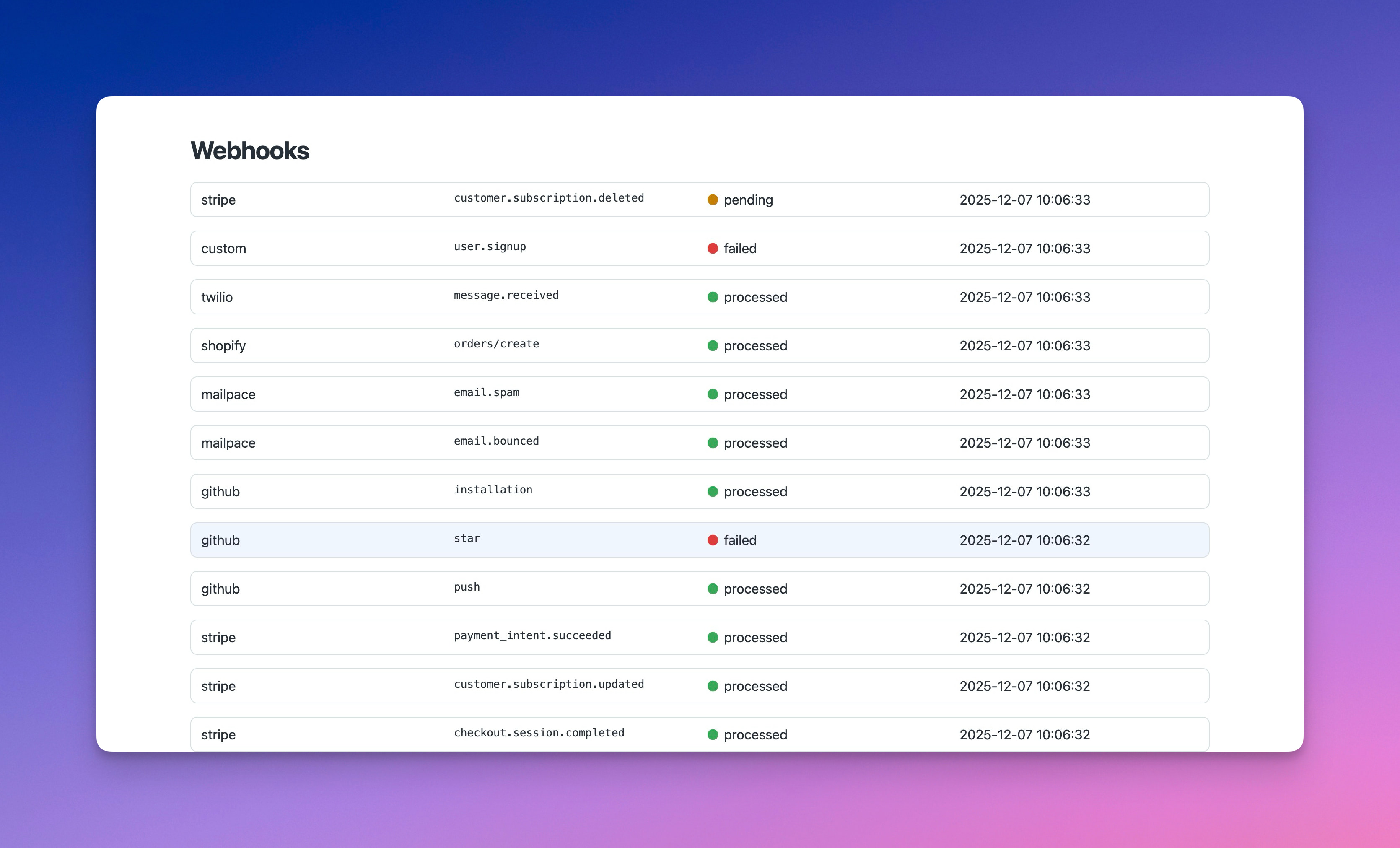
That's it. Webhooks are captured and visible at /webhooks.
Installation
Add to your Gemfile:
gem "fuik"
Then run:
bundle install
bin/rails generate fuik:install
bin/rails db:migrate
The engine mounts at /webhooks automatically.
Usage
View events
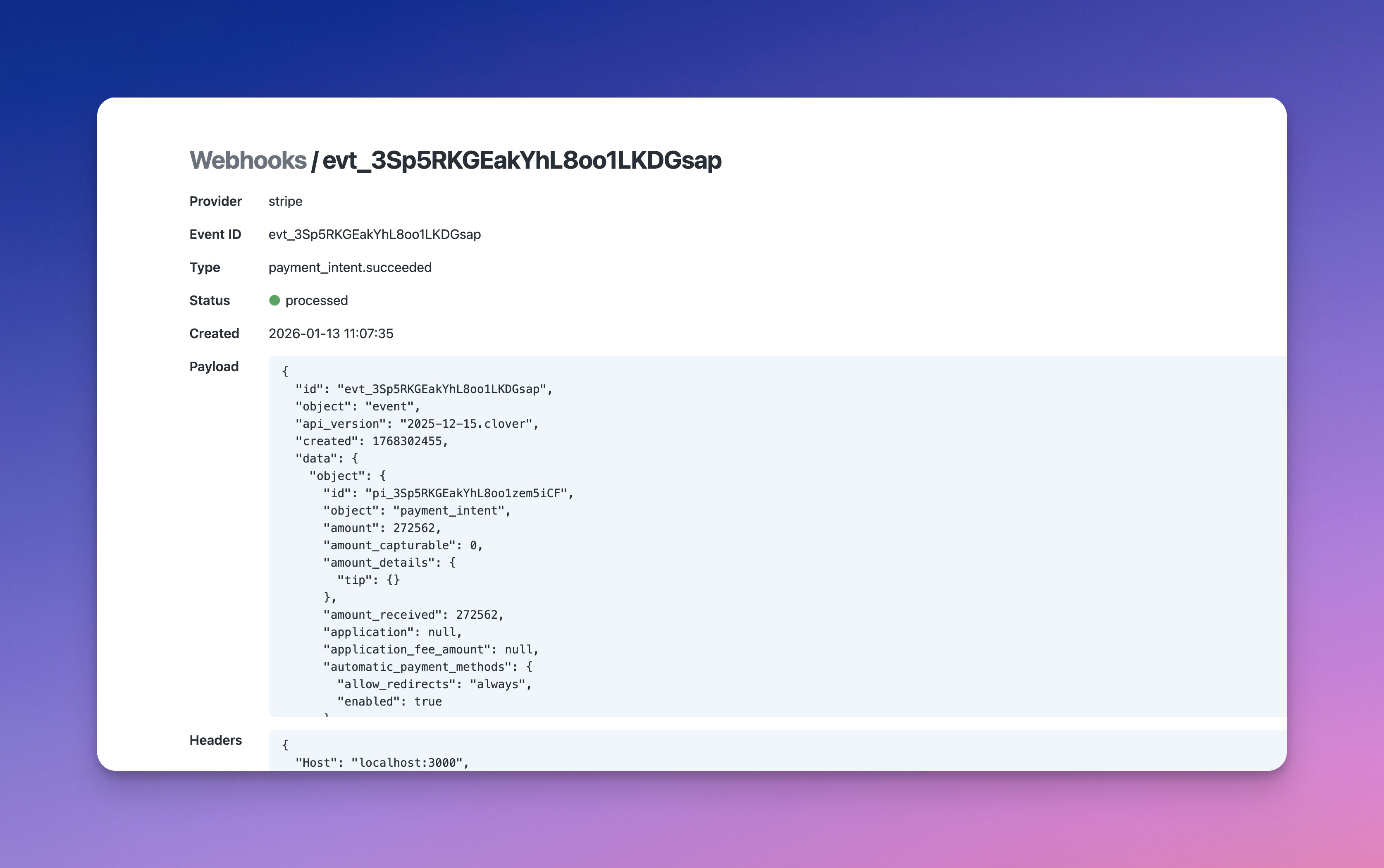
Visit /webhooks to see all received webhooks. Click any event to view all the payload details and copy the payload or download as JSON.
⚠️ The /webhooks path is by default not protected. Set Fuik.configuration.events_controller_parent to a controller that requires authentication.
Dashboard features
- Copy payload as JSON: click a button, payload is in your clipboard
- Download payload as JSON file: keep it for testing, debugging or throw it at your LLM agent, bot or colleague
- Add
.jsonto any URL: get the raw payload without the UI GET /events.json: index as JSON with filter support- Click any key to get the Ruby accessor path: click any key and get, e.g.
payload["line_items"][0]["product_id"](say what? 🤯)
Add business logic
Generate classes for events you want to process:
bin/rails generate fuik:provider stripe checkout_session_completed
This creates:
app/webhooks/stripe/base.rbapp/webhooks/stripe/checkout_session_completed.rb
Each class is a thin wrapper around your business logic:
module Stripe
  class CheckoutSessionCompleted < Base
    def process!
      User.find_by(id: payload.client_reference_id).tap do |user|
        user.activate_subscription!
        user.send_welcome_email

        # etc.
      end

      @webhook_event.processed!
    end
  end
end
The payload method supports dot notation and standard hash methods:
# Dot notation
payload.client_reference_id
payload.customer.email

# Hash syntax (strings/symbols)
payload["client_reference_id"]
payload[:customer_id]
Implement Base.verify! to enable signature verification:
module Stripe
class Base < Fuik::Event
def self.verify!(request)
secret = Rails.application.credentials.dig(:stripe, :signing_secret)
signature = request.headers["Stripe-Signature"]
Stripe::Webhook.construct_event(
request.raw_post,
signature,
secret
)
rescue Stripe::SignatureVerificationError => error
raise Fuik::InvalidSignature, error.
end
end
end
If Provider::Base.verify! exists, Fuik calls it automatically. Invalid signatures return 401 without storing the webhook.
Configuration
Configure Fuik in config/initializers/fuik.rb:
Fuik.configure do |config|
  # config.events_controller_parent = "AdministrationController"
  # config.providers_allowed = %w[stripe github postmark]
end
Custom job class
Webhook events are processed asynchronously by Fuik::WebhookProcessingJob. When processing raises, the event is marked as failed so you can retry it from the dashboard.
Define a custom job class, then configure Fuik to use it:
# app/jobs/webhook_processing_job.rb
class WebhookProcessingJob < ApplicationJob
  queue_as :webhooks

  retry_on MyApp::WebhookError, attempts: 5
  discard_on ActiveJob::DeserializationError

  def perform(event_class_name, webhook_event)
    event_class_name.safe_constantize.new(webhook_event).process!
  end
end
# config/initializers/fuik.rb
Fuik.configure do |config|
  config.webhook_processing_job_class = "WebhookProcessingJob"
end
The perform method receives two arguments:
event_class_name: a string like"Stripe::CheckoutSessionCompleted"that resolves to your event classwebhook_event: theFuik::WebhookEventrecord with the payload, headers and status
Testing event classes
Unit test your process! methods without a database using the built-in test helper:
# test/test_helper.rb
require "fuik/test_helpers"

class ActiveSupport::TestCase
  include Fuik::TestHelpers
end
# test/webhooks/stripe/checkout_session_completed_test.rb
module Stripe
  class CheckoutSessionCompletedTest < ActiveSupport::TestCase
    test "processes a completed checkout" do
      event = build_webhook_event(
        provider: "stripe",
        event_type: "checkout.session.completed",
        payload: { "client_reference_id" => "user_123" }
      )

      CheckoutSessionCompleted.new(event).process!

      assert_equal "processed", event.status
    end

    test "fails when customer is not found" do
      event = build_webhook_event(
        provider: "stripe",
        event_type: "checkout.session.completed",
        payload: {}
      )

      CheckoutSessionCompleted.new(event).process!

      assert_equal "failed", event.status
      assert_equal "Customer not found", event.error
    end
  end
end
Your process! calls @webhook_event.processed! on success and @webhook_event.failed!(error) on failure:
module Stripe
  class CheckoutSessionCompleted < Base
    def process!
      user = User.find_by(id: payload.client_reference_id)

      if user.present?
        user.activate_subscription!

        @webhook_event.processed!
      else
        @webhook_event.failed!("Customer not found")
      end
    end
  end
end
Provider allowlist
By default:
- Development/test: all providers are allowed
- Production/staging: only providers in
app/webhooks/are allowed
Configure with Fuik.configuration.providers_allowed:
# Allow all (including production)
Fuik.configuration.providers_allowed = :all

# Explicit allowlist (overrides directory scan)
Fuik.configuration.providers_allowed = %w[stripe github postmark]
Unknown providers return 404 Not Found.
Event type & ID lookup
Fuik automatically extracts event types and IDs from common locations:
Event Type:
- provider Base class (if configured);
- common headers (
X-Github-Event,X-Event-Type, etc.); - payload (
type,event,event_type); - falls back to
"unknown".
Event ID:
- provider Base class (if configured);
- common headers (
X-GitHub-Delivery,X-Event-Id, etc.); - payload (
id). - falls back to MD5 hash of request body.
Custom lookup
Define event_type and/or event_id on your provider's Base class if Fuik can't find them on its own:
module CustomProvider
  class Base < Fuik::Event
    event_type header: "X-Custom-Event"
    event_id header: "X-Custom-Id"
  end
end
You can also read from the payload body or use a static value:
event_type payload: "event_type"  # payload["event_type"]
event_type payload: "data.type"  # nested via dot-notation (payload["data"]["type"])
event_type "always_this_value"  # static/literal

event_id payload: "id"
Pre-packaged providers
Fuik includes ready-to-use templates for common providers.
Monitoring
Fuik publishes lifecycle events via ActiveSupport::Notifications. Subscribe to track webhook activity:
ActiveSupport::Notifications.subscribe("webhook_received.fuik") do |event|
  Rails.logger.info("[Fuik] Received #{event.payload[:provider]}:#{event.payload[:event_type]}")
end
Available events:
| Event | When it fires |
|---|---|
webhook_received.fuik |
Event record created |
webhook_processed.fuik |
process! completed |
webhook_failed.fuik |
process! raised |
webhook_signature_invalid.fuik |
Signature verification failed (401) |
webhook_receive_error.fuik |
Unexpected error during receive (500) |
Add your custom provider
Have a provider template others could use? Add it to lib/generators/fuik/provider/templates/your_provider/ and submit a PR!
Include:
base.rb.ttwith signature verification (if applicable);- event class templates with helpful TODO comments.
Contributing
This project uses Standard for formatting Ruby code. Please make sure to run rake before submitting pull requests.
License
The gem is available as open source under the terms of the MIT License.